Part of the Arizona Enrollment SeriesET. Updated weekly.
Correction (July 3, 2026): An earlier version reported a 0.16 correlation between enrollment growth and white-student share without stating the analysis threshold. That figure applies to matched districts that enrolled at least 1,000 students in 2018; across all matched districts, the correlation is close to zero.
Correction (July 21, 2026): The article has been narrowed to comparisons reproduced from Arizona's state enrollment data. External fiscal, financing, population, voucher and future-projection sections that were not part of that state-data analysis have been removed. Chart language describing student “migration” and district “collapse” has also been replaced with descriptive enrollment terms. The central enrollment and demographic comparisons are unchanged.
In 2017-18, four inner-city Phoenix elementary districts enrolled three times as many students as American Leadership Academy and Queen Creek Unified combined. By 2025-26, the lines crossed. American Leadership Academy↗ET and Queen Creek Unified↗ET now enroll 33,140 students. Isaac↗ET, Cartwright↗ET, Roosevelt↗ET, and Alhambra↗ET enroll 33,070. The gap closed by 30,588 students in eight years, and the entities that overtook them are 62% white in a state that is 32% white.
The data cannot show individual transfers, and several fast-growing Arizona entities are not white-majority. Tolleson Union High School District added 2,315 students since 2018 with a student body that is 4.8% white. Maricopa Unified gained 2,884 students at 21.8% white. The state data documents a geographic and demographic pattern, but it cannot determine how much housing growth, school choice or other factors contributed to it.
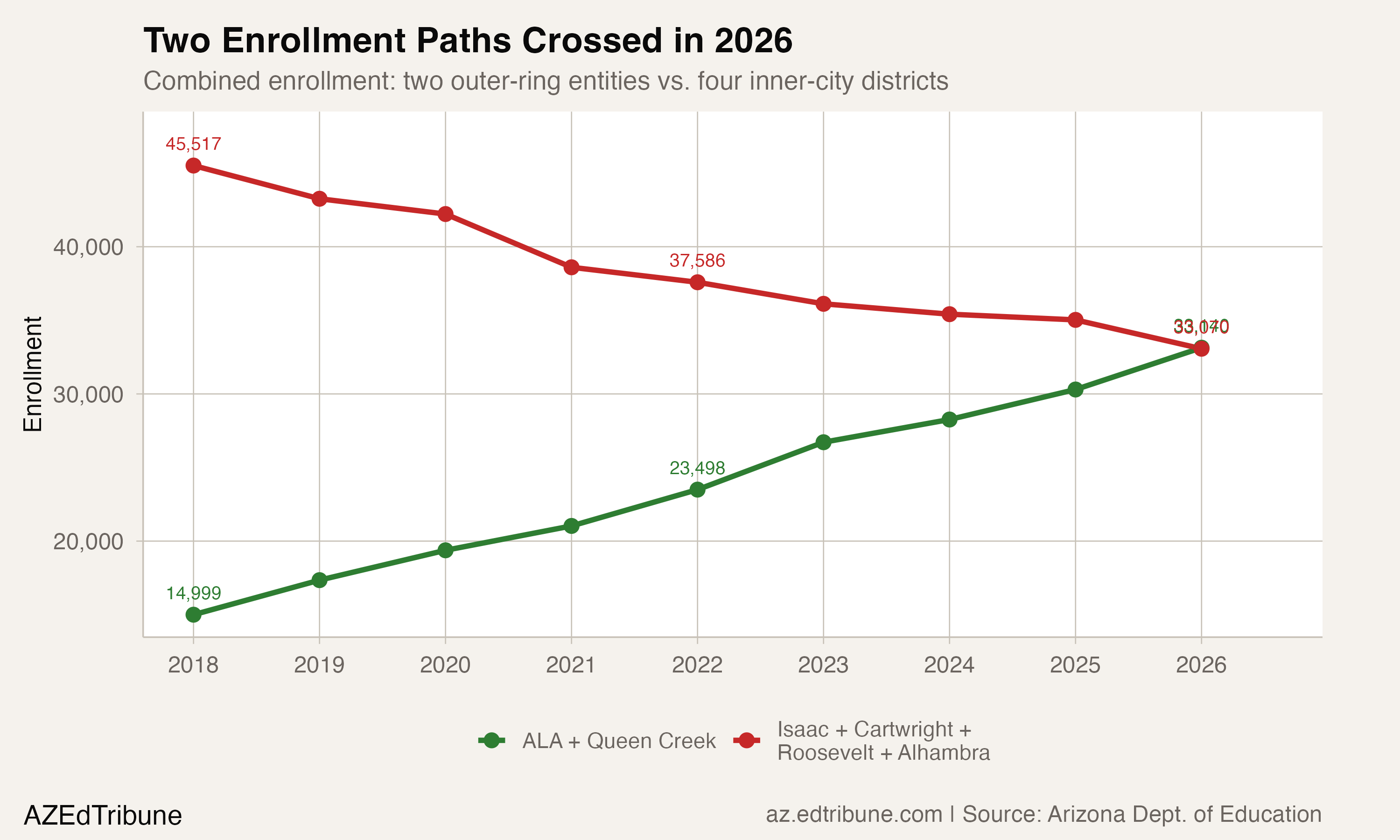
A 30,000-Student Gap Erased in Eight Years
The American Leadership Academy ADE entity analyzed here grew from 7,904 students in 2017-18 to 17,732 in 2025-26, a 124.3% increase. Queen Creek Unified expanded from 7,095 to 15,408, a 117.2% gain. Together, the two entities added 18,141 students.
On the other side: Isaac Elementary lost 2,588 students (38.1%), Cartwright Elementary lost 4,627 (26.8%), Alhambra Elementary lost 3,374 (26.9%), and Roosevelt Elementary lost 1,858 (20.9%). The four districts' combined loss was 12,447 students.
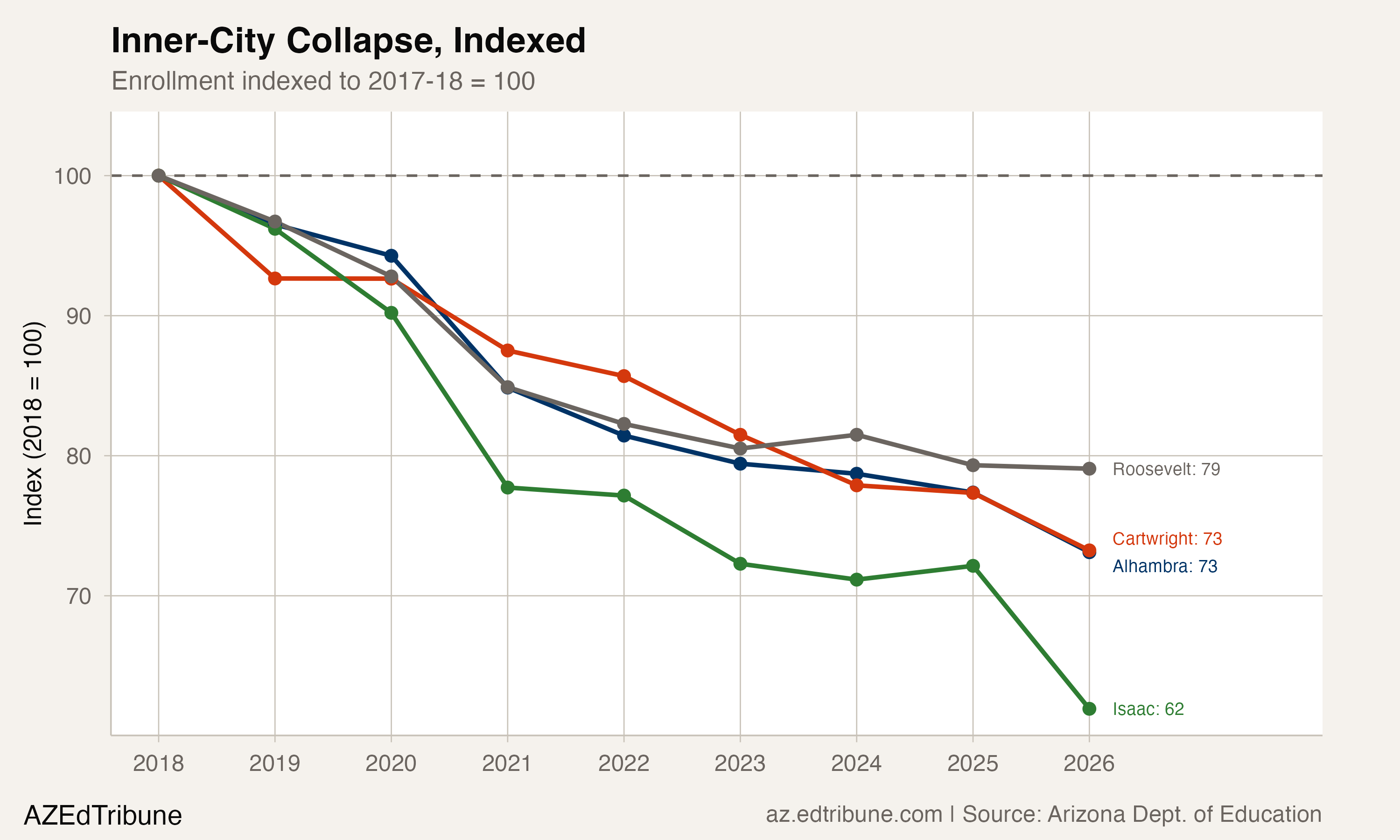
The demographic profiles of these two groups could hardly be more different. ALA is 62.9% white and 24.4% Hispanic. Queen Creek is 61.9% white and 25.8% Hispanic. Isaac is 1.4% white and 92.2% Hispanic. Cartwright is 2.0% white and 90.7% Hispanic. The state average sits between them: 32.3% white and 49.2% Hispanic.
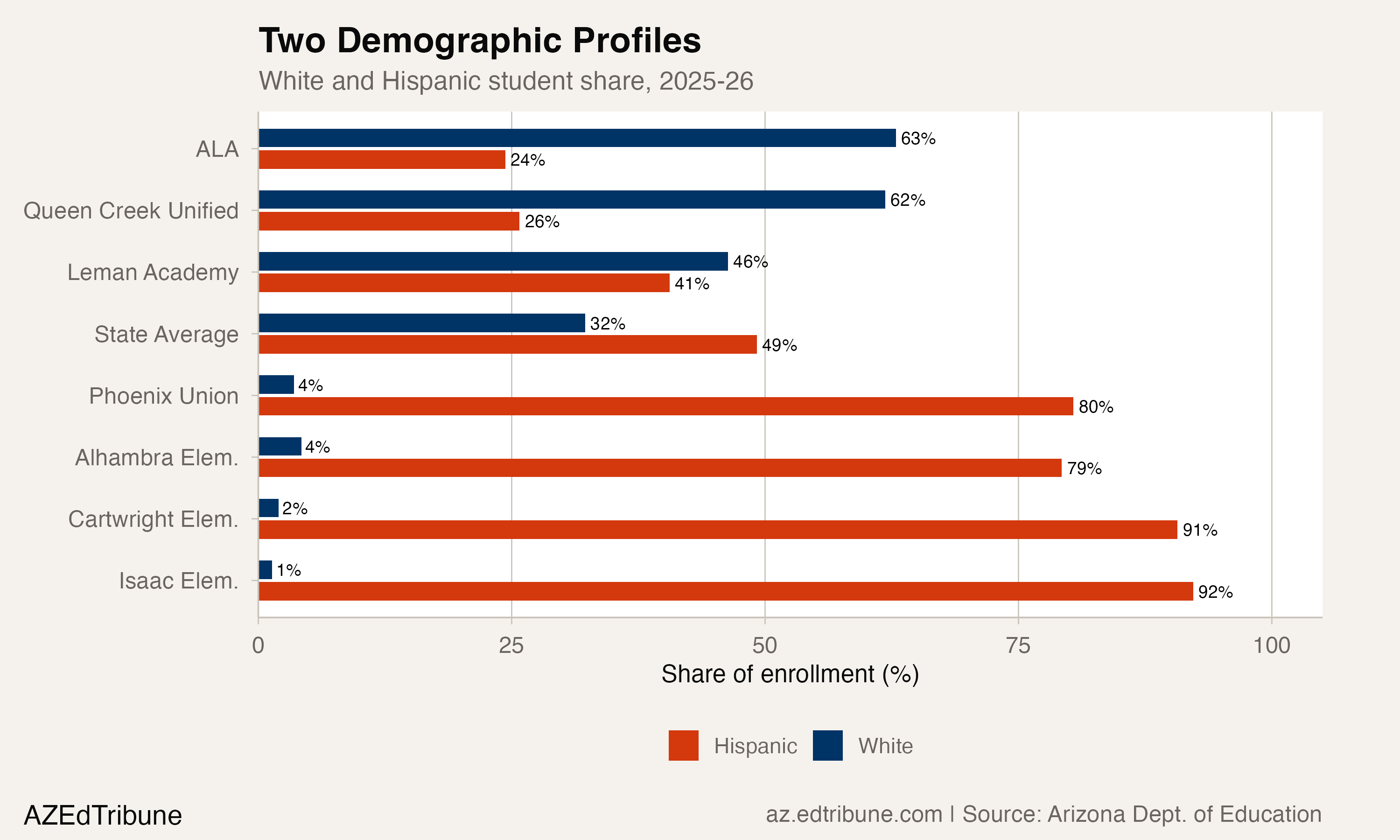
Statewide and District White-Enrollment Changes
Arizona lost 76,162 white students statewide between 2017-18 and 2025-26, dropping from 422,414 (38.0% of enrollment) to 346,252 (32.3%). The decline affected several large suburban districts: Mesa lost 7,880 white students, Chandler lost 7,474, Paradise Valley lost 5,054, Peoria lost 4,723, Deer Valley lost 4,498, and Gilbert lost 4,360.
ALA and Queen Creek moved in the opposite direction. ALA added 5,181 white students. Queen Creek added 4,732. Together, they added 9,913 white students while the rest of the state lost 86,075. Their combined share of statewide white enrollment grew from 2.5% to 6.0%, one in every 17 white students in Arizona.
The counts show white enrollment increasing in these two public entities while declining statewide. They do not track individual students or establish whether families relocated between the listed communities.
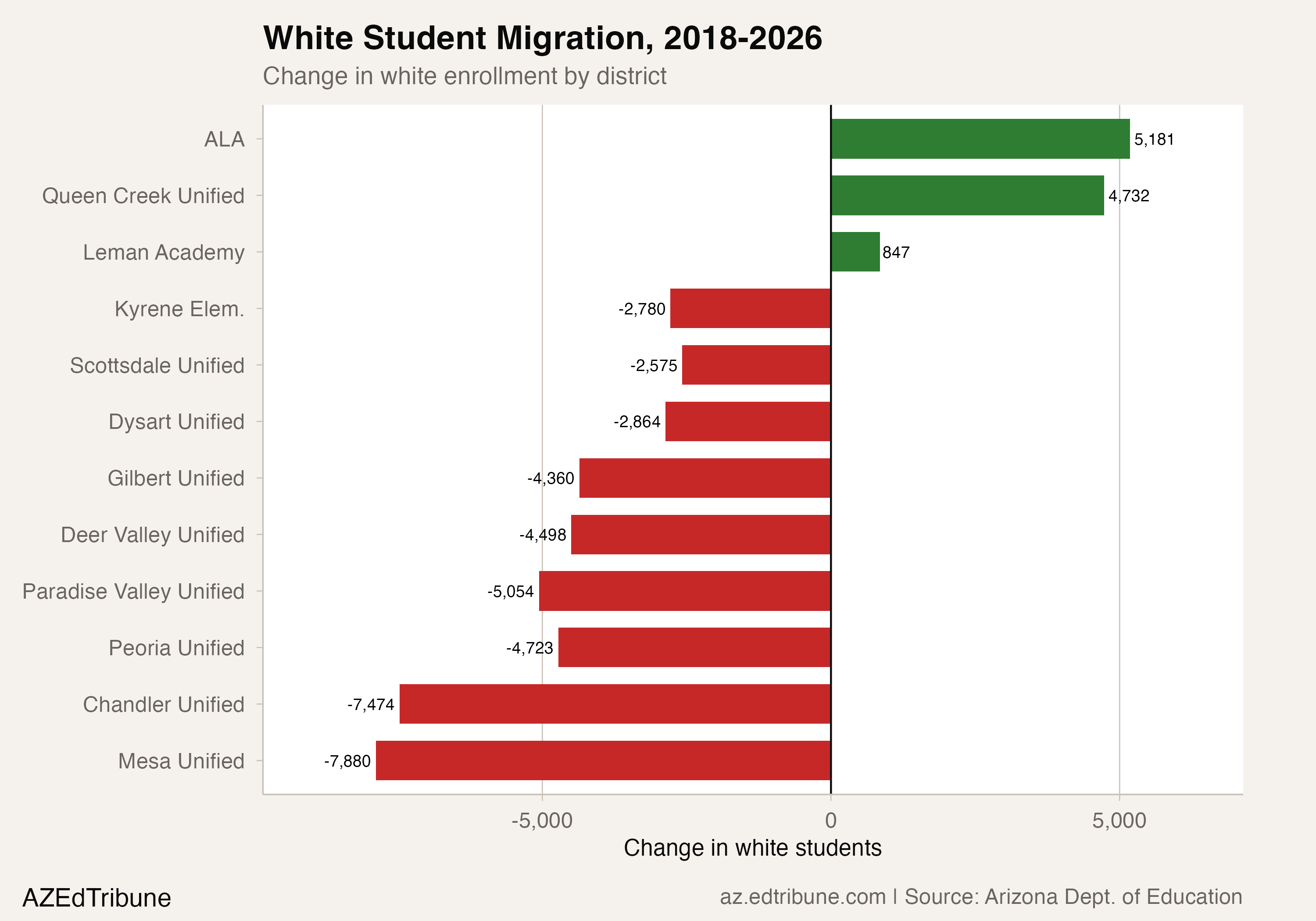
Demographic Shares Shifted
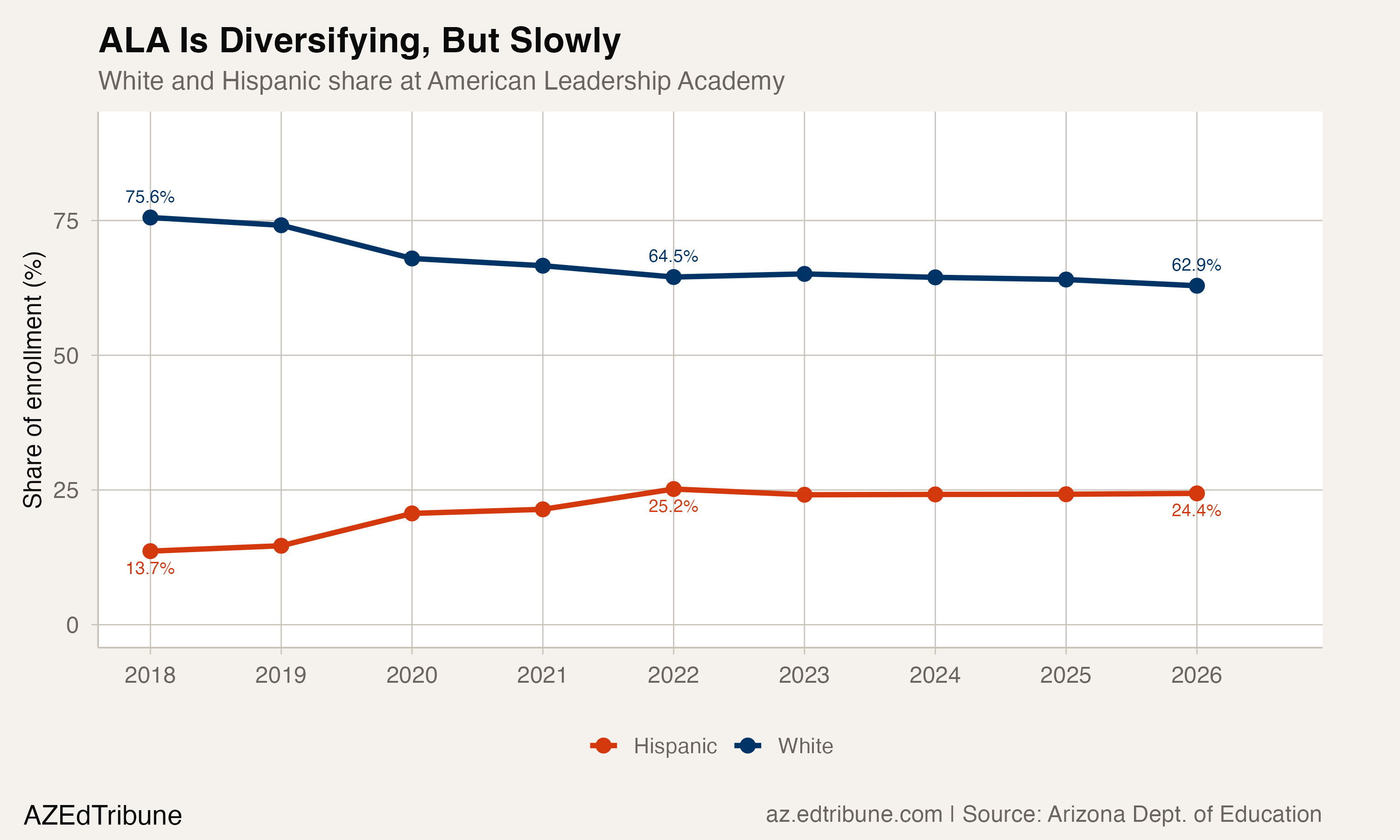
ALA's white share has declined, from 75.6% in 2017-18 to 62.9% in 2025-26, a 12.7 percentage-point drop. Its Hispanic share nearly doubled, from 13.7% to 24.4%. Queen Creek shows a similar pattern: 67.6% white to 61.9%, with Hispanic enrollment rising from 23.6% to 25.8%. Both entities are diversifying as they grow.
The diversification, though, is relative. ALA at 62.9% white is still nearly twice the state average of 32.3%. In 2025-26, Isaac was 92.2% Hispanic and 1.4% white, while Cartwright was 90.7% Hispanic. Both districts also enrolled fewer students than in 2017-18.
Phoenix Union High School District, at 80.4% Hispanic and 3.5% white in 2026, enrolled 23,570 students. That was 4,328 below its 2023 series peak of 27,898, a 15.5% decline.
Enrollment Growth and White Share
The correlation between enrollment growth and white student share across Arizona's larger districts (those enrolling at least 1,000 students in 2018) is weak: 0.16 on a Pearson scale. Across all matched districts, including the smallest, it is close to zero. The pattern is not that whiter districts uniformly grow. The two entities highlighted here are located east and southeast of Phoenix, but the enrollment file does not identify why their totals changed.
The enrollment data alone cannot determine how much of the pattern is driven by housing, school choice or other factors. It shows that the selected entities have different racial compositions and moved in opposite enrollment directions over the period; it does not measure family income or individual student movement. The endpoint comparison also does not determine whether the six ADE entities will continue along the same paths.
Detailed code that reproduces the analysis and figures in this article is available exclusively to EdTribune subscribers.
Discussion
Sign in to join the discussion.
Loading comments...