Part of the Arizona Enrollment SeriesET. Updated weekly.
The Isaac Elementary District↗ET is under state receivership. The Glendale Elementary District↗ET has closed five schools in two years. The Alhambra Elementary District↗ET just voted to shutter two more campuses. The Cartwright Elementary District↗ET has lost students every single year since at least 2018.
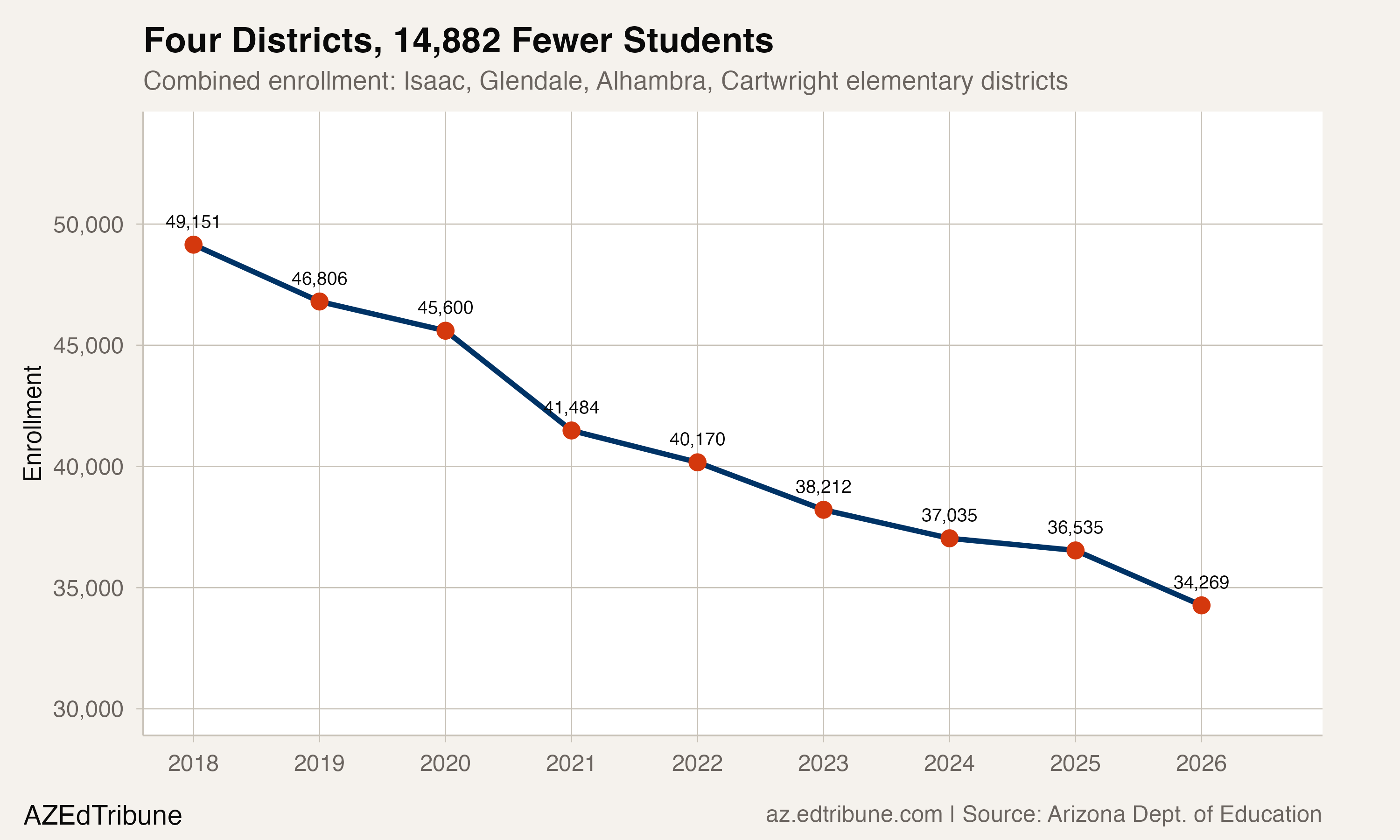
These four districts sit in a contiguous band across west and central Phoenix, serving some of the city's most heavily Hispanic, lowest-income neighborhoods. Together they enrolled 49,151 students in 2017-18. By 2025-26, that number had fallen to 34,269, a loss of 14,882 students, or 30.3%. Arizona as a whole lost 3.5% over the same period.
Four districts account for 38.0% of the state's entire enrollment decline.
The steepest falls
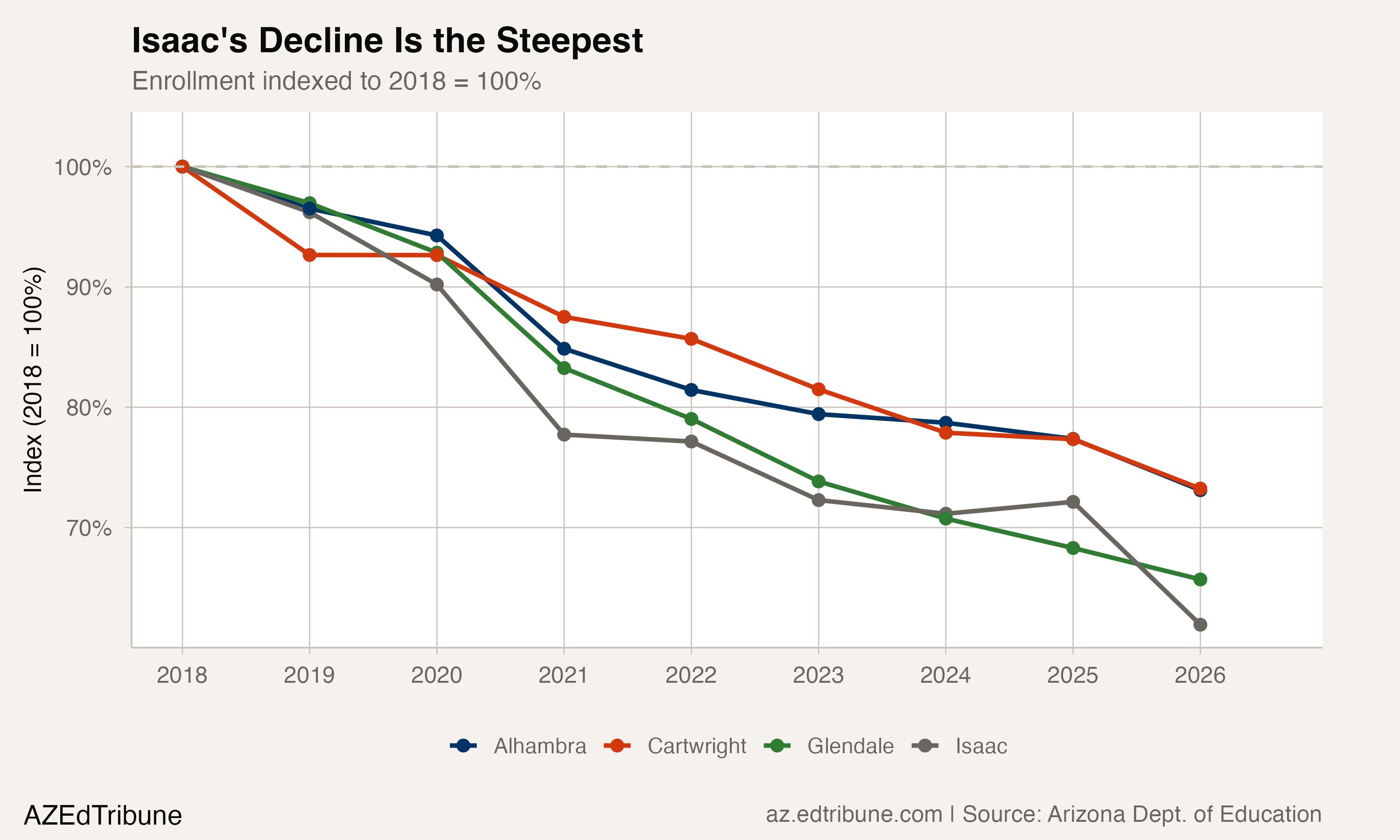
Isaac's trajectory is the most severe. The district lost 38.1% of its enrollment, falling from 6,798 to 4,210 students. It shed 694 students in 2025-26 alone, a 14.2% single-year drop that exceeded every prior year except the pandemic crash of 2020-21. Glendale Elementary lost 34.3%, falling from 12,513 to 8,220. Alhambra lost 26.9%, and Cartwright, the largest of the four at 12,665 students, lost 26.8%.
All four are in unbroken decline streaks stretching back to at least 2018. In no year during this period did any of the four add students, with one exception: Isaac gained 67 students in 2024-25 before losing 694 the following year.
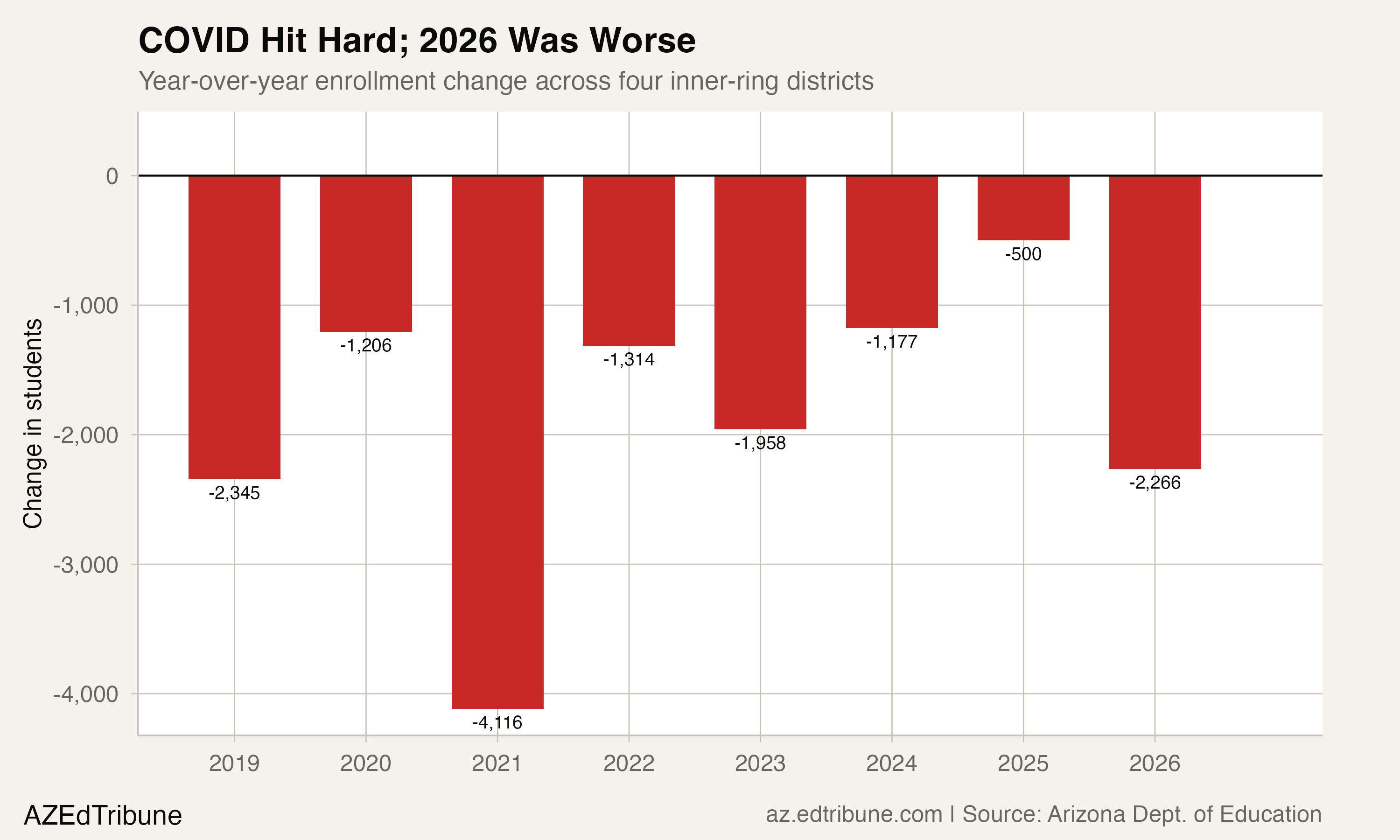
The combined year-over-year losses show a pattern that should unsettle planners. After the pandemic cratered enrollment by 4,116 in 2020-21, the pace appeared to moderate: losses of 1,314 in 2021-22, then 1,958 and 1,177 in subsequent years. But 2025-26 reversed the easing. The four districts shed 2,266 students, the second-worst year on record, behind only COVID.
Who is leaving
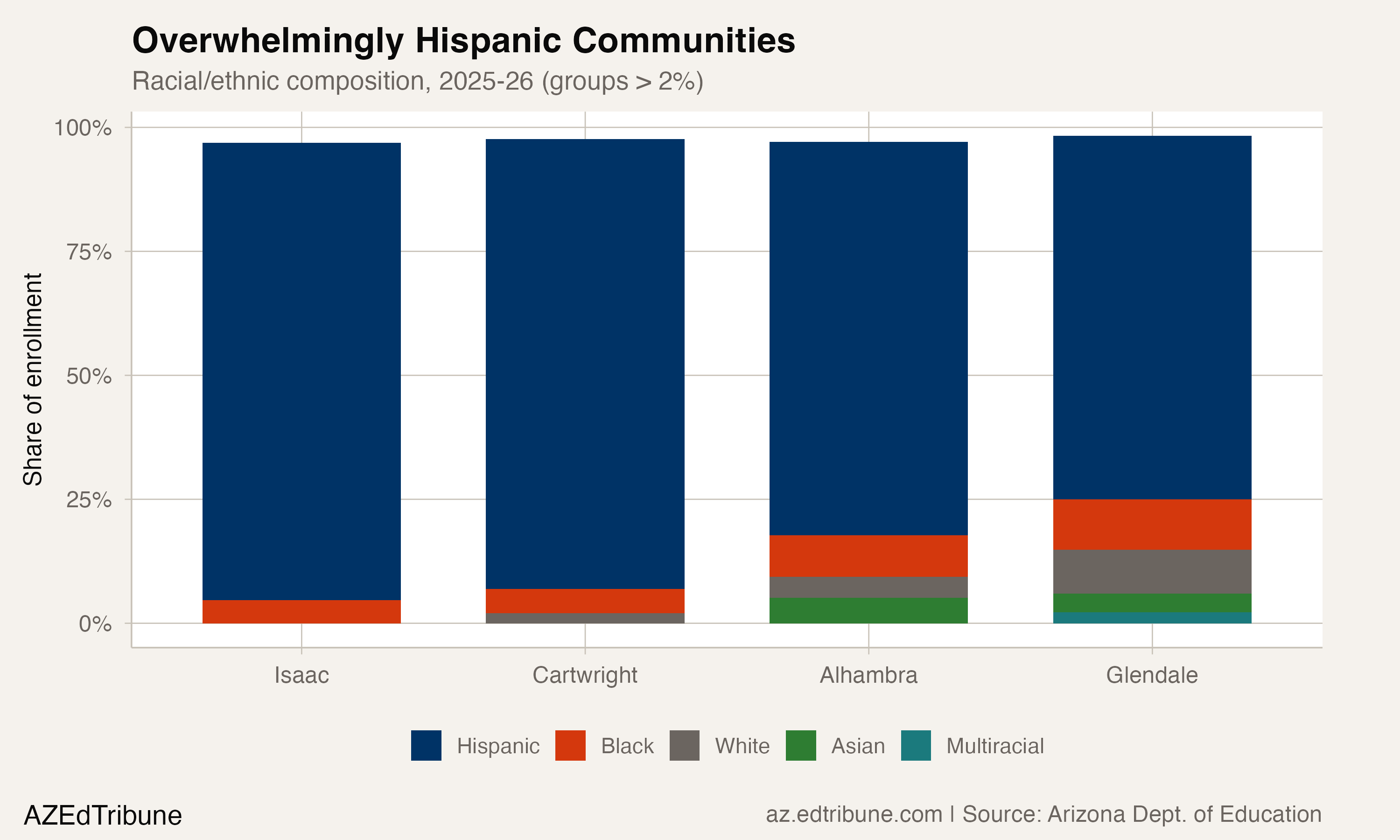
These are overwhelmingly Hispanic communities. Isaac's student body is 92.2% Hispanic. Cartwright is 90.7%. Alhambra is 79.3%, and Glendale is 73.3%. The combined Hispanic enrollment across the four districts fell from 40,448 to 28,667, a loss of 11,781 students, or 29.1%.
The districts also serve high concentrations of students whose instructional programs carry elevated per-pupil costs. In 2025-26, 85.4% of Isaac's students were classified as economically disadvantaged, along with 90.0% of Alhambra's, 79.7% of Cartwright's, and 64.4% of Glendale's. (Arizona's statewide economically disadvantaged rate jumped from 36.1% to 51.9% between 2024 and 2025 due to a Community Eligibility Provision reporting change, so these district-level figures may be inflated by the same methodological shift.) English learners make up 44.8% of Isaac's enrollment and 36.5% of Cartwright's, well above the state average.
Each departing student carries funding with them. Alhambra Superintendent Cecilia Maes told KTAR that the district loses approximately $12,000 for every student who leaves. At that rate, the combined 14,882-student loss across the four districts represents a funding reduction approaching $178 million annually compared to 2017-18 levels.
A pipeline that keeps shrinking
Kindergarten enrollment is the leading indicator for elementary districts. Across the four districts combined, kindergarten fell from 4,851 in 2017-18 to 3,058 in 2025-26, a 37.0% decline. In every year, fewer kindergartners entered these districts than eighth graders left them, a structural deficit that guarantees continued erosion even if the kindergarten count stabilizes.
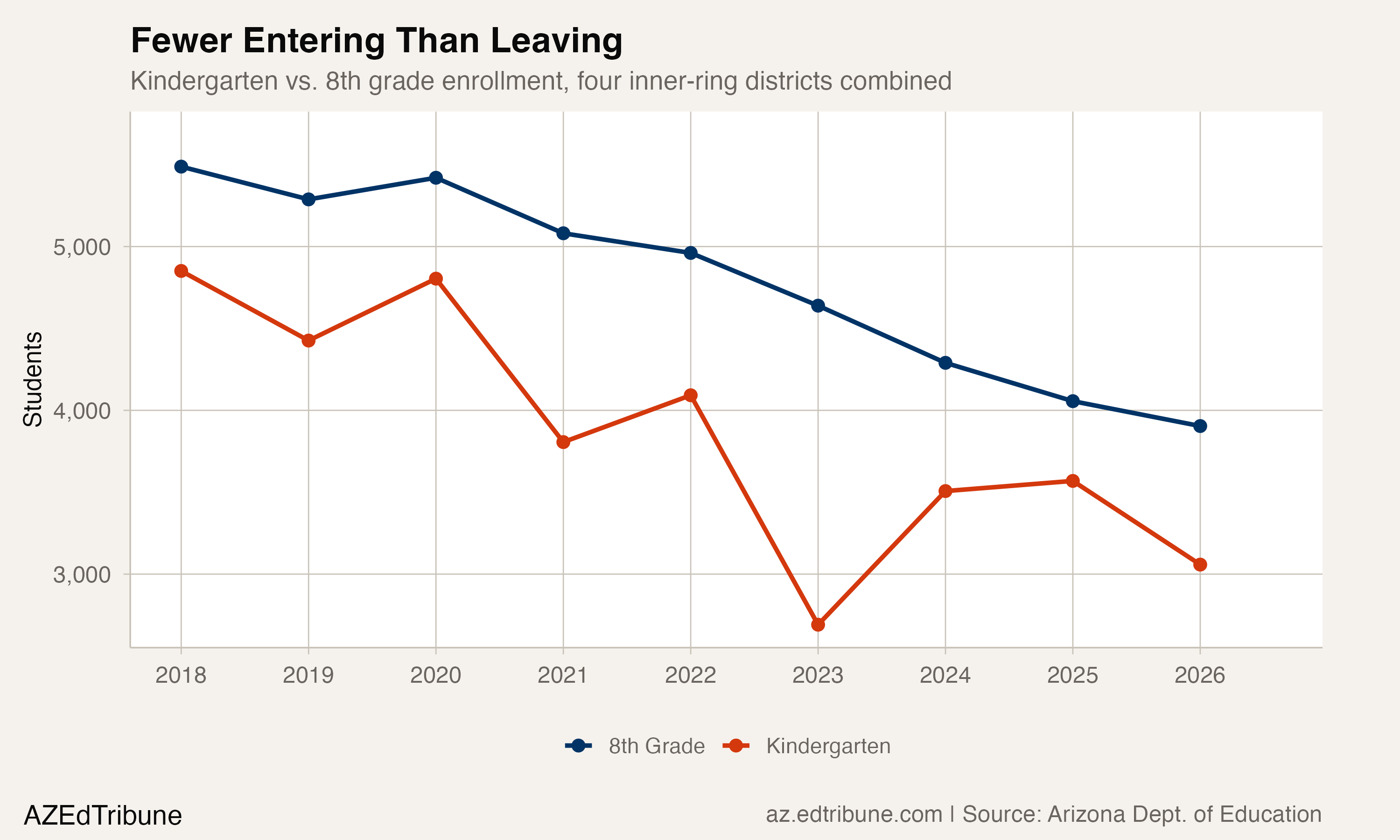
The gap between the two lines is the annual enrollment the districts cannot replace. In 2025-26, 3,058 kindergartners entered while 3,904 eighth graders graduated out, a net pipeline deficit of 846 students before accounting for any mid-year departures or transfers.
Closures and receivership
The enrollment decline has forced building closures across all four districts, but Isaac's situation is the most acute. In January 2025, the Arizona State Board of Education placed Isaac under state receivership after the district overspent by an estimated $22 million and misrepresented its finances to the Arizona Department of Education. The Maricopa County Treasurer cut off funding until debts were resolved, and teachers worked three days without pay before emergency measures restored operations.
State-appointed receiver Keith Kenny ordered the closure of Moya Elementary and P.T. Coe Elementary despite the governing board's vote against it:
"I've found the board to be irresponsible fiscally in voting not to close the two schools." -- Keith Kenny, state-appointed receiver, KJZZ, May 2025
Kenny estimated that restoring solvency would take five to 10 years. The district took a $25 million loan from Tolleson Union High School District at 6% interest, pledging Isaac Middle School as collateral.
Glendale Elementary has closed five schools in two years, including Coyote Ridge, Imes, and Sine elementary schools. In 2021, the district's assistant superintendent of finance said Glendale would need to grow by about 4,000 students, sustained for nine years, to change course. Instead, enrollment fell from 10,418 in 2020-21 to 8,220 in 2025-26.
Alhambra voted in early 2026 to close Valencia Newcomer Academy and Choice Learning Academy after the 2025-26 school year. Valencia, a school established in 2018 to serve immigrant and refugee students with English language instruction, had dwindled to just 22 students. The closures will save $1.4 million, but Superintendent Maes acknowledged the shortfall is much larger:
"The fact is, our shortfall is much greater than that. And so, we've looked at other creative ways of utilizing our staff, adjusting our staffing..." -- Cecilia Maes, Alhambra superintendent, KTAR, Feb. 2026
Multiple forces, one outcome
No single factor explains a 30% enrollment loss in eight years. District leaders across the Valley consistently point to three converging pressures: declining birth rates dating to the 2008 recession, housing affordability that has pushed young families out of older neighborhoods, and competition from charter schools and Arizona's Empowerment Scholarship Account (ESA) voucher program.
The birth rate explanation has some structural support. The children entering kindergarten in 2025-26 were born in 2019-20. Maricopa County birth rates have declined since 2007, and the Phoenix metro area's population growth is now driven almost entirely by migration rather than natural increase. But migration does not distribute evenly. Newer families tend to settle in outer-ring suburbs, while the older, denser neighborhoods these four districts serve are not the destination of choice.
The ESA program is a subject of fierce debate. A Common Sense Institute Arizona report argued in 2024 that demographic shifts, not vouchers, primarily drive the decline. But the program has grown rapidly, with nearly 89,000 students using ESAs and annual costs exceeding $1 billion. Whether ESA students are leaving these specific inner-ring districts or come disproportionately from other areas is not clear from enrollment data alone.
Charter school competition is another factor that enrollment data cannot cleanly separate. Arizona has no charter flag in its state enrollment files, making it impossible to track sector-level shifts with precision. The state has approximately 580 charter schools enrolling an estimated 232,000 students, but which districts those students would otherwise attend is unknown.
What enrollment data can show is that these four districts are not merely shrinking at the state average rate. They are declining eight to 10 times faster than Arizona as a whole. Something specific to these neighborhoods, whether it is housing costs, school quality perceptions, program competition, or demographic turnover, is compounding the statewide trend.
The downstream question
These four districts are PK-8 feeders. Their graduates flow primarily into Phoenix Union High School District↗ET, which peaked at 27,898 students in 2022-23 and has since lost 4,328 students, a 15.5% decline in three years. The shrinking pipeline from the inner-ring elementary districts means Phoenix Union's losses are likely to deepen.
Across Arizona, more than 20 public schools closed or began closing in 2025, spanning districts from Roosevelt (five schools) to Kyrene (six schools) to Scottsdale (two schools). Beth Lewis, executive director of Save Our Schools Arizona, called it "an unprecedented clip of school closures." The four inner-ring districts examined here are at the epicenter of that wave, but the closures are rippling outward.
The kindergarten pipeline ensures these districts will continue to shrink. How many buildings can close, how many staff positions can be cut, and how many consolidations can happen before the remaining schools are too far from the families they serve to function as neighborhood institutions — that is the practical problem Isaac's receiver and Alhambra's superintendent are trying to solve right now.
Detailed code that reproduces the analysis and figures in this article is available exclusively to EdTribune subscribers.
Discussion
Sign in to join the discussion.
Loading comments...