Arizona's statewide chronic absenteeism picture is grim: recovery has stalled, gaps have widened, and nearly one in four students still misses too much school. But behind the state average, 106 districts have been getting better every single year since 2022-23.
These are districts where the chronic rate dropped in 2023, dropped again in 2024, and dropped again in 2025. Three consecutive years of improvement, while the state's overall pace of recovery ground nearly to a halt.
The Biggest Turnarounds
The most dramatic improvements came from districts that started in crisis:
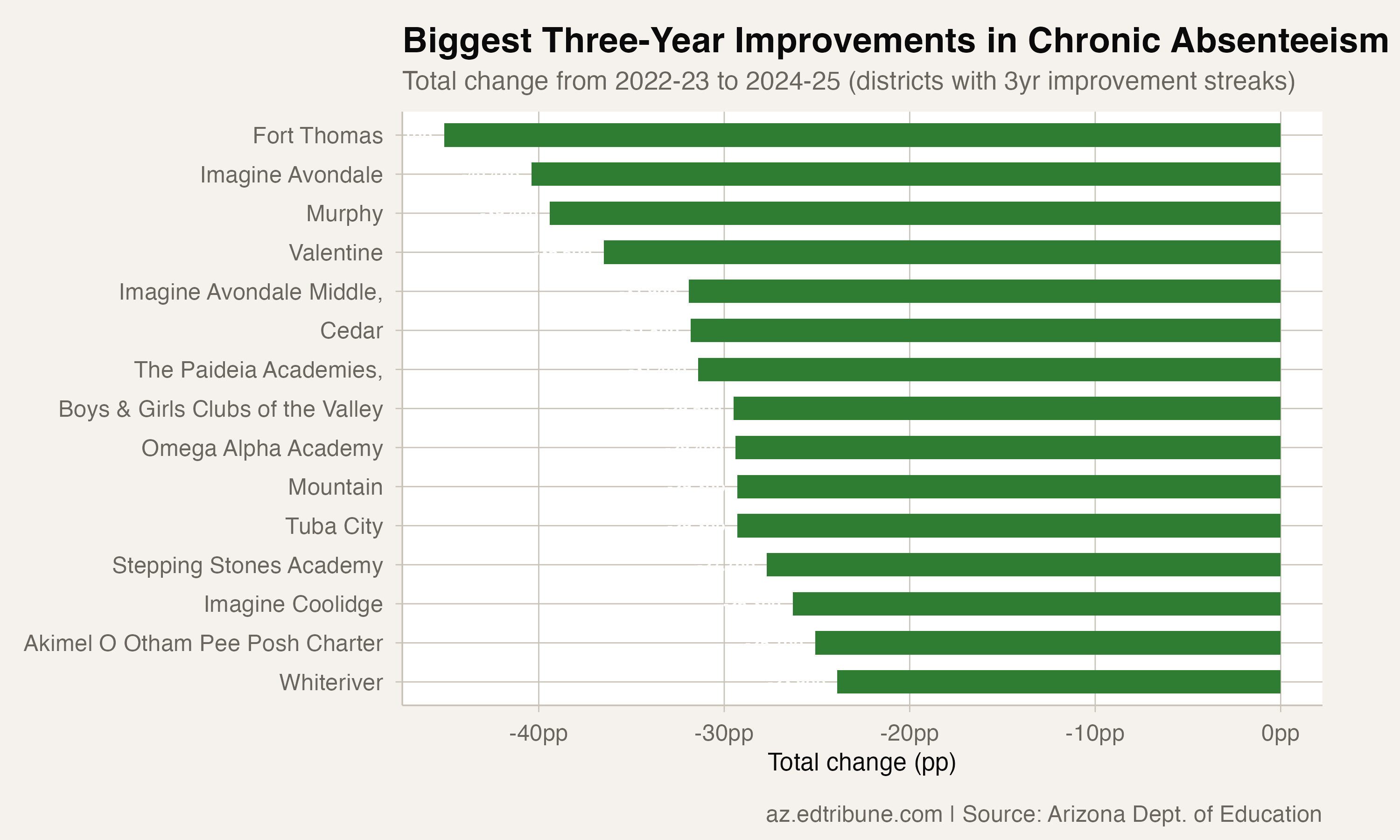
Fort Thomas Unified↗ET, a small rural district in southeastern Arizona, cut its chronic rate by 45.1 percentage points over three years. Murphy Elementary dropped 39.4 points. Valentine Elementary dropped 36.5 points.
These are transformative changes. A district that went from 60%+ chronic absenteeism to below 20% has fundamentally altered the daily experience of its students.
Tuba City: The Signature Story
The most significant improvement streak belongs to Tuba City Unified↗ET, a Navajo Nation district that went from 57.2% in 2022 to 27.9% in 2025.
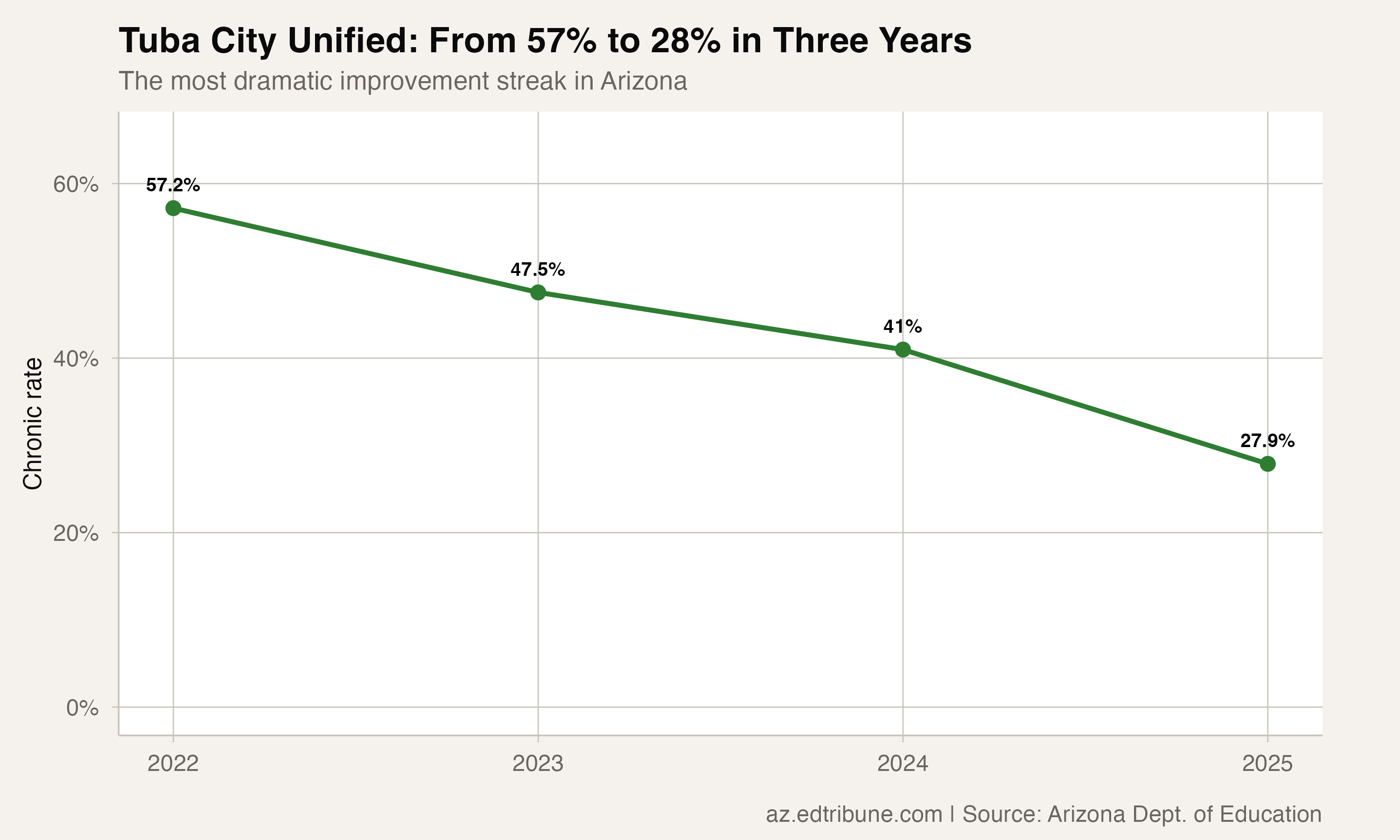
What makes Tuba City's trajectory so important is context. This is a reservation district facing the same structural barriers (geographic isolation, poverty, limited transportation, intergenerational trauma) that keep neighboring districts above 40%, 50%, even 60%. Yet Tuba City improved steadily, roughly 10 points per year, until it crossed below the state average.
Other reservation districts have not followed. Peach Springs held steady above 62%. San Carlos dropped from 75.7% to 52.5% before spiking back to 61.7%. Whatever Tuba City did differently offers a potential model for communities facing similar challenges.
Traditional Districts Too
The improvement streaks are not limited to small districts coming down from extreme levels. Large traditional districts in the Phoenix and Tucson metros show sustained progress:
- Peoria Unified↗ET: 37.8% to 20.0% (-17.8pp)
- Amphitheater Unified↗ET: 42.8% to 22.5% (-20.3pp)
- Gilbert Unified↗ET: 24.6% to 15.6% (-9.0pp)
These are sizable districts serving diverse populations. Their sustained improvement suggests that institutional capacity, not just demographics, drives attendance recovery.
The Distribution
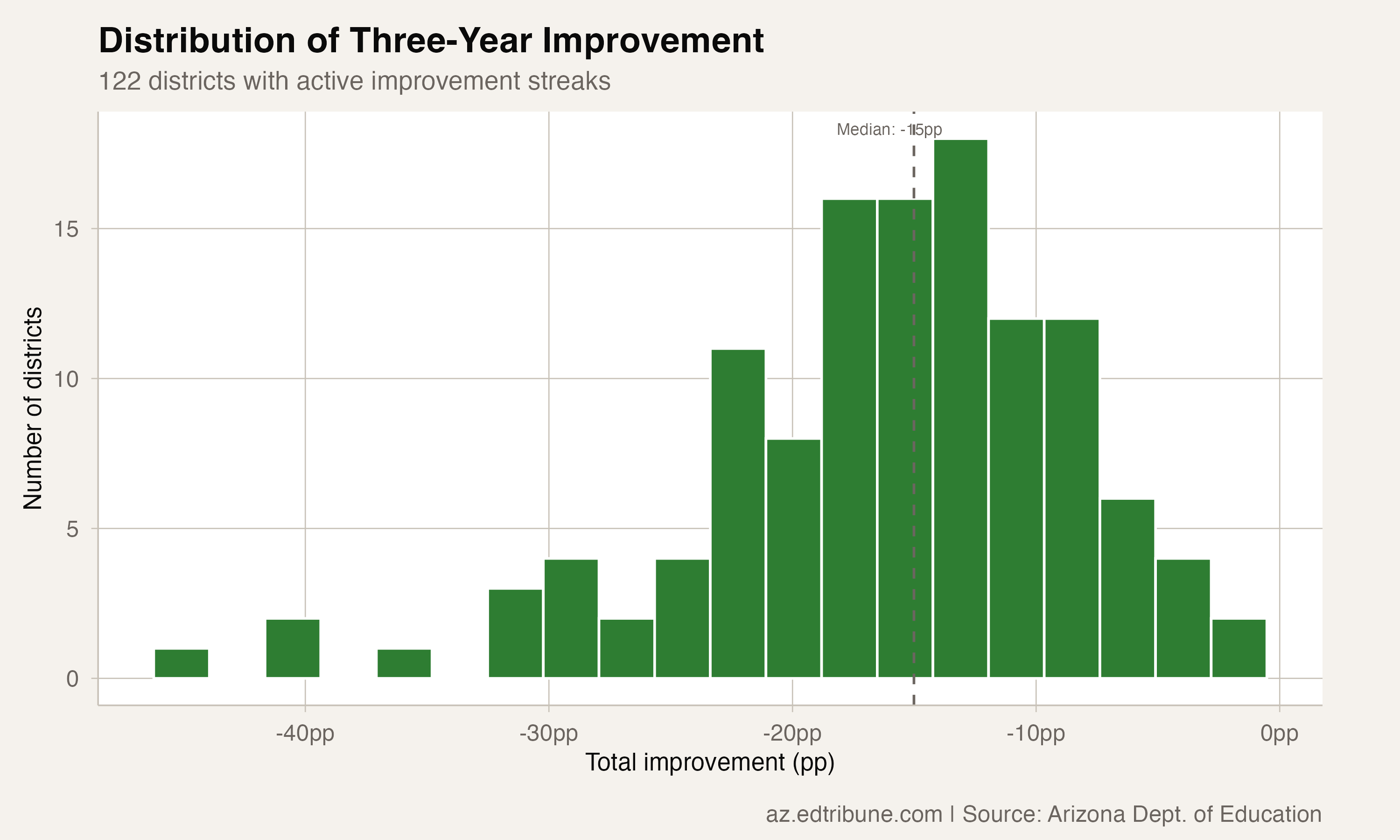
Among the 106 districts with active improvement streaks, the median total improvement was meaningful, not just statistical noise. The range runs from modest single-digit improvements in districts that were already relatively low to the dramatic 40+ point drops in districts that started at crisis levels.
Why This Matters
The 106 districts with improvement streaks represent roughly one-quarter of all Arizona districts with enough data to measure. That means most districts have either stalled, worsened, or oscillated rather than sustaining steady improvement.
But it also means that sustained recovery is possible across district types, sizes, and demographics. The state's overall stall (only 0.6 percentage points of improvement in 2025) is not a universal condition. It is the average of districts still improving and districts that have plateaued or reversed.
Tuba City went from 57% to 28% while Peach Springs, 75 miles away on the same reservation system, stayed above 62%. Gilbert dropped to 15.6% while Mesa, its next-door neighbor, is still above 20%. The improving districts are not a random sample. They are specific places where specific people made specific choices. Figuring out what those choices were is the obvious next step.
Detailed code that reproduces the analysis and figures in this article is available exclusively to EdTribune subscribers.
Discussion
Sign in to join the discussion.
Loading comments...