In nine Arizona school districts, chronic absenteeism is not a problem affecting a subset of students. It is the default experience.
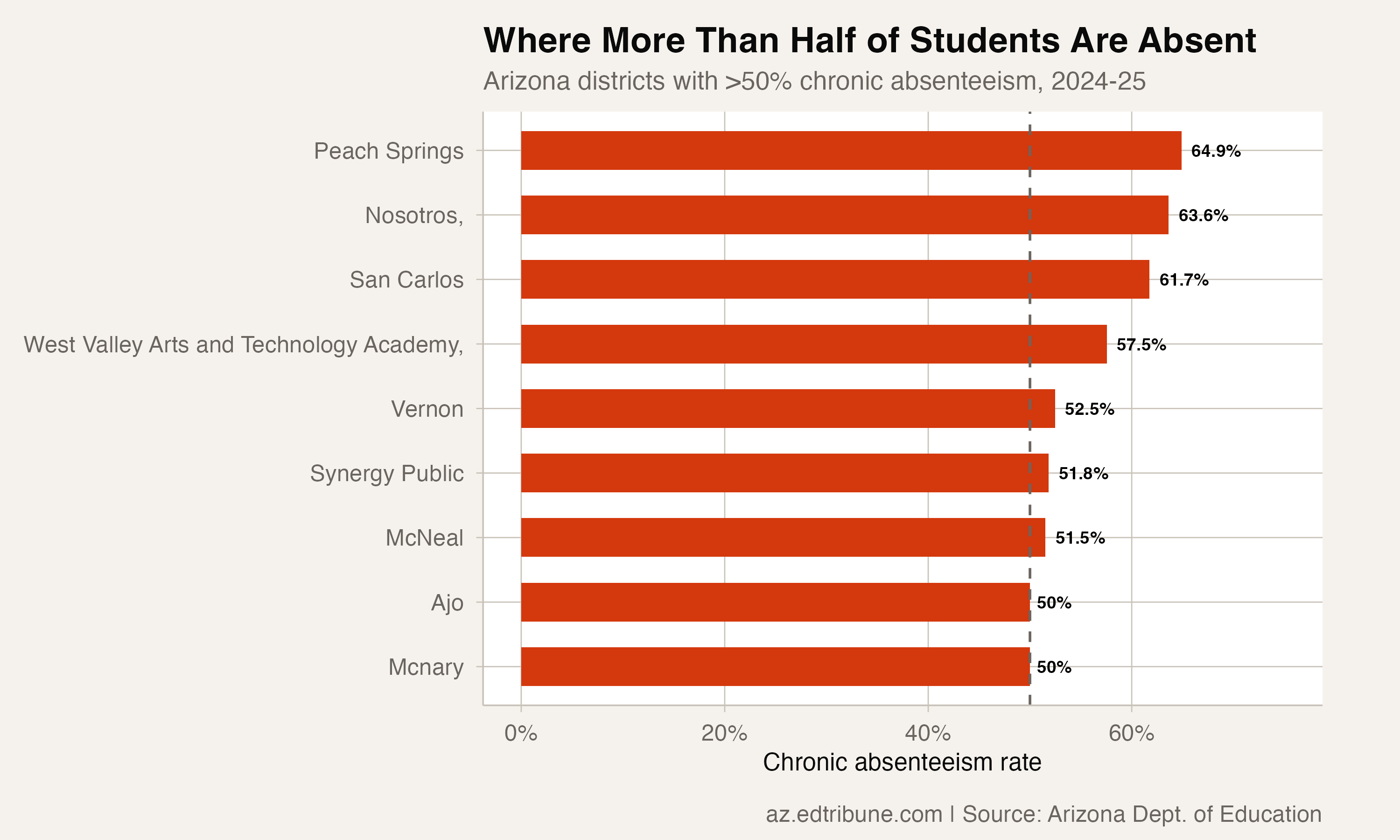
At least half of all students in these districts missed 18 or more days of school in 2024-25. At Peach Springs Unified↗ET, on the Hualapai reservation, the rate hit 64.9%. At Nosotros, Inc., an alternative education provider, it was 63.6%. At San Carlos Unified↗ET, on the Apache reservation, 61.7%.
| District | Chronic Rate |
|---|---|
| Peach Springs Unified | 64.9% |
| Nosotros, Inc. | 63.6% |
| San Carlos Unified | 61.7% |
| West Valley Arts and Technology Academy | 57.6% |
| Vernon Elementary | 52.5% |
| Synergy Public School | 51.8% |
| McNeal Elementary | 51.5% |
| Mcnary Elementary | 50.0% |
| Ajo Unified↗ET | 50.0% |
The list is a map of Arizona's deepest structural challenges. Two are reservation communities. Two are small rural districts in remote southern Arizona (McNeal, Vernon). Two are alternative or charter schools serving students who have already disengaged from traditional settings. Ajo is a former copper mining town that has lost most of its economic base.
What Majority Absent Looks Like
At a chronic rate above 50%, the concept of a "normal" school day shifts. On any given day, a significant portion of enrolled students simply is not there. Teachers cannot plan sequential instruction. Group projects don't work. Social bonds that keep students connected to school fray when classmates cycle in and out unpredictably.
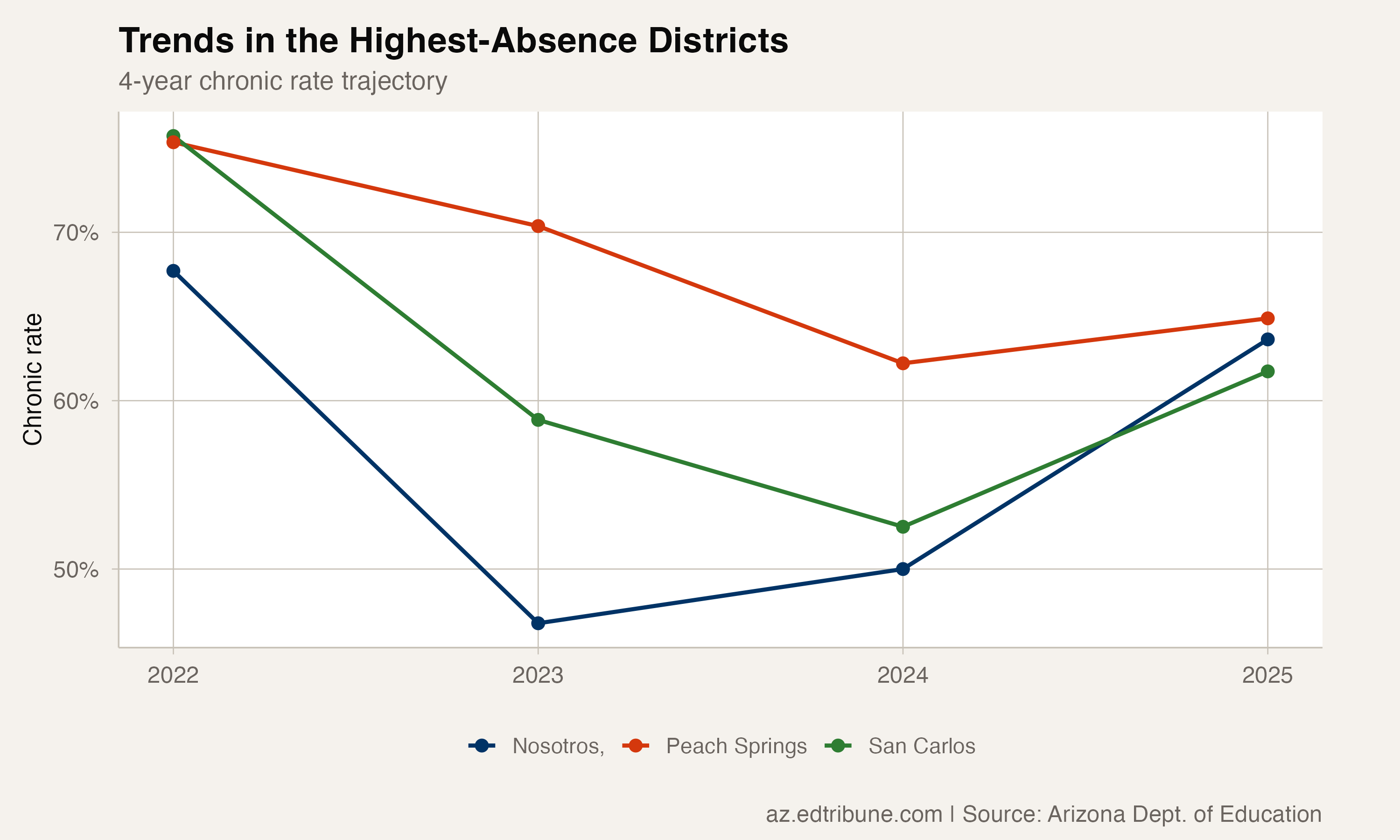
Peach Springs has been above 62% for all four years of available data — 75.4% in 2022, 70.4% in 2023, 62.2% in 2024, 64.9% in 2025. The improvement from 2022 to 2024 was genuine: nearly 13 points. But even at its best, two in three students were missing excessive school. And the 2025 uptick suggests that progress may not hold.
San Carlos followed a similar pattern — a significant decline from 75.7% in 2022 to 52.5% in 2024, then a spike back to 61.7% in 2025.
The State Average Masks a Bifurcation
Arizona's overall chronic rate of 23.8% sits at the midpoint of an enormous range. At the low end, several districts are below 10%. At the high end, nine districts are above 50%. The spread between the lowest and highest chronic rates in the state exceeds 60 percentage points.
The nine districts above 50% serve relatively small student populations, so their impact on the state average is limited. But for the students attending these schools, the state average is irrelevant. Their experience of school is one where absence is more common than attendance, where institutional capacity is stretched beyond what should be expected, and where the gap between their educational experience and that of students in suburban Phoenix is nearly impossible to close.
Detailed code that reproduces the analysis and figures in this article is available exclusively to EdTribune subscribers.
Discussion
Sign in to join the discussion.
Loading comments...