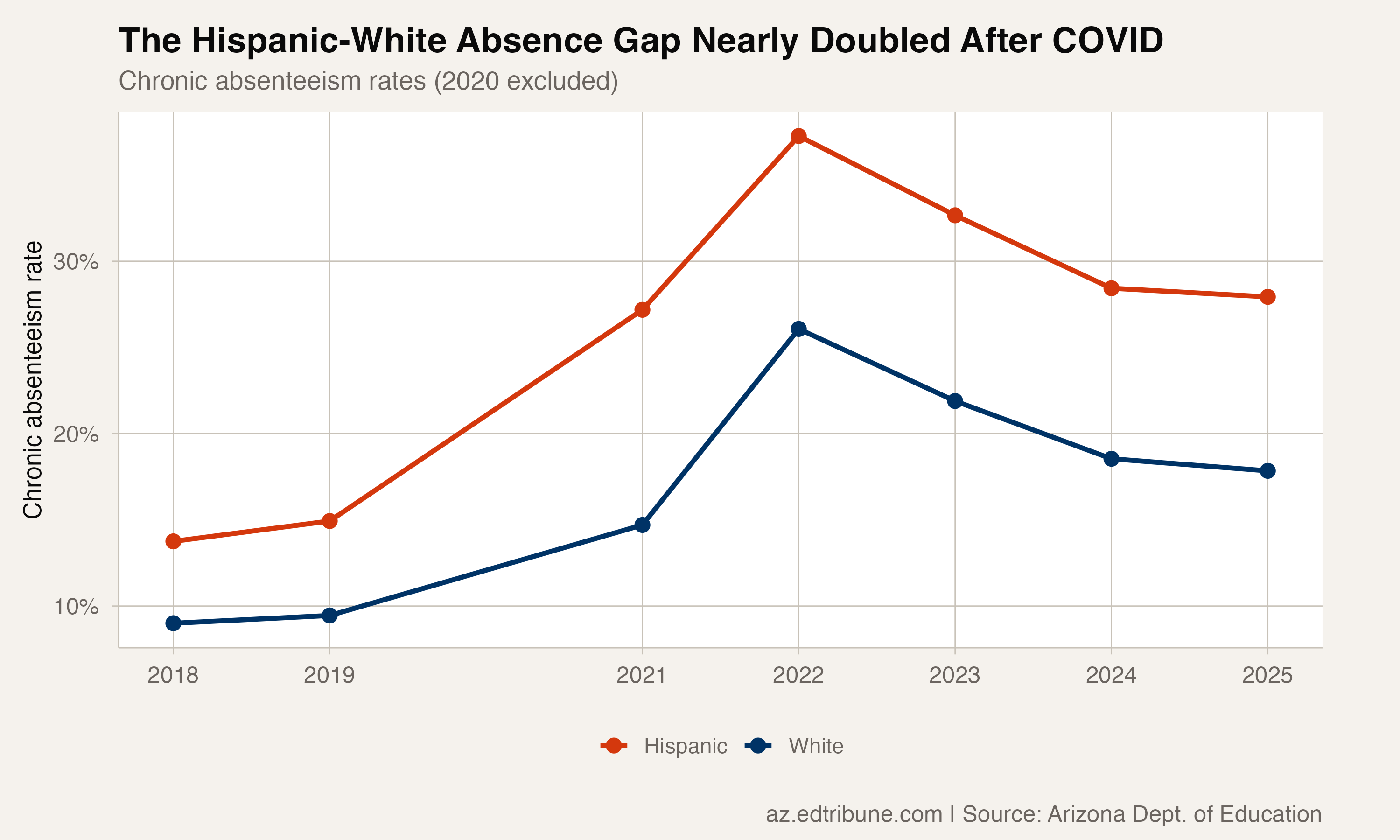
Before the pandemic, the gap between Hispanic and white chronic absenteeism in Arizona was 5.5 percentage points. Hispanic students had a 14.9% chronic rate in 2018-19; white students had 9.5%.
In 2024-25, Hispanic students are at 27.9%. White students are at 17.8%. The gap stands at 10.1 percentage points, nearly double what it was before COVID.
This matters beyond the numbers. Hispanic students are Arizona's largest demographic group, making up 49.2% of the state's enrollment. When more than one in four members of the majority population is chronically absent, the problem is not confined to a subgroup. It is the state's central attendance challenge.
The Gap Opened Wide and Stayed
COVID widened the gap sharply. In 2020-21, the first full in-person year after lockdowns, Hispanic chronic absenteeism jumped to 27.2% while white rates rose to 14.7%, a 12.5-point gap that was more than double the pre-COVID level. The peak came in 2021-22, when Hispanic students hit 37.3% and white students 26.1%.
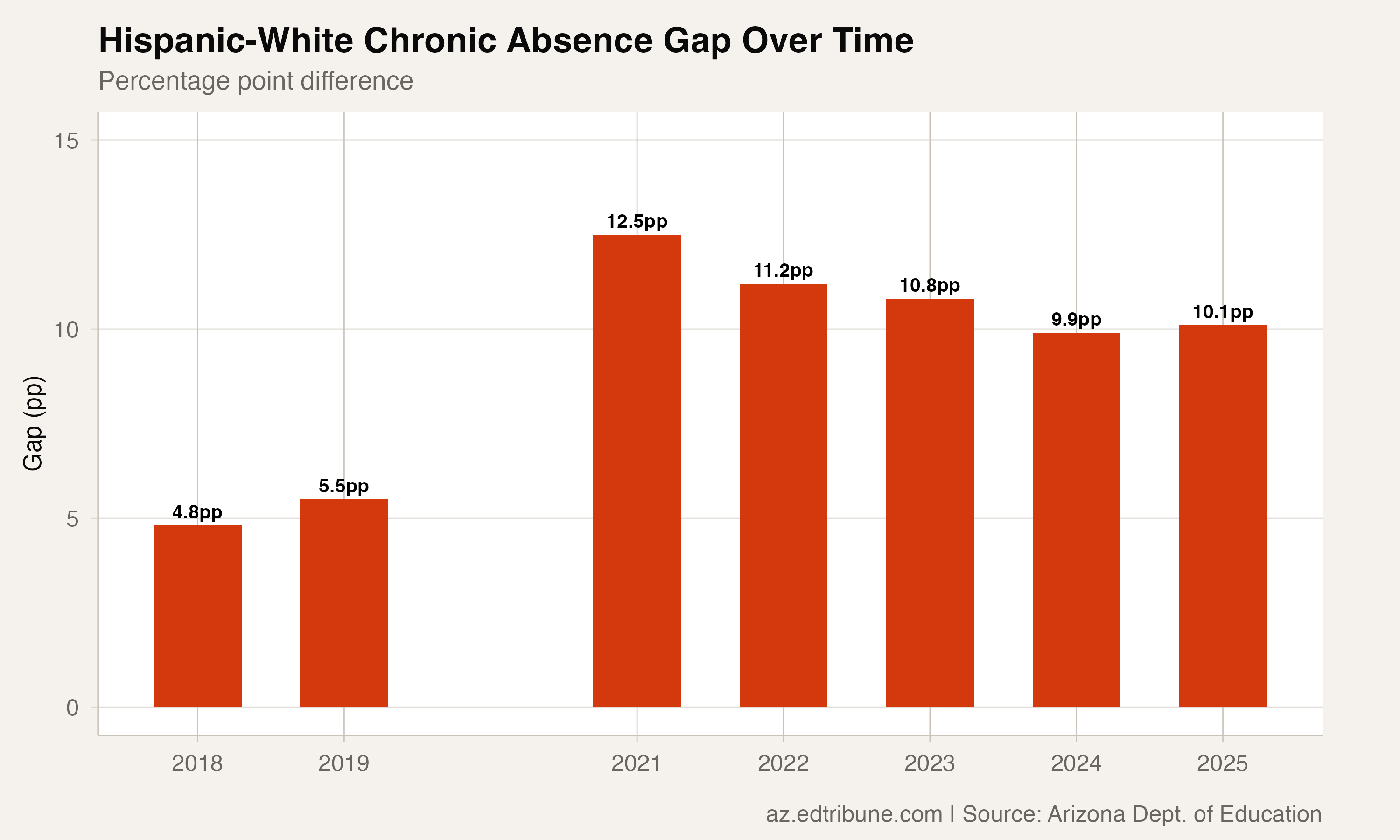
Since then, both groups have improved. But white students have recovered faster: their rate dropped 8.3 points from peak, compared to 9.4 points for Hispanic students. In percentage terms, white students have recovered 49.5% of their COVID-era spike; Hispanic students have recovered 41.8%. The gap has bounced between 9.9 and 12.5 points since 2021, showing no clear trajectory toward narrowing.
Where Hispanic Students Stand Among All Groups
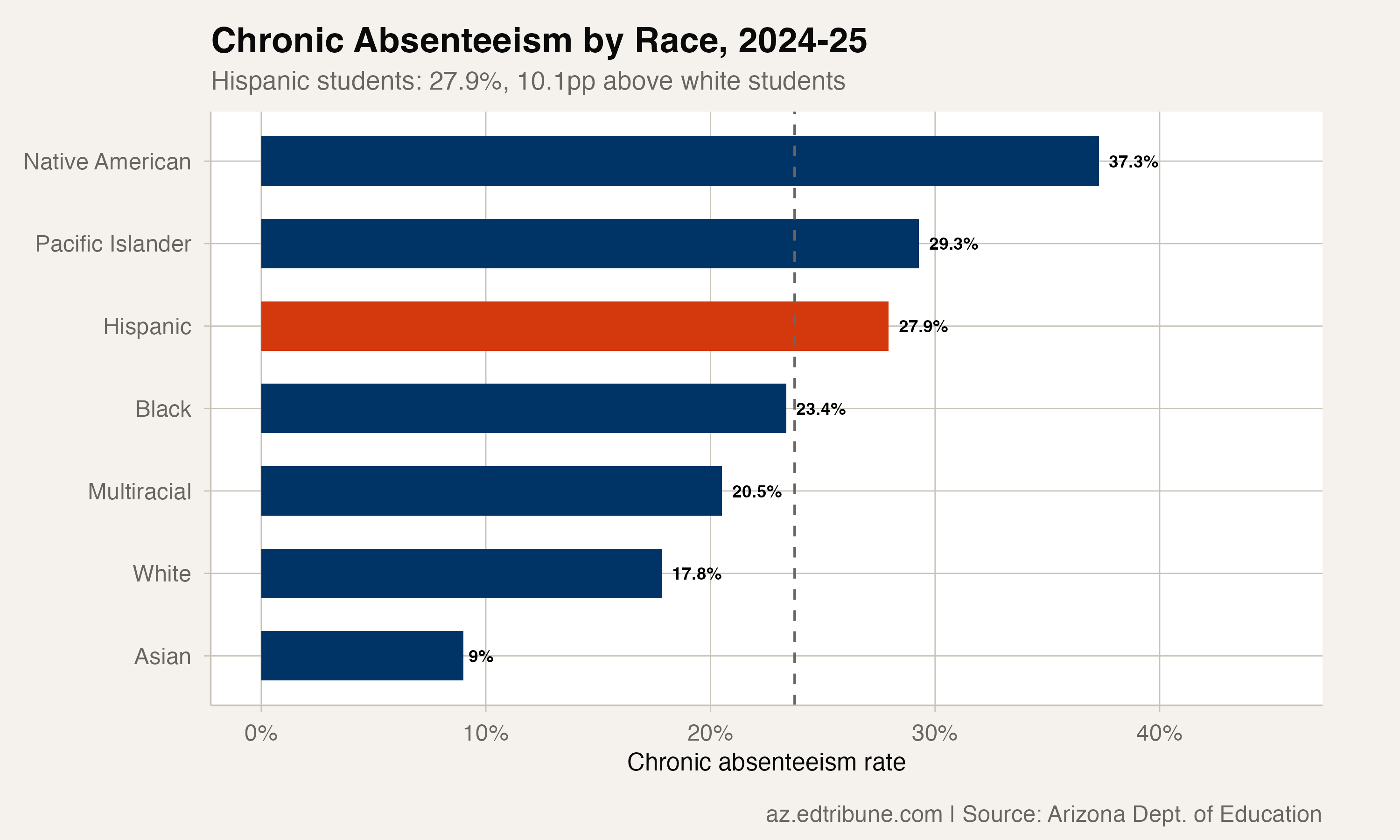
At 27.9%, Hispanic students have the third-highest chronic absenteeism rate among racial groups, behind Native American students (37.3%) and Pacific Islander students (29.3%). But given the size of the Hispanic student population, the absolute number of chronically absent Hispanic students dwarfs every other group.
Asian students, at 9.0%, are the only group below 10%. White students at 17.8% and multiracial students at 20.5% sit below the state average. Black students at 23.4% are essentially at the state average.
What 27.9% Means
A chronic absenteeism rate of 27.9% means that for roughly every seven Hispanic students in an Arizona classroom, two are missing at least 18 days of school per year. At that scale, chronic absence becomes a community-wide pattern, not an individual behavior.
The drivers are well-documented: economic instability that forces older students to work or care for siblings, transportation barriers in sprawling metro areas and rural communities, distrust of institutions, language barriers that reduce family engagement with school attendance systems, and health care access gaps that turn treatable illnesses into multi-day absences.
Arizona's attendance data does not include student counts, so the absolute number of Hispanic students who are chronically absent cannot be calculated directly from this dataset. But with roughly 530,000 Hispanic students in Arizona and a 27.9% chronic rate, the scale is in the range of 148,000 students, a population larger than many Arizona cities.
Hispanic students will be the majority of Arizona's enrollment within a year or two. A 10.1-point absence gap with white students is not a subgroup problem, and three years of recovery have only modestly closed it.
Detailed code that reproduces the analysis and figures in this article is available exclusively to EdTribune subscribers.
Discussion
Sign in to join the discussion.
Loading comments...