Before COVID, Pacific Islander students in Arizona had a chronic absenteeism rate of 13.0% — just 3.6 percentage points above white students' 9.5%. The gap was modest, barely distinguishable from the overall population.
By 2024-25, the Pacific Islander rate had reached 29.3%, and white students were at 17.8%. The gap had tripled to 11.4 percentage points.
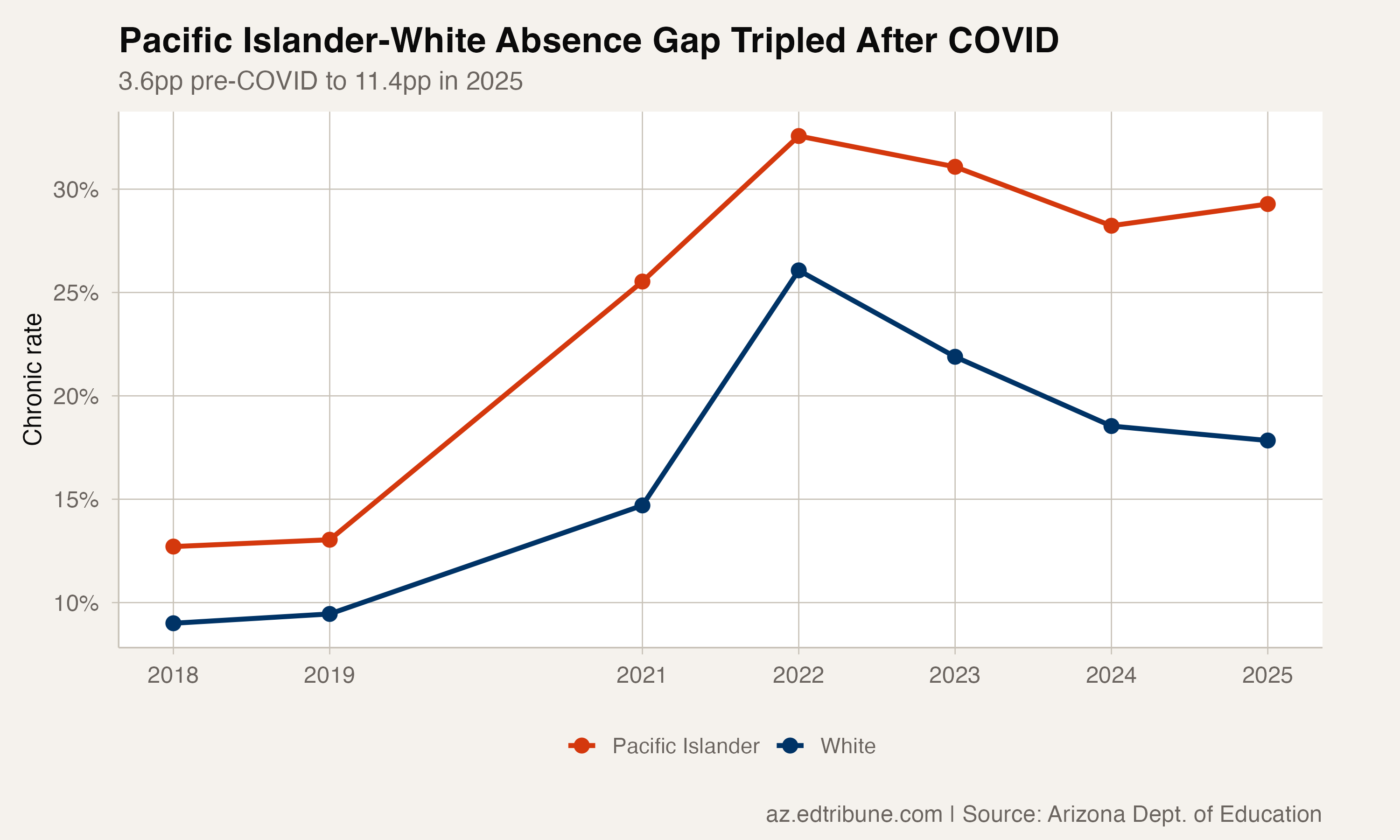
Of all racial and ethnic subgroups tracked by the Arizona Department of Education, Pacific Islander students experienced the most dramatic relative gap expansion. Their absolute rate more than doubled, and their gap with white students grew by 7.8 points.
The Gap Trajectory
The gap's evolution tells a story of uneven pandemic impact and uneven recovery:
| Year | PI Rate | White Rate | Gap |
|---|---|---|---|
| 2017-18 | 12.7% | 9.0% | 3.7pp |
| 2018-19 | 13.0% | 9.5% | 3.6pp |
| 2020-21 | 25.5% | 14.7% | 10.8pp |
| 2021-22 | 32.6% | 26.1% | 6.5pp |
| 2022-23 | 31.1% | 21.9% | 9.2pp |
| 2023-24 | 28.2% | 18.5% | 9.7pp |
| 2024-25 | 29.3% | 17.8% | 11.4pp |
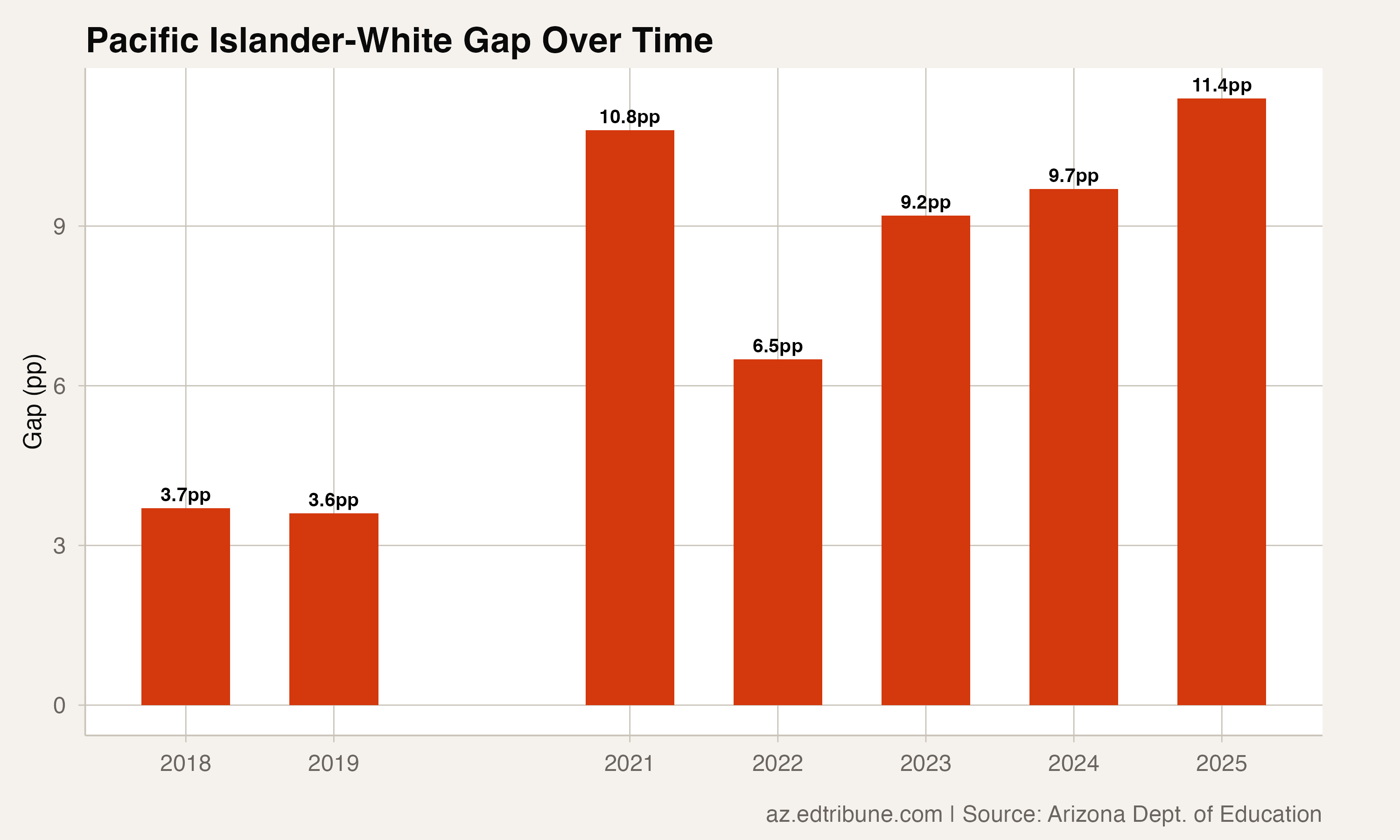
The gap compressed briefly in 2021-22 when both groups were at their highest rates — the pandemic was so broadly disruptive that differences between groups temporarily narrowed. As white students recovered faster, the gap reopened and has now reached its widest point.
Pacific Islander students' recovery has been minimal: just 3.3 points of improvement from the 32.6% peak in 2022 to 29.3% in 2025. White students dropped 8.3 points over the same period. The 2024-to-2025 data actually shows Pacific Islander rates ticking back up by 1.1 points, suggesting what little recovery occurred may be reversing.
A Small Population, an Outsized Signal
Arizona's Pacific Islander student population is relatively small, which means the rates can be more volatile year to year than for larger groups. But the consistency of the pattern — four consecutive years with a gap above 6 points, when it was 3.6 before COVID — suggests this is structural, not statistical noise.
Pacific Islander communities in Arizona, concentrated primarily in the Phoenix metro area, face many of the same socioeconomic pressures as other communities of color: housing instability, multigenerational households where illness spreads quickly, limited access to culturally competent health care, and employment in sectors that don't offer paid sick leave for parents.
Before COVID, the gap was small enough to overlook. It is not small anymore. At 29.3%, nearly three in ten Pacific Islander students are chronically absent, and the 2025 uptick suggests it could get worse. The pre-pandemic rate of 13% is starting to look like a different era.
Detailed code that reproduces the analysis and figures in this article is available exclusively to EdTribune subscribers.
Discussion
Sign in to join the discussion.
Loading comments...