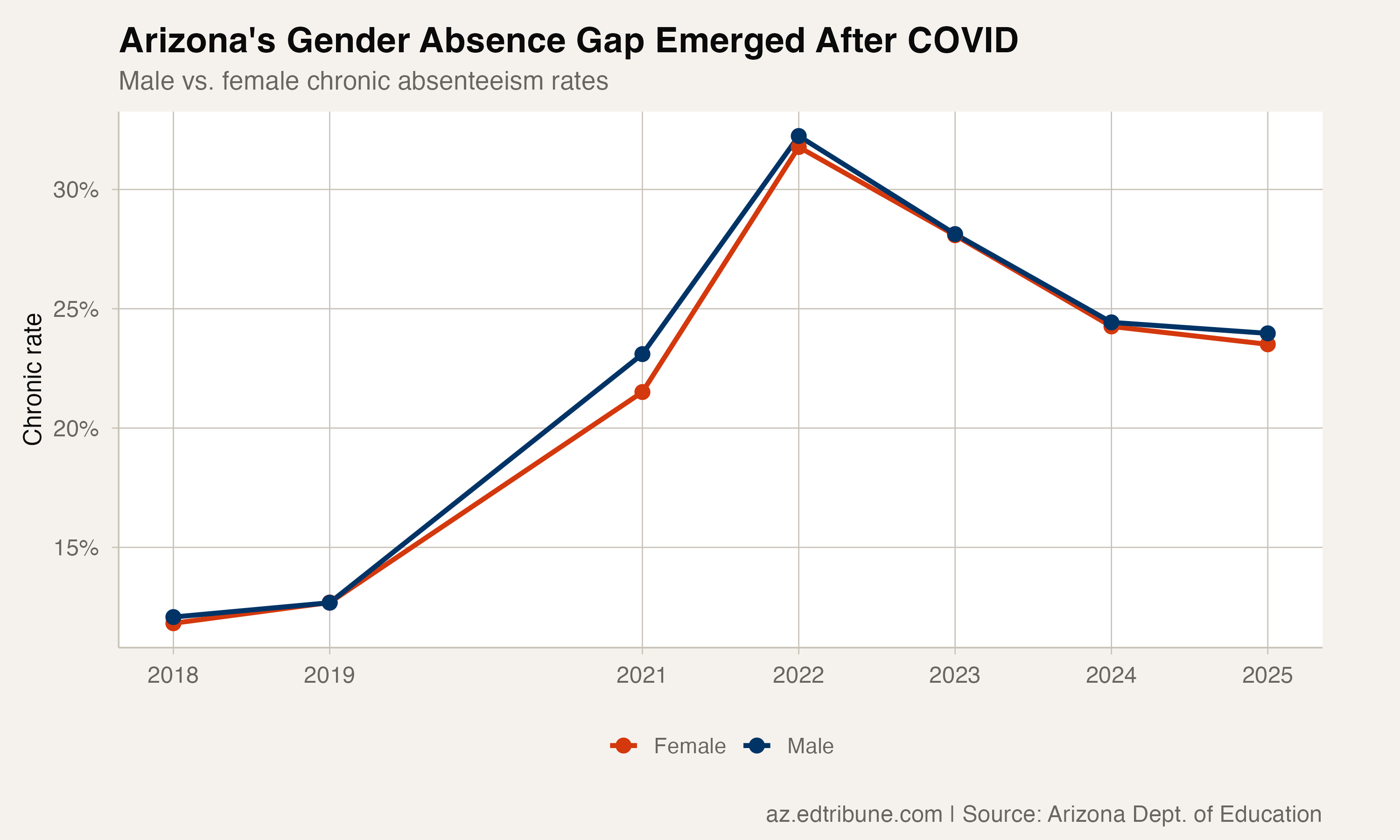
In 2018-19, the chronic absenteeism rate for male and female students in Arizona was identical: 12.7% each. The gender gap was zero.
Five years later, it is not zero. In 2024-25, male students posted a 24.0% chronic rate compared to 23.5% for female students, a 0.5 percentage point gap. The difference is small in absolute terms, but its emergence where none existed before the pandemic signals a shift worth tracking.
How the Gap Opened
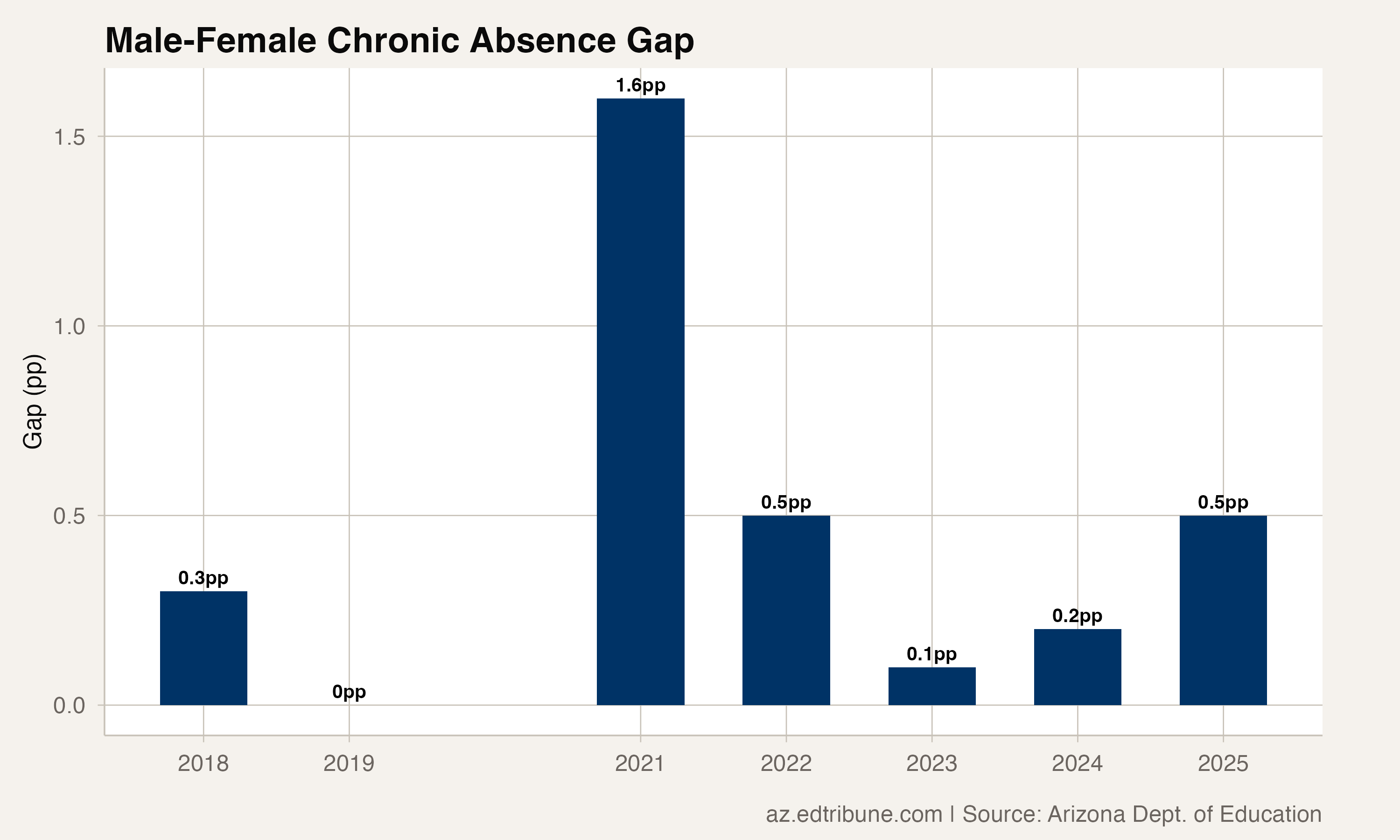
The gap first appeared during the pandemic's most disruptive year. In 2020-21, male students surged to 23.1% while female students hit 21.5%, a 1.6-point gap, the largest recorded. The gap compressed in 2021-22 to just 0.5 points as both groups hit near-peak levels. It essentially disappeared in 2022-23 (0.1 points), then re-emerged at 0.2 points in 2023-24 and 0.5 points in 2024-25.
| Year | Female | Male | Gap |
|---|---|---|---|
| 2017-18 | 11.8% | 12.1% | 0.3pp |
| 2018-19 | 12.7% | 12.7% | 0.0pp |
| 2020-21 | 21.5% | 23.1% | 1.6pp |
| 2021-22 | 31.8% | 32.2% | 0.5pp |
| 2022-23 | 28.1% | 28.1% | 0.1pp |
| 2023-24 | 24.3% | 24.4% | 0.2pp |
| 2024-25 | 23.5% | 24.0% | 0.5pp |
The 2024-25 gap of 0.5 points is consistent with the 2021-22 level but below the 2020-21 peak. It appears to be stabilizing as a persistent, small differential rather than growing over time.
Context: The National Pattern
The emergence of a gender gap in chronic absenteeism aligns with broader national patterns documented since the pandemic. Boys have shown higher rates of behavioral disengagement, disciplinary issues, and mental health challenges in the post-COVID era. Arizona ranks 49th nationally for youth mental health access, according to Mental Health America, meaning that whatever is driving higher male absenteeism has limited support infrastructure to address it.
Boys tend to disengage through behavioral channels (truancy, suspension, dropping out) while girls are more likely to keep showing up even when struggling. The pandemic stripped away routines and social structures that kept marginally engaged boys connected, and some of them never reconnected.
A Signal, Not a Crisis
At 0.5 percentage points, this is not a crisis. It is a signal. The gap is too small to drive policy on its own and too volatile year-to-year to predict with confidence.
But the pre-COVID baseline was zero. The fact that a gender gap now exists at all, and has persisted for four years, suggests that the pandemic created or revealed a gendered difference in school attachment that did not exist before. Whether it persists, grows, or disappears will be worth monitoring.
In a state where the overall chronic rate is stuck near 24%, half a percentage point between boys and girls barely registers. But zero used to be the number. The fact that it is no longer zero, and has not been zero for four years, is a small change that says something about the pandemic's uneven legacy.
Detailed code that reproduces the analysis and figures in this article is available exclusively to EdTribune subscribers.
Discussion
Sign in to join the discussion.
Loading comments...