The gap between Arizona's reservation school districts and a set of suburban East Valley districts is 28.8 percentage points.
In 2024-25, six reservation-area districts — Peach Springs↗ET, San Carlos↗ET, Window Rock↗ET, Tuba City↗ET, Chinle↗ET, and Whiteriver↗ET — averaged a 45.7% chronic absence rate. Five suburban East Valley districts — Chandler↗ET, Gilbert↗ET, Scottsdale↗ET, Paradise Valley↗ET, and Kyrene↗ET — averaged 16.8%.
Children in the same state are experiencing fundamentally different attendance realities.
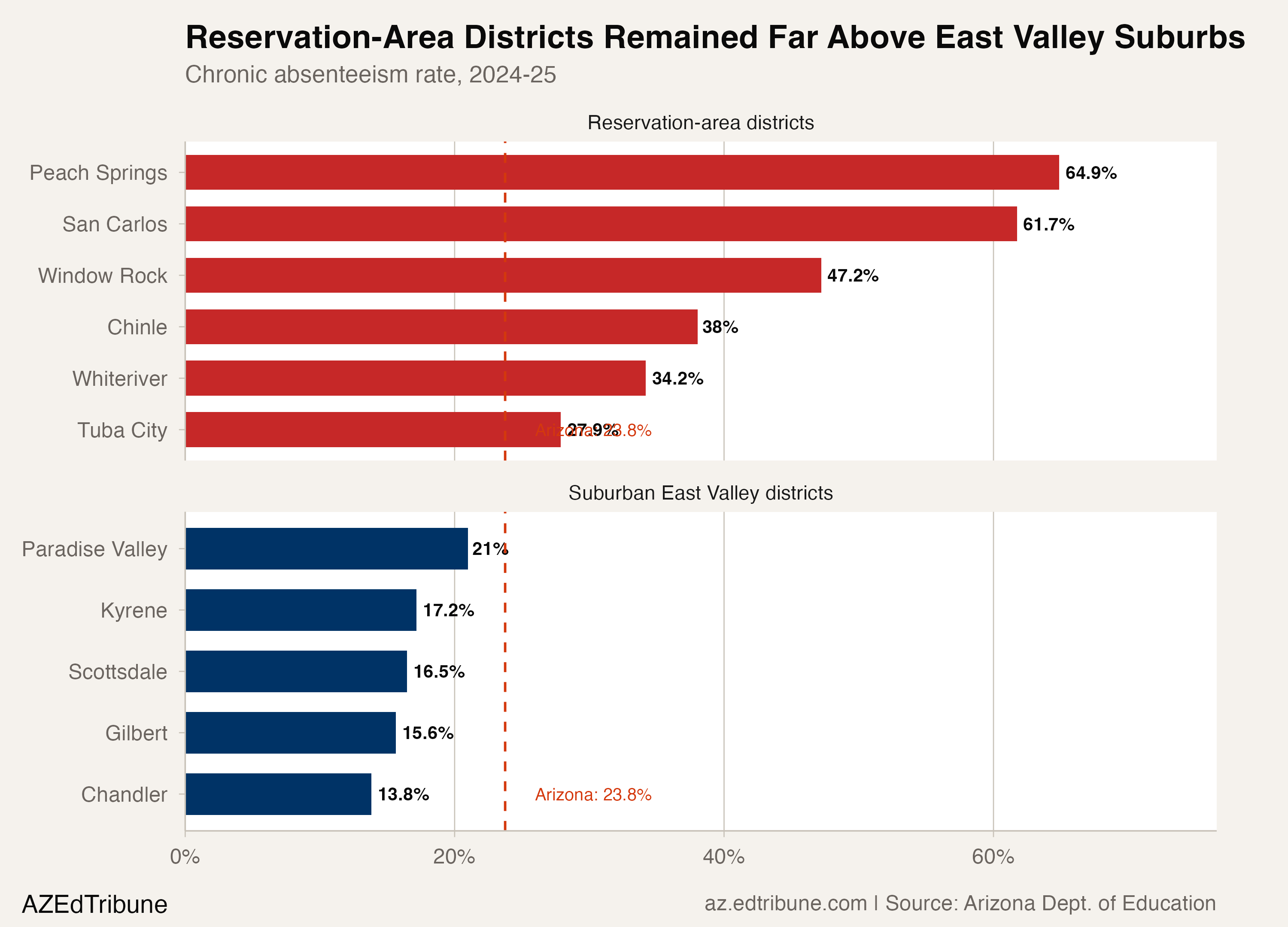
The Extremes
On the reservation-area side, the range runs from Peach Springs' 64.9% to Tuba City's 27.9%. On the suburban side, it runs from Chandler's 13.8% to Paradise Valley's 21.0%. Even the highest suburban rate in this comparison was lower than the lowest reservation-area rate.
Window Rock is where the Navajo Nation Office of the President and Vice President is based. Chinle sits near Canyon de Chelly National Monument.
Window Rock posted 47.2%. Chinle was at 38.0%. These are not small differences. At 47.2%, nearly half of students are chronically absent under the state measure.
The Tuba City Exception
The most important data point in this comparison is Tuba City Unified, which cut its chronic rate from 57.2% in 2022 to 27.9% in 2025 — a 29.3 percentage point drop.
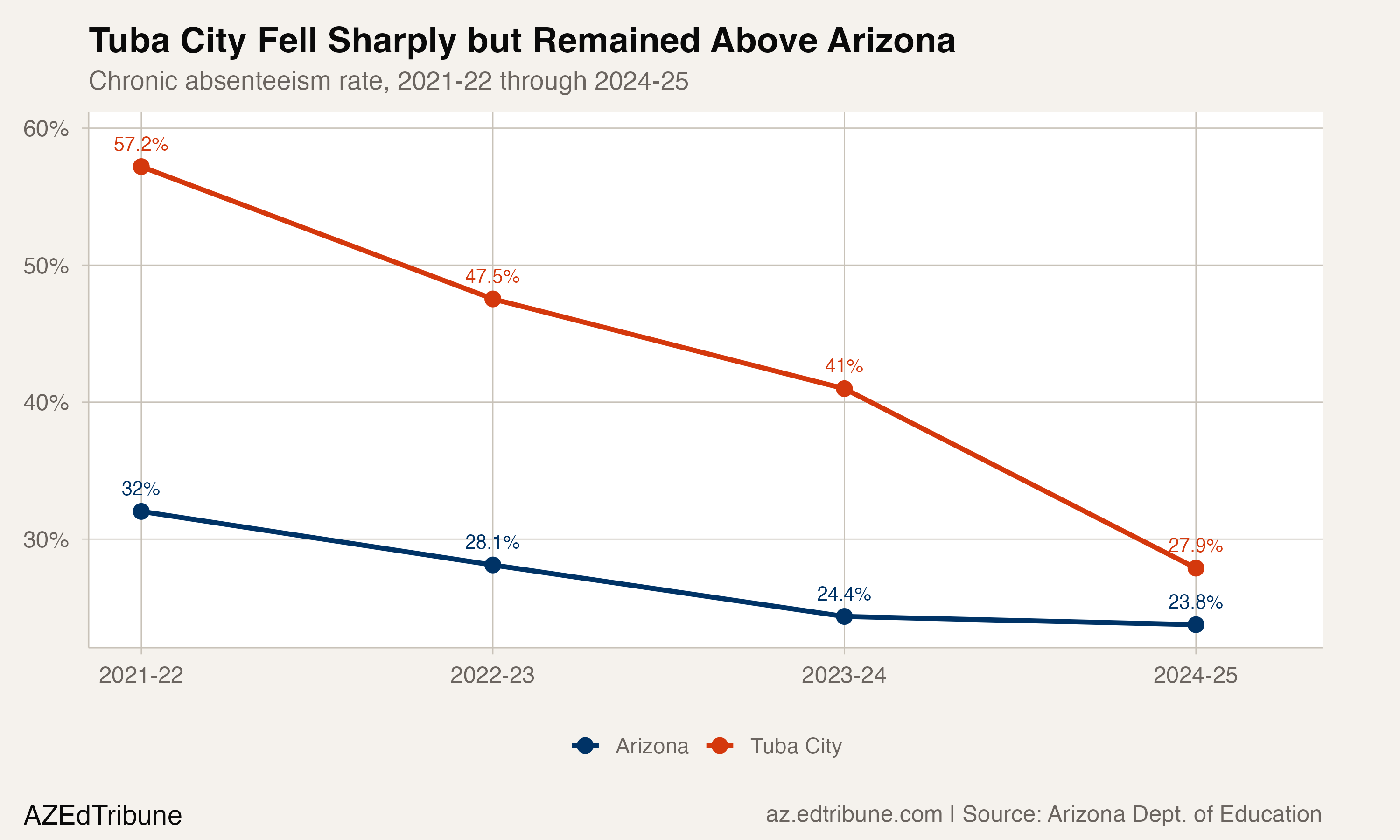
Tuba City is still above Arizona's 23.8% statewide rate, but only by 4.1 points. Three years earlier, it stood 25.2 points above the state. Its improvement was also consistent: the district's rate fell every year from 2022 through 2025, with year-over-year drops of 9.7, 6.5, and 13.1 points.
The full statewide dataset keeps the claim in bounds. Tuba City's 57.2% rate in 2022 ranked 17th-highest among 464 districts with data. Its 29.3-point improvement ranked 14th among districts with complete 2022 and 2025 records. It was a major recovery, not a unique one.
Peach Springs and San Carlos remained above 60% in 2025. Tuba City's trajectory does not prove the structural barriers can always be overcome. But it does show that the divide is not fixed at the same level in every reservation-area district.
The Barriers Are Structural
The reservation-suburb gap reflects more than school operations, but the district data alone cannot assign causes.
Suggestive context: National reporting on Native student absenteeism has identified transportation problems, unstable housing, limited educational infrastructure, and distrust rooted in the history of forced assimilation as recurring barriers in tribal communities (PBS NewsHour). A WestEd brief similarly points to systemic barriers, unwelcoming school environments, disciplinary disparities, and lack of culturally relevant curriculum as contributors to chronic absenteeism for American Indian and Alaska Native students (WestEd).
Unresourced in this article's data: The analysis file verifies the attendance gap and the district comparisons. It does not measure transportation access, housing stability, health care access, family income, or local program design for the named districts.
The 28.8-point gap is not a mystery. It is the measurable distance between communities that have accumulated advantages over generations and communities from which advantages have been systematically extracted.
Detailed code that reproduces the analysis and figures in this article is available exclusively to EdTribune subscribers.
Discussion
Sign in to join the discussion.
Loading comments...