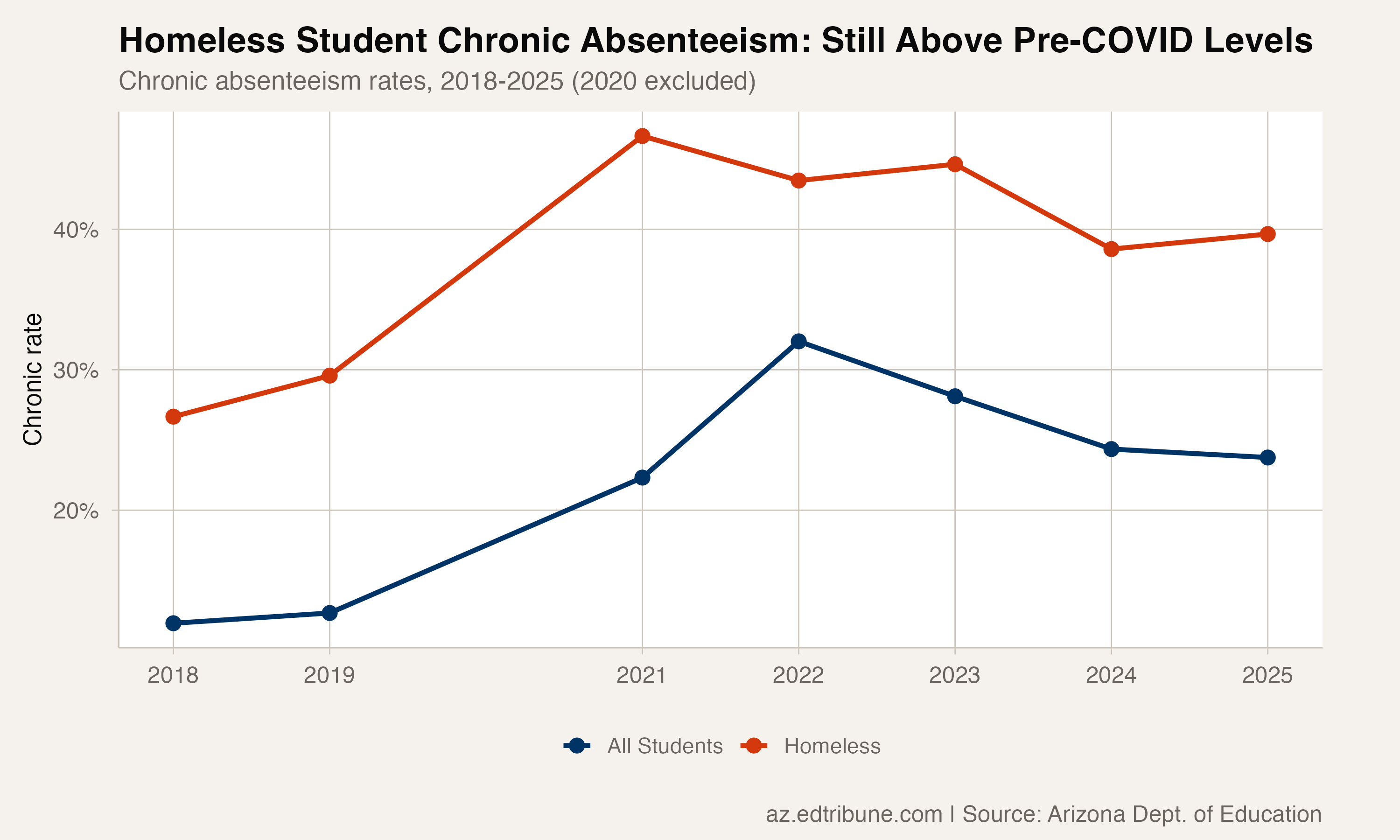
Arizona's students who are currently homeless had a 39.7% chronic absenteeism rate in 2024-25. That is 15.9 percentage points above the overall state rate, and 10.1 points above where students who are currently homeless stood before the pandemic.
The pre-COVID rate was 29.6% in 2018-19. It surged to 46.6% during the 2020-21 school year. Four years later, with overall attendance recovery stalling, students who are currently homeless remain at a level meaningfully worse than before COVID.
A Permanently Elevated Baseline
For most student populations, the story of chronic absenteeism after COVID follows a pattern: surge, then partial recovery. Students who are currently homeless follow a different trajectory. Their rate was already high before the pandemic, spiked to nearly 47%, and has settled into a new baseline around 40%, permanently elevated.
The gap with the overall population tells a nuanced story:
| Year | Homeless Rate | Overall Rate | Gap |
|---|---|---|---|
| 2017-18 | 26.7% | 12.0% | 14.7pp |
| 2018-19 | 29.6% | 12.7% | 16.9pp |
| 2020-21 | 46.6% | 22.3% | 24.3pp |
| 2021-22 | 43.5% | 32.0% | 11.4pp |
| 2022-23 | 44.6% | 28.1% | 16.5pp |
| 2023-24 | 38.6% | 24.4% | 14.2pp |
| 2024-25 | 39.7% | 23.8% | 15.9pp |
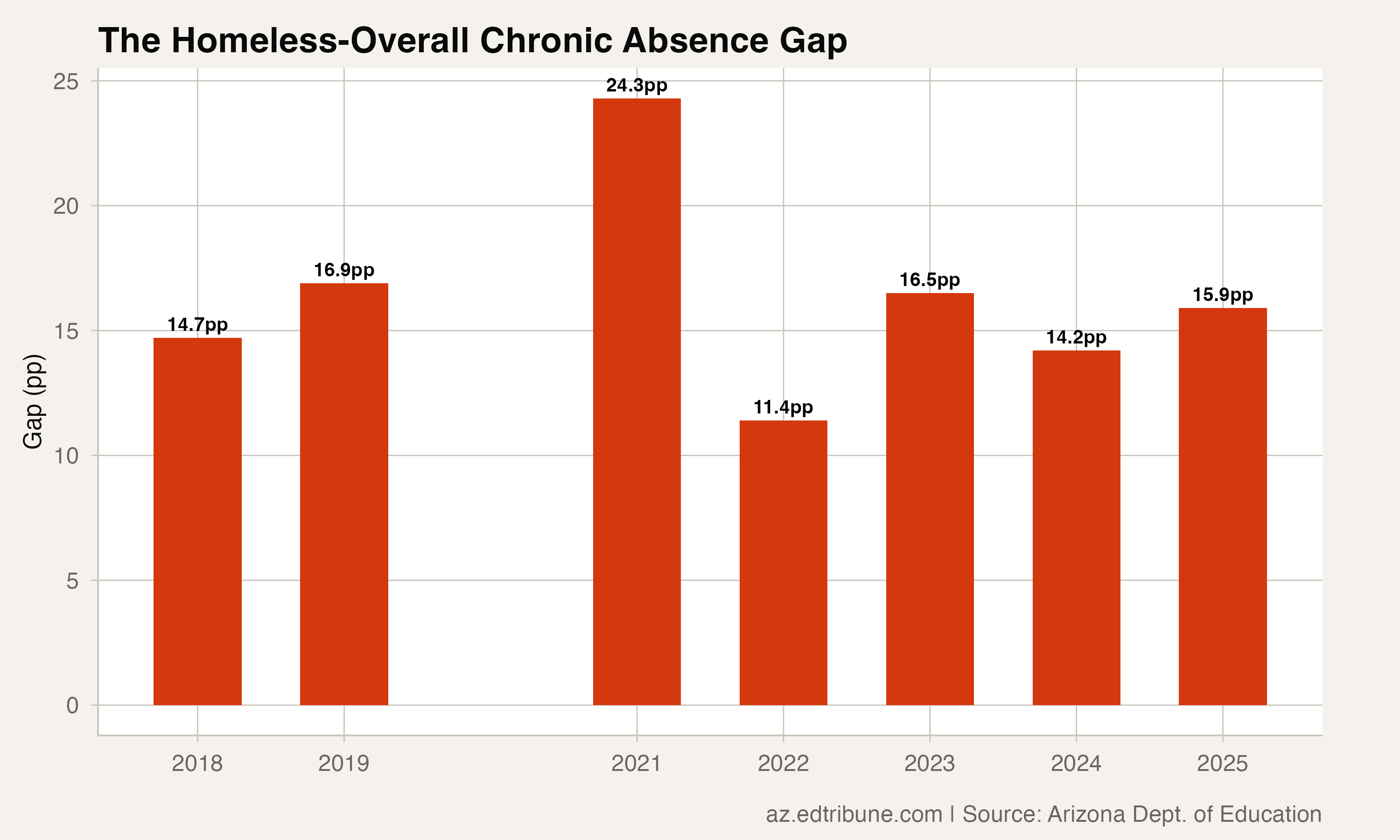
The gap widened dramatically during COVID (24.3 points in 2021), compressed when the overall population caught up to high absence levels in 2022, then re-expanded as the general population recovered faster. At 15.9 points, the current gap is close to the pre-COVID level, but both the homeless rate and the overall rate are now much higher.
Among the Most Vulnerable
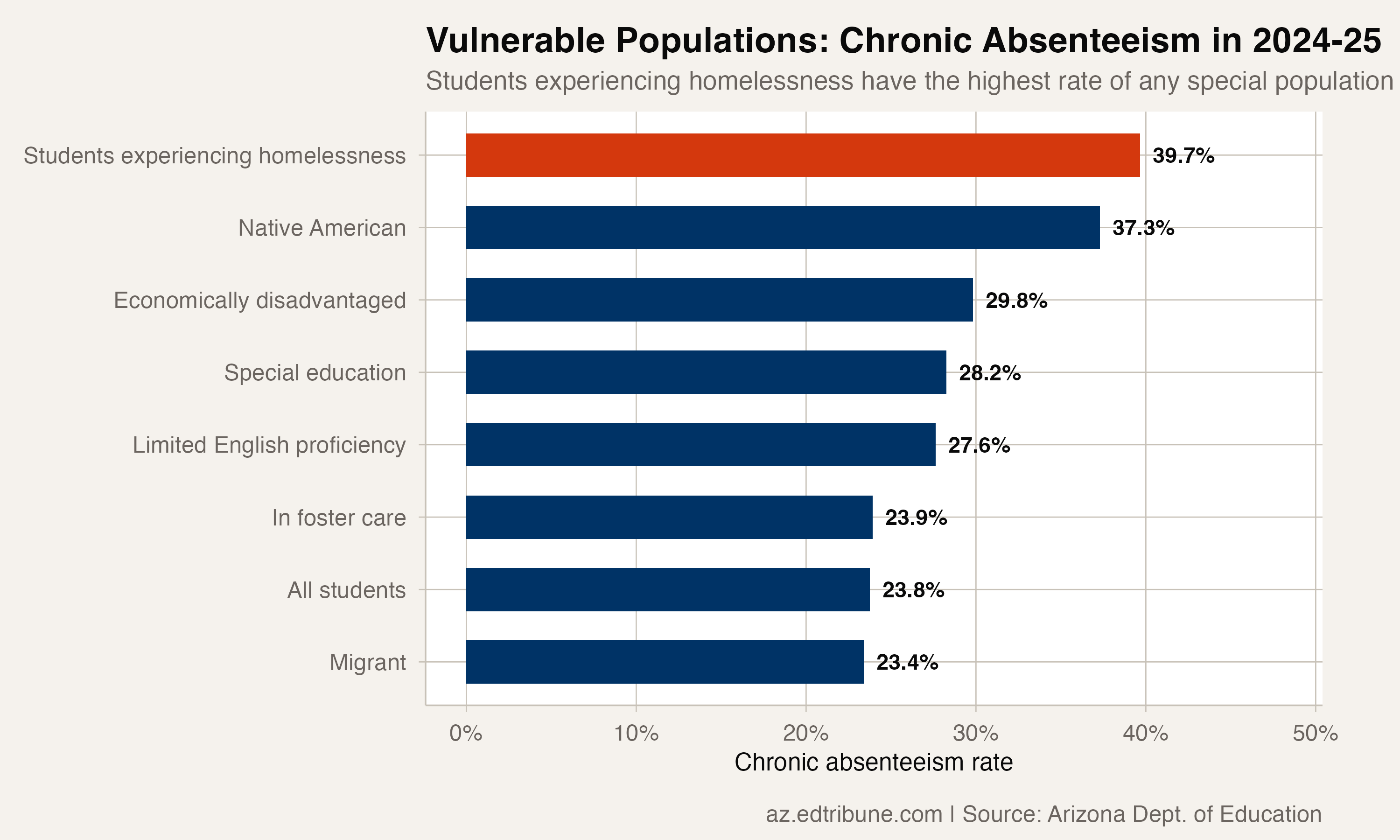
Students who are currently homeless have the highest chronic rate of any special population tracked by Arizona. Native American students are next at 37.3%. Economically disadvantaged students face a 29.8% rate, and students with limited English proficiency are at 27.6%.
The pattern across these populations is consistent: the more marginalized the group, the higher the chronic rate, and the less recovery has occurred since the pandemic peak.
Why Homeless Attendance Is Different
Students who are currently homeless face attendance barriers that operate at a fundamentally different level than those facing housed students. A student living in a shelter, a car, or doubled up with relatives may change schools multiple times in a year, and each transition means lost days. Transportation is unreliable or nonexistent. Health care is episodic rather than preventive, so chronic conditions go untreated until they force extended absences.
The McKinney-Vento Homeless Assistance Act requires schools to provide transportation and enrollment stability for students who are currently homeless, but the resources to fulfill that mandate are often inadequate. A homeless liaison coordinator managing hundreds of students across a sprawling district cannot solve problems that originate in housing markets and labor conditions.
At 39.7%, roughly two in five students who are currently homeless are missing at least 18 days, more than three and a half weeks, of instruction per year. For students whose out-of-school lives are already unstable, the academic consequences of that much missed time compound rapidly. School, for many of these students, may be the most stable institution in their lives. But the data says they are losing access to even that.
Detailed code that reproduces the analysis and figures in this article is available exclusively to EdTribune subscribers.
Discussion
Sign in to join the discussion.
Loading comments...