Three years ago, nearly one in three Arizona students was chronically absent. The state's chronic absenteeism rate had surged to 32.0% in the 2021-22 school year, a figure so far beyond historical norms that Superintendent of Public Instruction Tom Horne called it "catastrophic."
Arizona responded. The rate fell to 28.1% in 2022-23, then 24.4% in 2023-24. Nearly eight points of improvement in two years. Progress was real.
Then it stopped.
The 2024-25 rate came in at 23.8%, a decline of just 0.6 percentage points. After two years of cutting roughly four points annually, the improvement decelerated by more than 80%. Arizona appears to have hit a recovery floor — a level of chronic absence that standard interventions cannot easily push below.
The Deceleration
The numbers tell a clear story of momentum stalling:
- 2022 to 2023: -3.9 percentage points
- 2023 to 2024: -3.8 percentage points
- 2024 to 2025: -0.6 percentage points
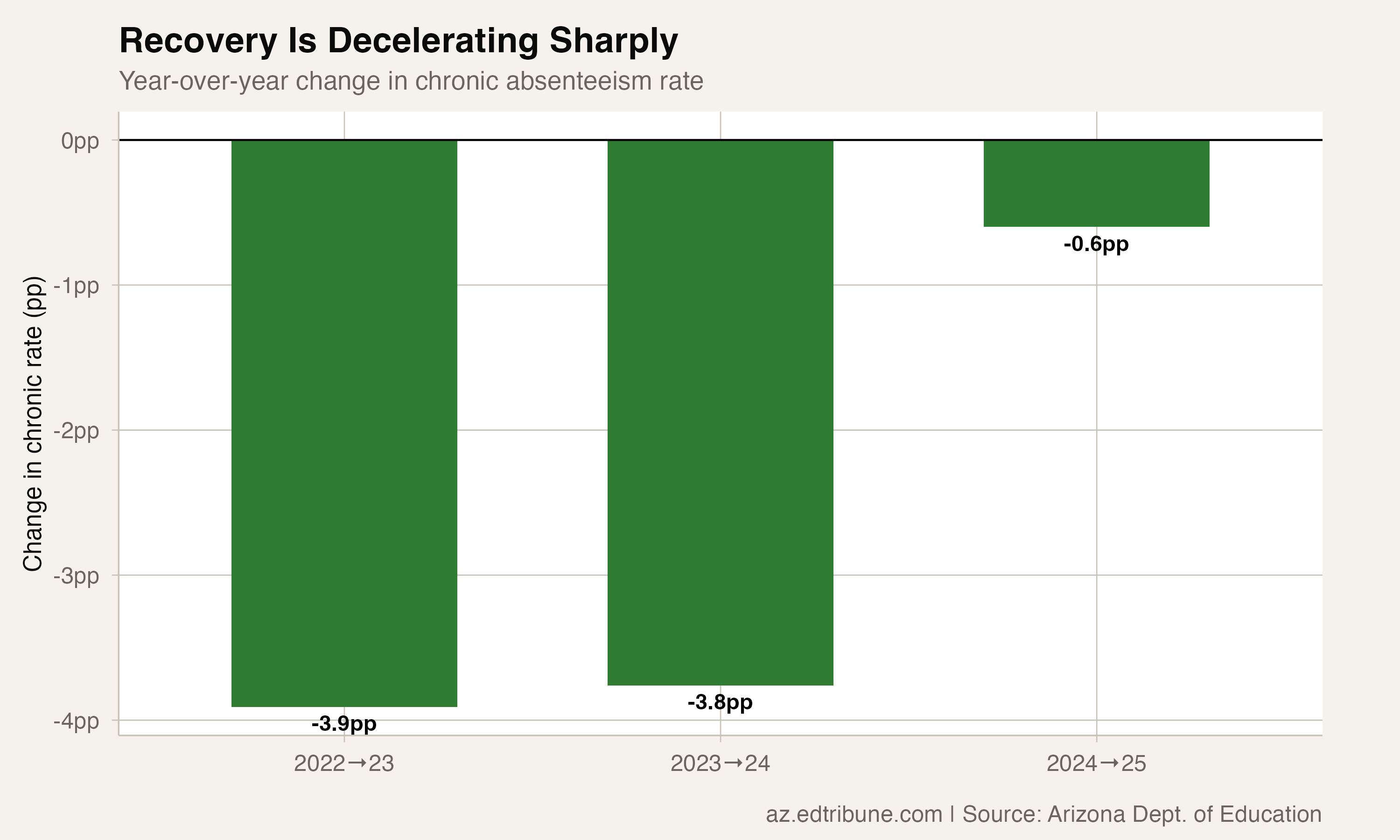
If Arizona had maintained its 2022-2024 improvement pace, the chronic rate would have dropped below 21% in 2024-25. Instead, it barely moved. The state has recovered 42.8% of the way back to its pre-COVID baseline of 12.7% — less than halfway, with the easy gains seemingly exhausted.
What the Projection Looks Like
At the 2025 improvement pace of 0.6 percentage points per year, simple arithmetic produces a sobering projection: Arizona would not return to its pre-COVID chronic rate until approximately 2043.
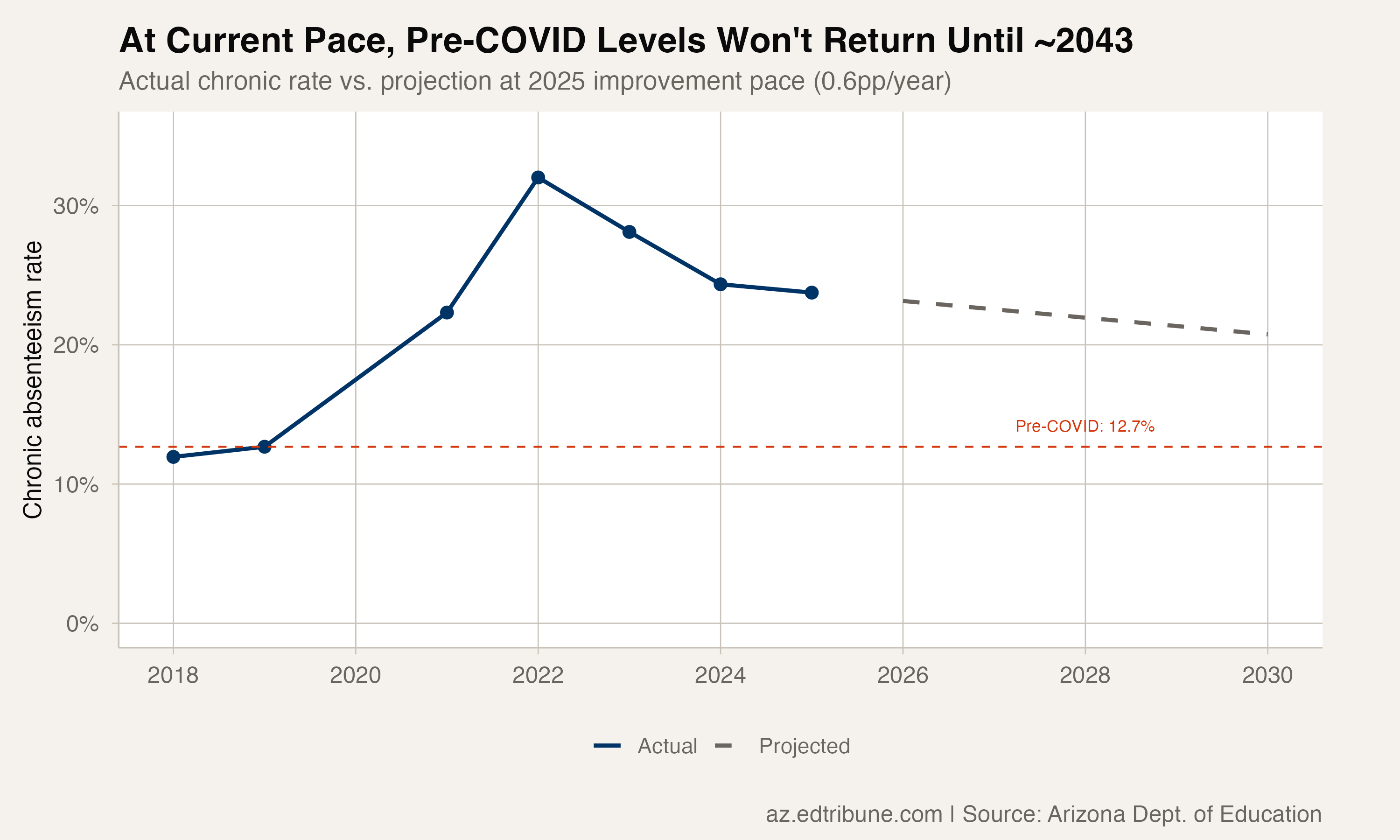
That projection is almost certainly too pessimistic. Funding initiatives, accountability measures, and community-based interventions could accelerate improvement. But it illustrates how far Arizona remains from normal — and how much the stall year matters. Every year of flat-lined improvement extends the timeline considerably.
Nearly Double the Pre-COVID Rate
Arizona's current 23.8% chronic rate is 11.1 percentage points above its 2018-19 level of 12.7%. Put another way: the state has nearly twice as many chronically absent students as it did before the pandemic.
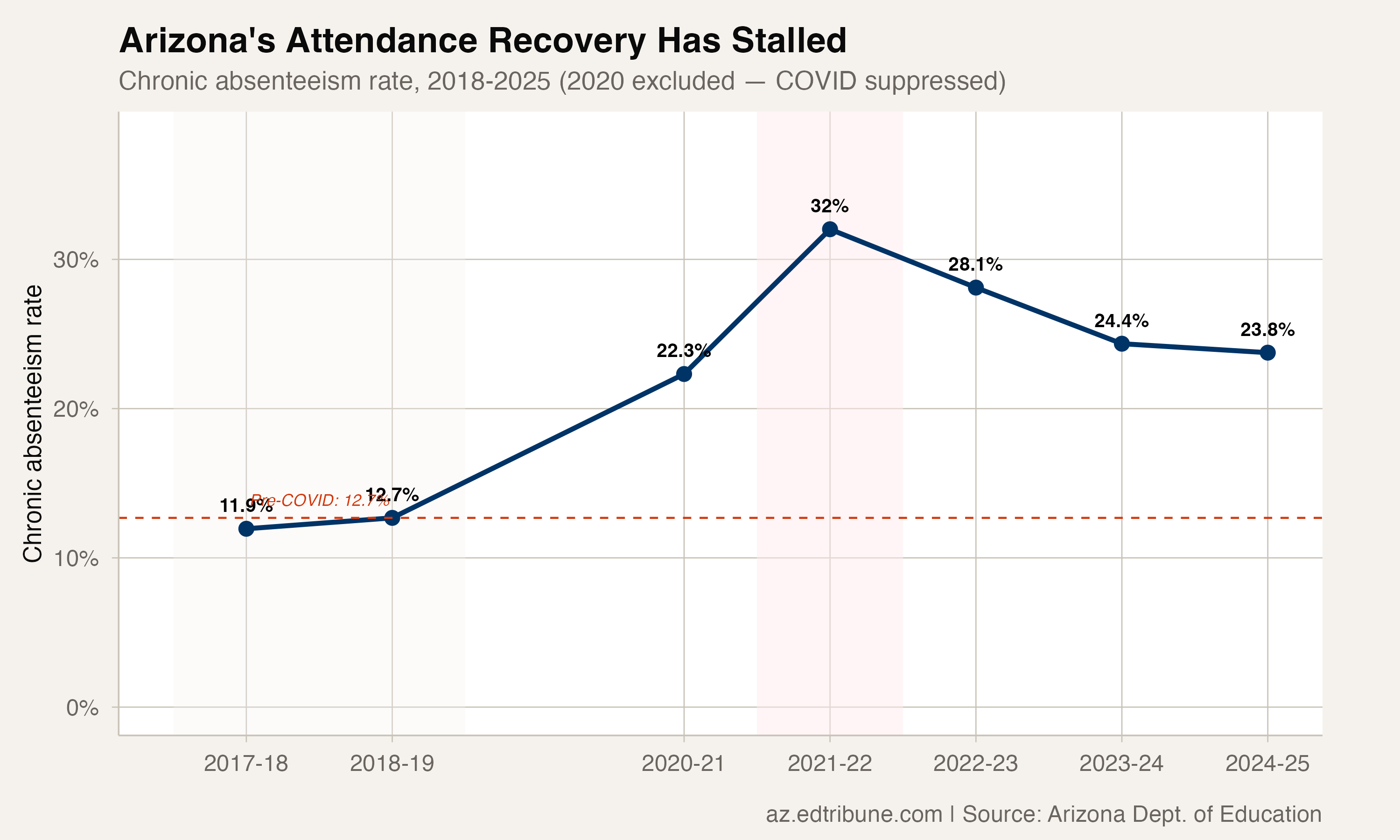
The pre-COVID trend was already troubling. Arizona's chronic rate edged up from 11.9% in 2017-18 to 12.7% in 2018-19. The pandemic didn't create a crisis from nothing — it amplified an existing problem and then locked in a higher baseline.
Who Has Recovered — and Who Hasn't
Recovery varies dramatically across student populations. White students have recovered 49.5% of their COVID-era spike, the best of any racial subgroup. Economically disadvantaged students have recovered 47.0%. But the groups that were hit hardest have recovered least:
- Native American students: 37.3% chronic rate in 2025, only 31.4% recovered
- Homeless students: 39.7% chronic rate, only 27.4% recovered
- Black students: 23.4% chronic rate, 38.9% recovered
- Hispanic students: 27.9% chronic rate, 41.8% recovered
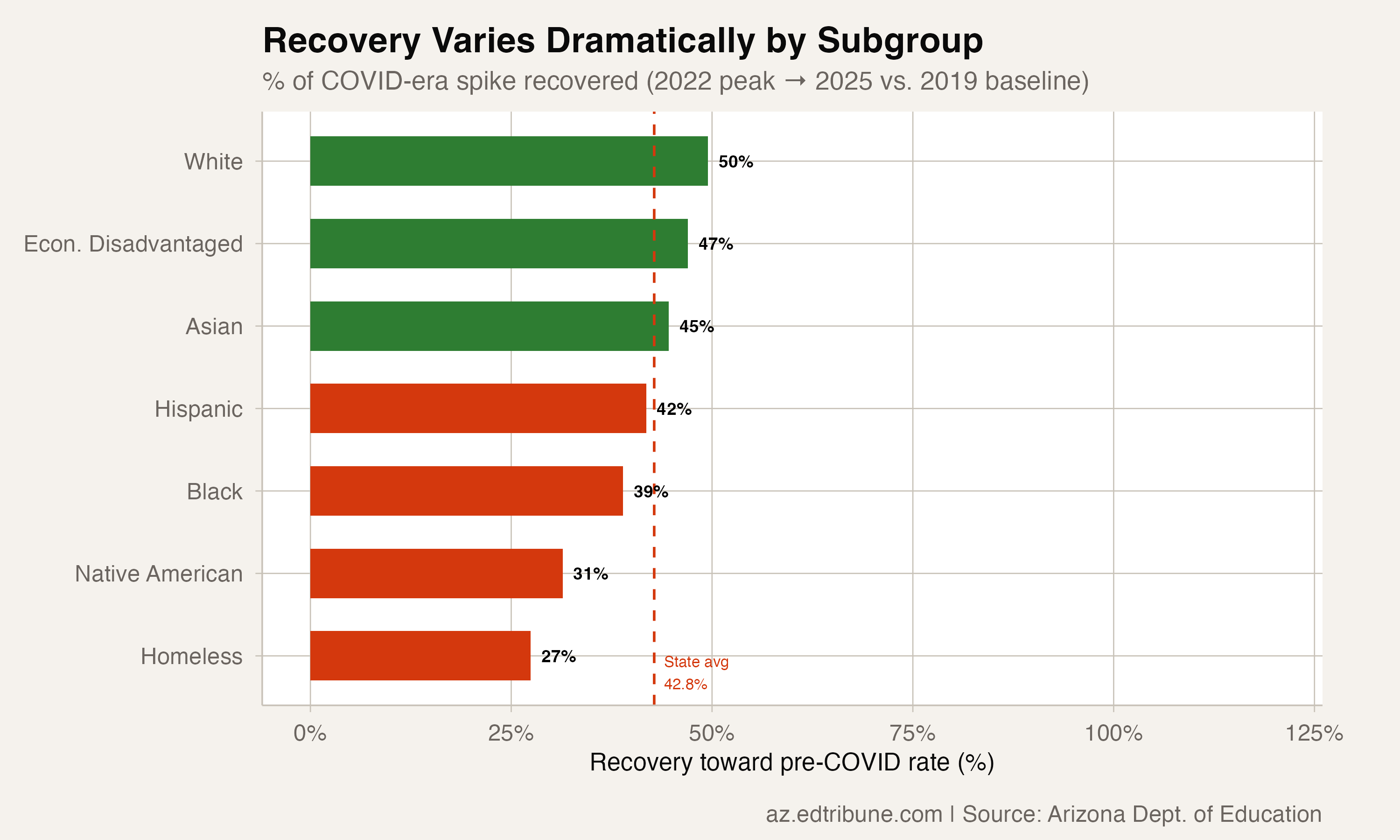
The pattern is consistent: the higher the pre-COVID rate, the less recovery has occurred. The groups most vulnerable before the pandemic remain the most vulnerable after it — and the gap between them and the overall average has widened.
What the Stall Means
A chronically absent student in Arizona misses roughly 18 days per year, nearly a full month of instruction. At 23.8%, that is one in four students statewide.
Superintendent Horne has responded with punitive measures: automatic grade retention for students with 18 or more absences, proposed automatic F's after nine unexcused absences. The theory is that consequences will change behavior. But the students still missing school after two years of recovery efforts are disproportionately Native American, homeless, and low-income. Their barriers are less about motivation than about getting to school at all.
Whatever Arizona did to cut eight points between 2022 and 2024 is no longer working. The 0.6-point improvement in 2025 is not a slowdown. It is a wall.
Detailed code that reproduces the analysis and figures in this article is available exclusively to EdTribune subscribers.
Discussion
Sign in to join the discussion.
Loading comments...