Part of the Arizona Enrollment SeriesET. Updated weekly.
Correction (May 29, 2026): An earlier version of this article reported district-recovery figures computed against an outdated data extract. Every district-level count and the loss/gain/gap arithmetic have been recomputed against the current Arizona Department of Education data and corrected, including the headline figure (now 71,505 students). The state totals and named-district numbers were unaffected.
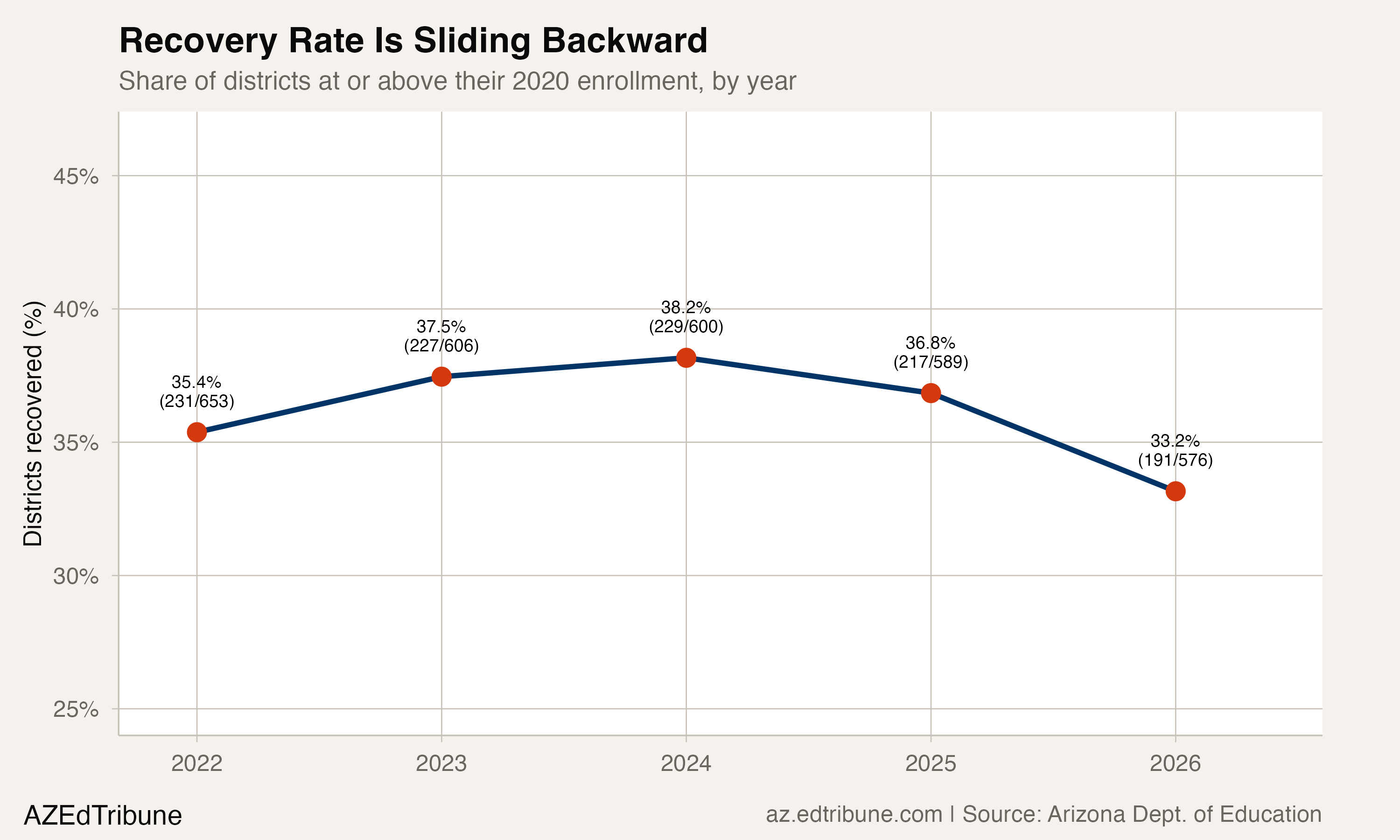
Only 191 of Arizona's 576 school districts have regained their pre-pandemic enrollment. Five years after COVID emptied classrooms across the state, two out of three districts are still underwater, and the share that has recovered is actually shrinking, from 38.2% in 2024 to 33.2% in 2026.
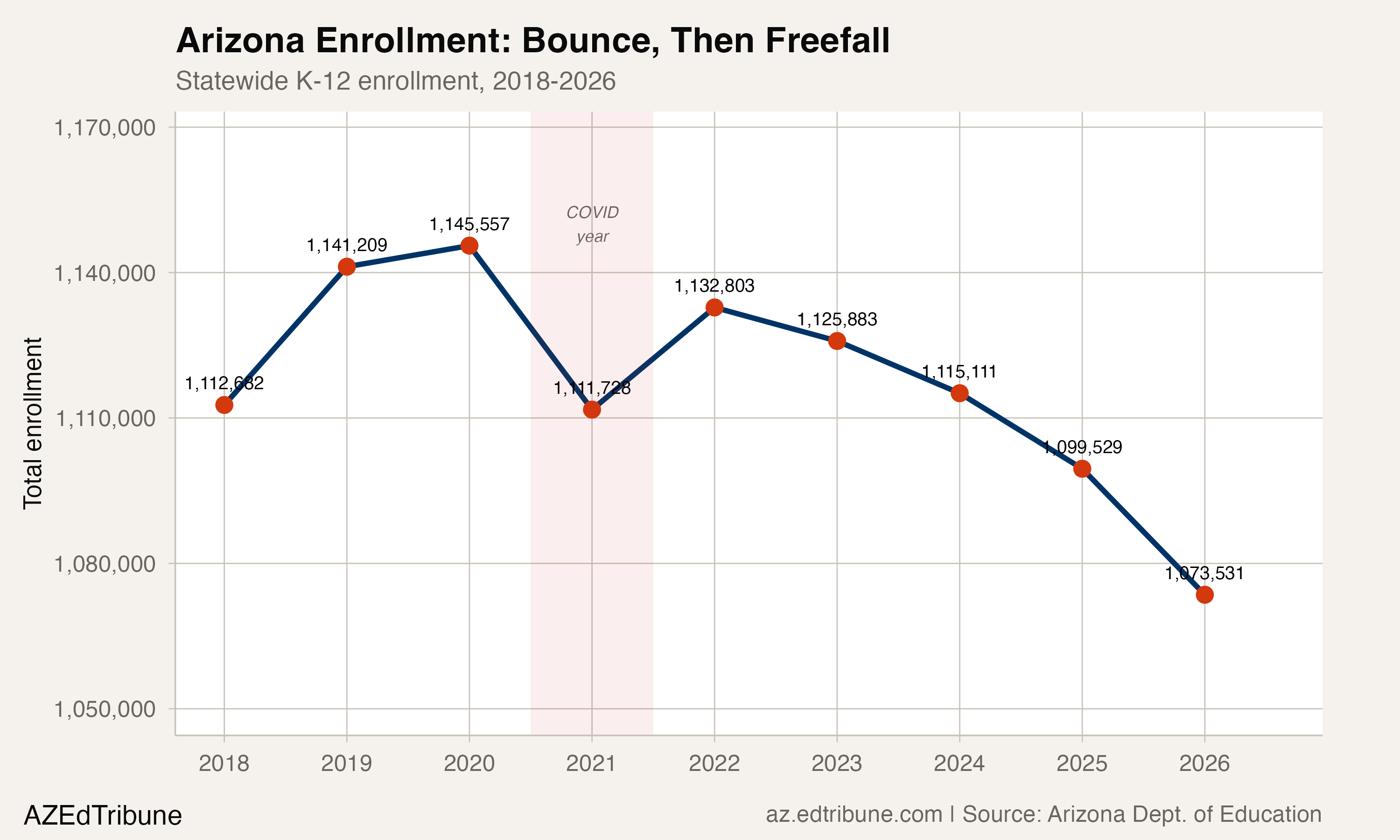
The bounce that wasn't
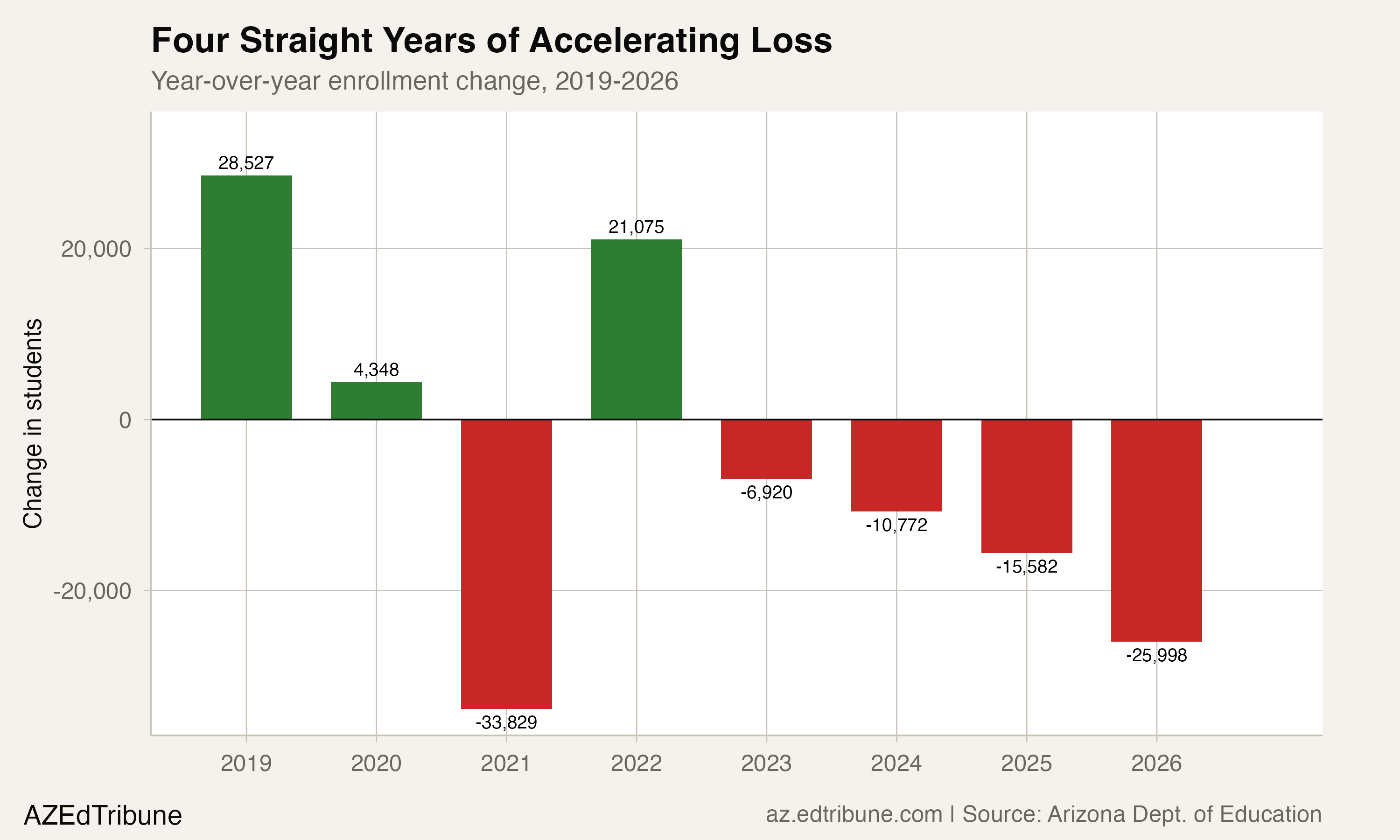
The post-COVID recovery lasted exactly one year. In 2022-23, enrollment dropped by 6,920. The next year: 10,772. Then 15,582. Then 25,998, the largest single-year loss outside the pandemic itself. The losses have accelerated by roughly half again each year. The 2025-26 decline of 25,998 students is the steepest non-pandemic decline in the dataset; only the 2020-21 COVID shock, when the state lost 33,829 students in a single year, was larger.
At the district level, the recovery picture is bleaker. Only 191 of 576 districts, 33.2%, have returned to their 2020 enrollment levels. That share peaked at 38.2% in 2024 before sliding backward. Nearly three out of four Arizona students now attend a district that is smaller than it was before the pandemic.
The damage is concentrated at the top. Among the 55 districts with 5,000 or more students in 2020, only 13, or 23.6%, have recovered. Every one of Arizona's 10 largest districts is smaller than it was before the pandemic. Together, those 10 lost 48,566 students, two-thirds of the statewide shortfall, on a combined base of roughly 365,000.
Where 71,505 students went
The arithmetic is lopsided. Districts that shrank lost a combined 133,473 students since 2020. Districts that grew added 61,968. The 71,505-student gap represents students who left the public enrollment system entirely, a population larger than Chandler Unified↗ET's current enrollment.
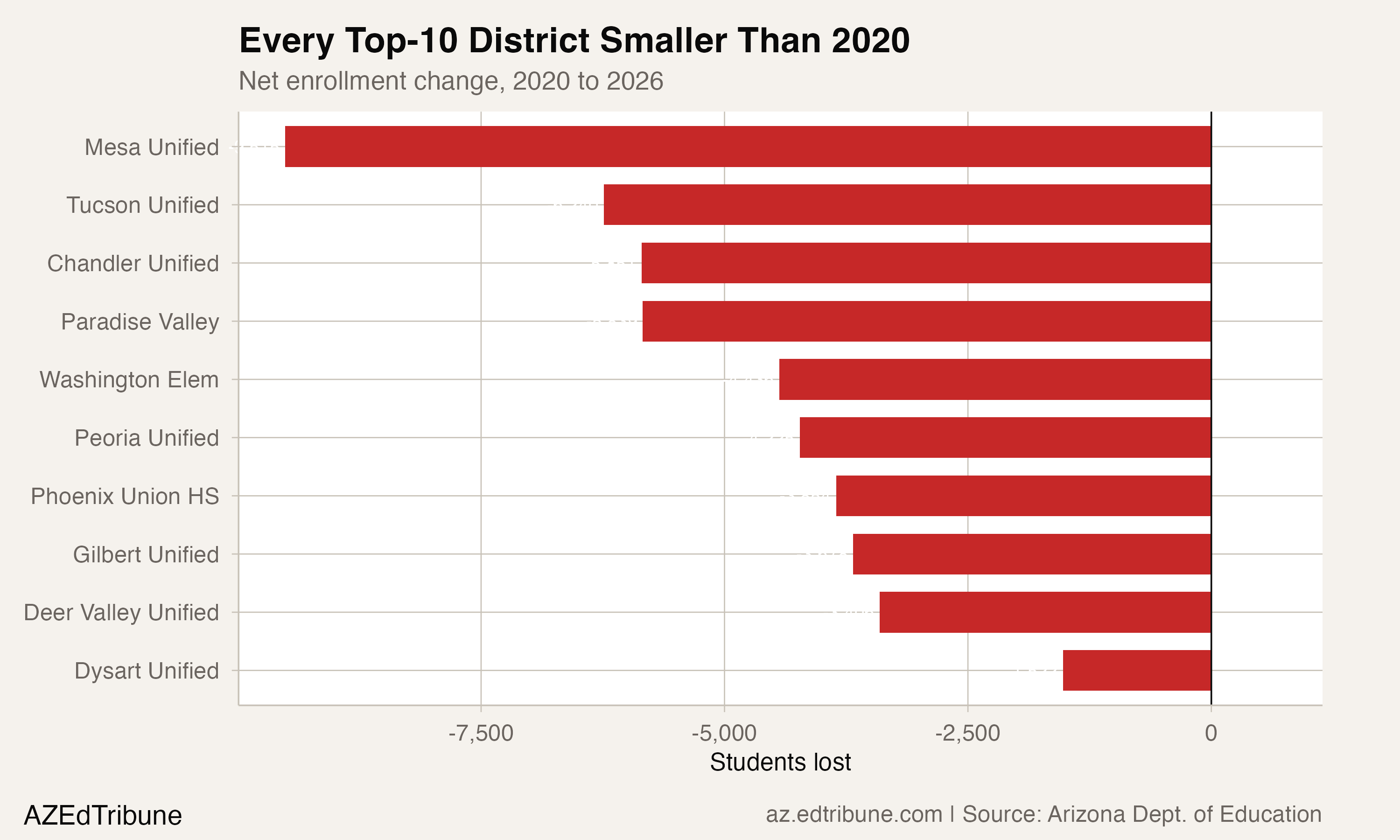
Mesa Unified↗ET leads the losses at 9,515 students, a 15.2% decline that forced the district to lay off 400 employees and plan another 150 position eliminations by the end of 2025-26. Tucson Unified↗ET lost 6,240 (13.8%), prompting Superintendent Gabriel Trujillo to tell his governing board in December that the district is in a fight for survival.
"We are in a do-or-die struggle for enrollment. We have to think big and we have to fire big." -- Tucson Unified Superintendent Gabriel Trujillo, AZ Luminaria, Dec. 2025
Chandler Unified (-5,851, -12.9%) and Paradise Valley Unified↗ET (-5,839, -18.9%) round out the top four. Washington Elementary↗ET, a K-8 district in central Phoenix, has lost nearly one in five students since 2020, a 19.8% decline that erased 4,436 seats.
Among the gainers, the names are telling. American Leadership Academy↗ET, a charter network, added 7,767 students (+77.9%). Queen Creek Unified↗ET, an outer-ring suburb absorbing new housing, added 5,998 (+63.7%). ASU Preparatory Academy Digital, a virtual school, grew from 611 to 4,277 students. The pattern: growth is concentrated in charters, virtual schools, and exurban communities on the metro fringe.
Falling off a cliff, or walking off one
Three forces are converging on Arizona's enrollment. The question that divides education politics in the state is which one matters most.
The most structurally durable factor is demographic. Arizona births peaked at over 102,000 in 2007 and have fallen 36% since then. Kindergarten enrollment in the state data has dropped from 81,305 in 2019-20 to 66,935 in 2025-26, a 17.7% decline that locks in smaller cohorts for the next 12 years. Glenn Farley of the Common Sense Institute Arizona has noted the pipeline effect.
"Every kindergarten class for the past decade has been smaller than the one before." -- Glenn Farley, Common Sense Institute Arizona, KJZZ, Jan. 2025
Mesa Public Schools has cited an 18% statewide decline in birth rates over the last decade and a 28% decline within the city of Mesa specifically.
The second force is Arizona's universal Empowerment Scholarship Account program. Since eligibility expanded to all students in 2022, participation has grown from roughly 12,000 to nearly 100,000 students, at an annual cost exceeding $1 billion. Between fiscal years 2024 and 2025 alone, more than 5,000 students left public district schools for the ESA program. However, roughly 71% of universal ESA participants were already in private school or homeschool before receiving the voucher, complicating any simple narrative about ESA as a drain on public enrollment.
The third force is charter expansion. The enrollment data cannot distinguish charter from traditional district students, but the top gainers list is suggestive: charter networks like American Leadership Academy and Academy of Mathematics and Science South account for several of the largest growth stories, even as traditional districts contract.
Birth rates alone do not explain why 2026's loss was nearly four times larger than 2023's. ESA alone does not explain it either, since 71% of voucher recipients were not in public schools to begin with. The most likely explanation is that all three forces are compounding, each one slightly accelerating the others, with no single factor dominant enough to reverse by addressing it alone.
The fell-back 77
Perhaps the most telling detail is what happened to districts that thought they had recovered. Of 209 districts that returned to their 2020 enrollment levels by 2022, 77 have since fallen back below the line. Phoenix Union High School District was 306 students above its pre-COVID mark in 2022. By 2026, it was 3,854 below it. Florence Unified, J.O. Combs Unified, and Glendale Union High School District followed the same arc: brief recovery, then sustained decline.
This fell-back cohort underscores that the bounce in 2022 was a return to school, not a return to growth. Families who came back after COVID closures did not stay, or were not replaced by the next cohort of kindergartners.
Closures and layoffs follow the money
Per-pupil funding follows students in Arizona. When enrollment drops, revenue drops the following year. An Arizona Auditor General report found that one-third of the state's school districts are now at "increased financial risk" due to declining enrollment and the funding losses that come with it.
The operational fallout is already visible. More than 20 Valley schools have closed or are closing since 2025. Kyrene Elementary District↗ET, down 24.2% since 2020, voted to close six schools over two years, projecting $5.8 million in annual savings to cover most of a $6.7 million budget shortfall. Paradise Valley Unified has already closed three campuses. Chandler Unified approved over 100 position cuts. Roosevelt Elementary District closed five schools in December 2025.
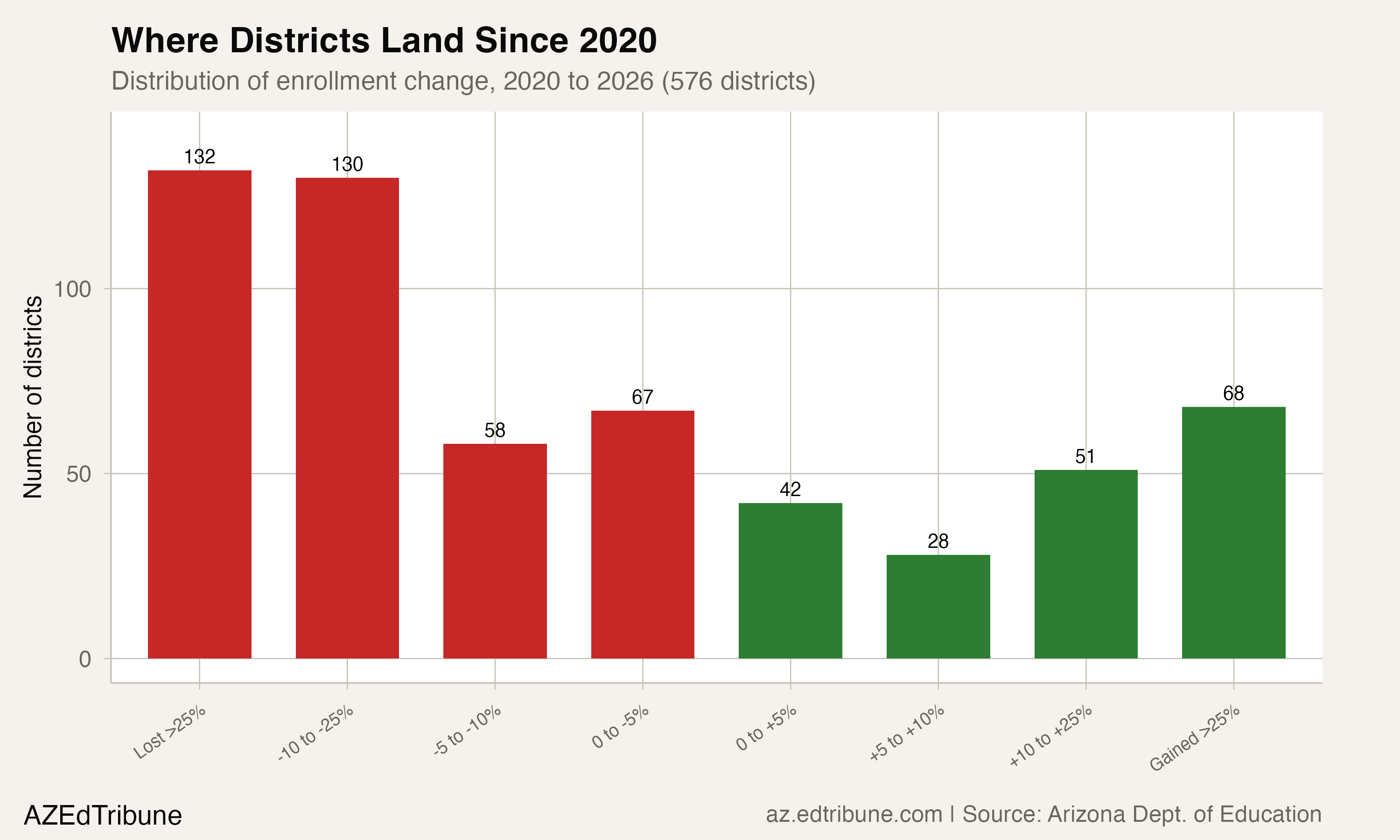
The distribution of outcomes is skewed heavily toward loss. Of 576 districts with data in both years, 385 lost enrollment. Among those, 262, nearly half of all Arizona districts, lost more than 10%. Only 189 districts grew at all, and about one in five of those gained less than 5%.
What the kindergarten pipeline signals
The state cannot outgrow its birth cohorts. Kindergarten enrollment has fallen every year since 2022's partial bounce, from 78,898 to 66,935 in 2025-26. Grade 12 enrollment, by contrast, peaked at 98,216 in 2024-25 before ticking down slightly to 98,012. Arizona is graduating far larger classes than it is enrolling. Until that pipeline inverts, total enrollment will continue to fall regardless of what happens with ESA, charter growth, or migration.
Arizona's largest districts are not waiting for enrollment to recover. They are planning for a system that will be permanently smaller, funded for fewer students, and operating in buildings designed for cohorts that no longer exist.
Detailed code that reproduces the analysis and figures in this article is available exclusively to EdTribune subscribers.
Discussion
Sign in to join the discussion.
Loading comments...