Part of the Arizona Enrollment SeriesET. Updated weekly.
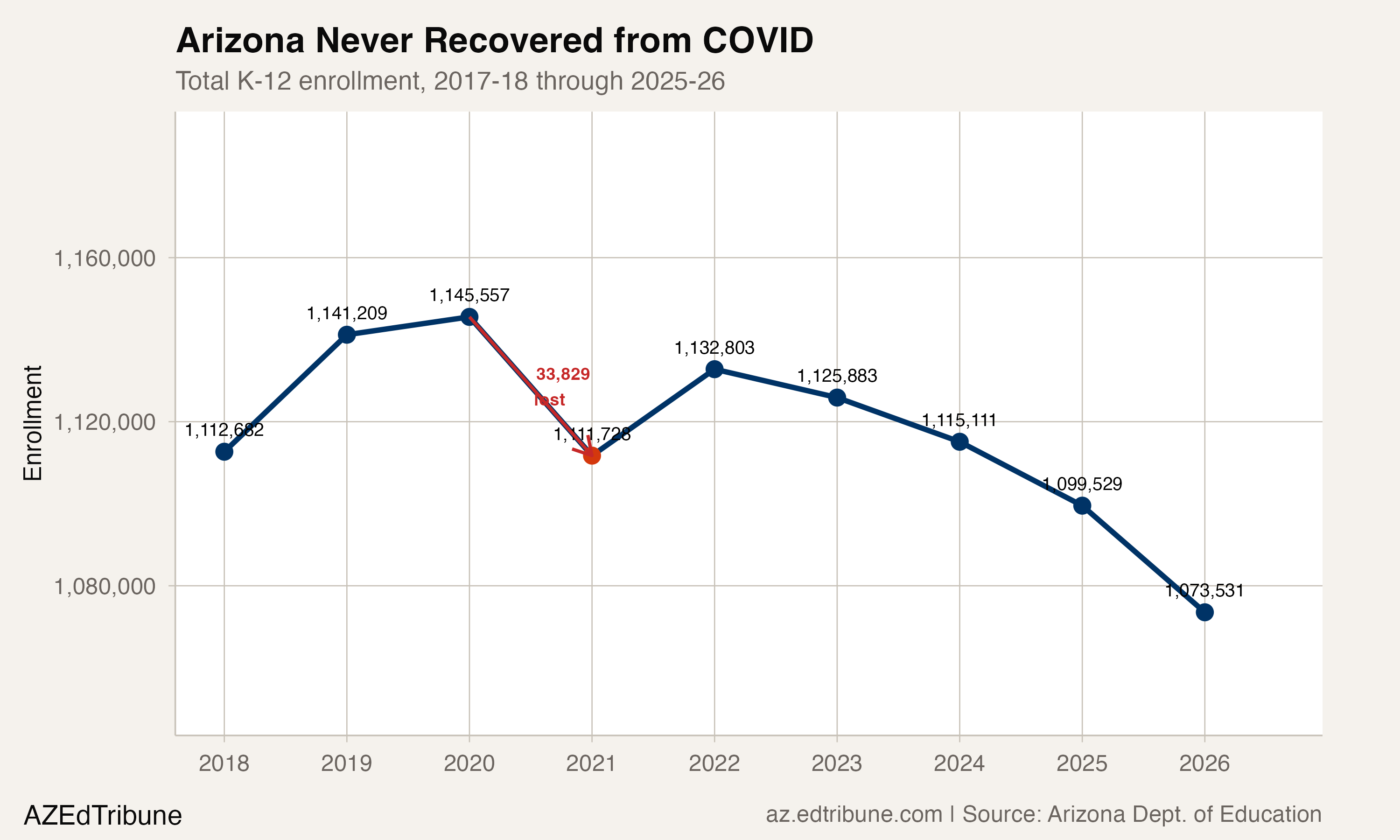
Between the 2019-20 and 2020-21 school years, Arizona lost 33,829 students, a 3.0% drop that wiped out the previous two years of growth in a single fall. It was the largest year-over-year loss in the state's enrollment data. But the pandemic shock, as severe as it was, is no longer the main story. The 2021-22 school year brought a bounce of 21,075 students that looked like the beginning of recovery. It wasn't. Since that bounce, Arizona has lost another 59,272 students, nearly twice the COVID loss itself. Enrollment now sits at 1,073,531, a level 72,026 students below the 2020 peak and falling at an accelerating rate.
The pandemic did not cause Arizona's enrollment crisis. It revealed one that was already forming and then made it permanent.
The shape of the shock
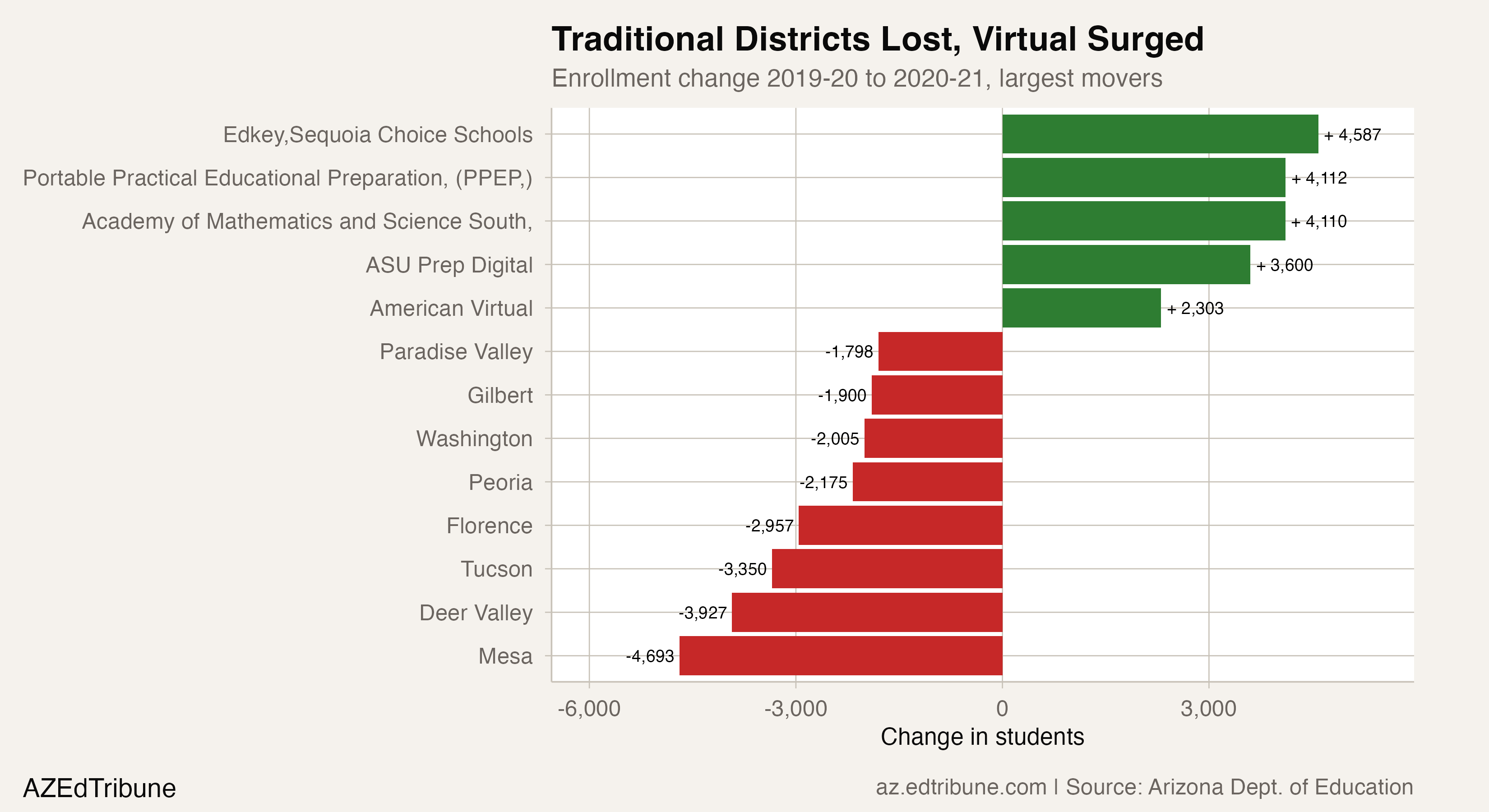
Arizona's enrollment hit 1,145,557 in 2019-20, the highest level in the available data. One year later it was 1,111,728. The loss of 33,829 students, 3.0% of enrollment, fell hardest on the state's largest traditional districts. Mesa Unified↗ET lost 4,693 students, 7.5% of its total. Deer Valley Unified↗ET lost 3,927, an 11.4% drop. Tucson Unified↗ET lost 3,350. Across the state, 453 of 654 districts reported fewer students.
The losses fell along a clean gradient of size. Eleven districts with 20,000 or more students collectively lost 24,053 students during the COVID year; 44 medium-sized districts lost 22,053. Small districts with 1,000 to 5,000 students actually netted 8,465 new students, as families fled large systems for smaller ones, or as virtual entities classified as small districts absorbed the overflow.
And there was a lot of overflow. Edkey/Sequoia Choice Schools went from 1,110 students to 5,697, a 413% surge. ASU Prep Digital went from 611 to 4,211. PPEP, a Tucson-based alternative education provider, added 4,042 students. Academy of Mathematics and Science South grew from 1,875 to 5,985. In total, a handful of virtual and digital entities absorbed more than 18,000 students during the COVID year.
The bounce that fooled everyone
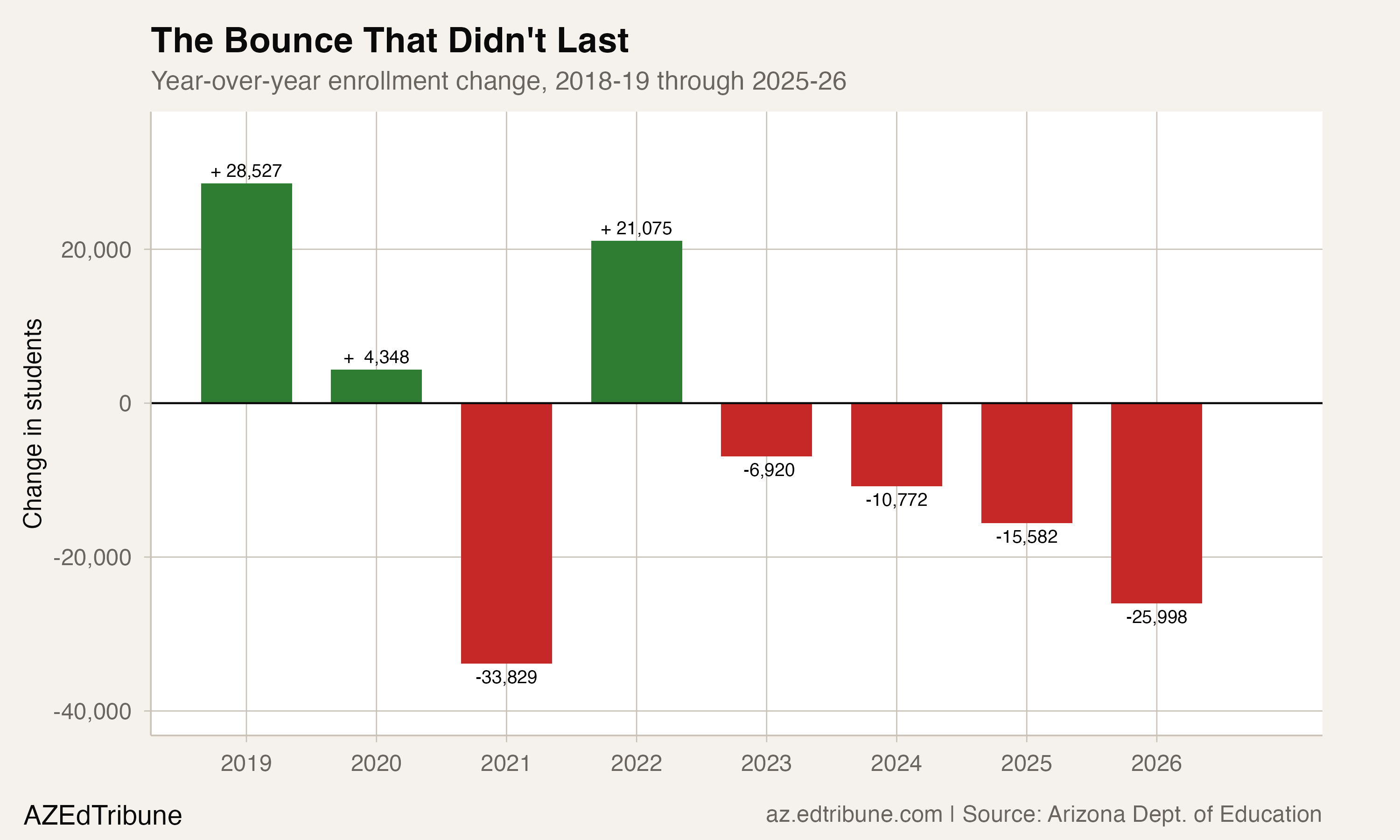
In 2021-22, enrollment jumped back by 21,075 students, recovering 62.3% of the COVID loss. The Arizona Department of Education credited its "Ready for School AZ" campaign for bringing families back. The headline numbers suggested the worst was over.
It was a false signal. Every year since the bounce has been negative, and the losses have accelerated: -6,920 in 2022-23, then -10,772, then -15,582, then -25,998 in 2025-26. The four post-bounce years together erased 59,272 students, 5.2% of the 2022 total and 75% more than the COVID shock itself.
Most of the virtual entities that surged during COVID gave their gains back. Edkey/Sequoia Choice fell from 5,697 back to 1,375 by 2025-26. Primavera Virtual Academy dropped from 7,030 to 4,483. Arizona Connections Academy went from 3,083 to 1,961. The students who left traditional districts during the pandemic did not simply return to traditional districts after it. Many left the public system entirely.
Where 72,026 students went
The gap between the 2020 peak and current enrollment did not open because of a single cause. At least three forces pulled students out of Arizona's public schools, and they reinforced each other.
The most structurally significant is demographic. Arizona's school-age population peaked in 2021 and is projected to decrease by 40,000 by 2028, according to the Common Sense Institute of Arizona, citing Census Bureau estimates. The children under five in Arizona fell from 455,375 in 2010 to 393,413 in 2022, a 14% decline. Kindergarten enrollment tracks this: Arizona enrolled 81,305 kindergartners in 2019-20, then 66,935 in 2025-26, a 17.7% drop that shows no sign of reversing.
The second force is school choice. Arizona expanded its Empowerment Scholarship Account program to all students in September 2022, and participation surged from 12,127 to 61,689 in a single year, a 409% increase. By January 2026, more than 100,000 students were using ESAs. The Learning Policy Institute found that 71.2% of universal ESA participants had not previously attended public school, meaning the program's primary fiscal effect was adding new state costs rather than transferring existing students. But the remaining 28.8%, roughly 17,700 students when the program hit 61,689 participants, did leave public schools. In Tucson, 3,300 families within TUSD's boundaries use ESAs to attend private schools, according to KGUN9.
The third is homeschooling, which surged nationally during the pandemic and has not fully receded. The Common Sense Institute reported that Arizona homeschooling jumped from roughly 2% to 11% of the student population during the pandemic before settling to approximately 6%.
No single force accounts for the full 72,026-student gap. The demographic decline was happening before the pandemic; school choice accelerated after it; homeschooling surged during it and partially stuck. The pandemic's role was catalytic: it forced families to make active enrollment decisions, and many of them decided not to come back.
78% of districts are still underwater
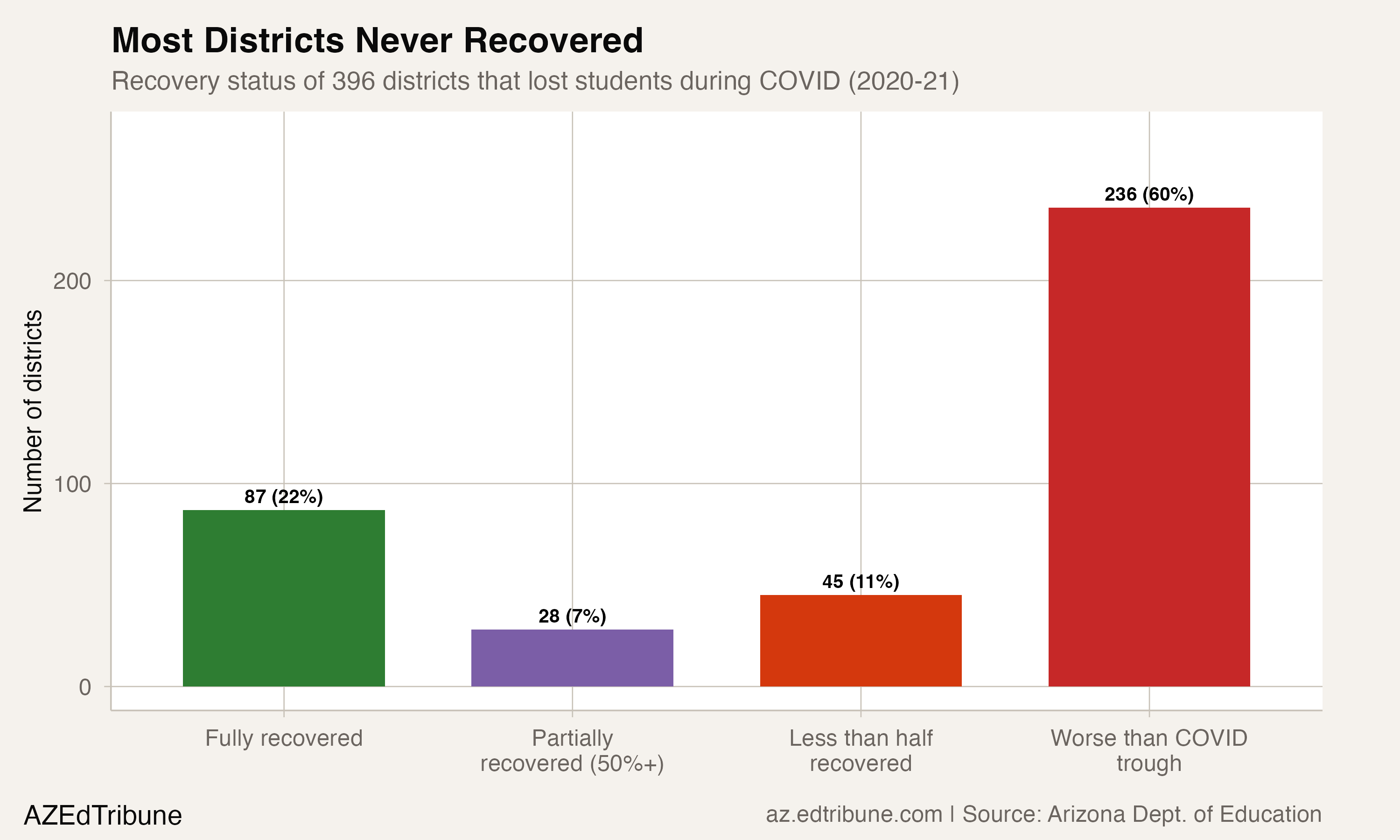
Of 396 districts that lost students during the COVID year and have data through 2025-26, only 87 (22.0%) have recovered to their 2020 levels. The remaining 309 are still below where they stood before the pandemic. Sixty percent, 236 districts, are now below even their 2021 COVID trough, meaning they have continued losing students every year since the pandemic hit.
None of the state's 10 largest traditional districts have recovered. Mesa Unified has gone from 62,490 in 2020 to 52,975 in 2026, a net loss of 9,515 students (15.2%). Paradise Valley Unified↗ET lost 18.9%. Washington Elementary↗ET lost 19.8%.
The fiscal consequences are landing now. Mesa Public Schools Superintendent Matt Strom told KJZZ in August 2025 that the district's student population had decreased by 3,400 over three years, with projections showing an additional 4,900-student decline over the next three:
"In the last three years, our student population has decreased by nearly 3,400 students. Projections for the next three years show a further decline of approximately 4,900 students." -- KJZZ, August 2025
Mesa eliminated nearly 400 positions in 2024, laid off 42 certified staff and cut 147 district-level positions in early 2025, and announced another 43 cuts in August. The projected budget shortfall runs between $9 million and $18 million. Nearly 90% of the district's budget goes to employee compensation, leaving almost no margin when per-pupil revenue drops.
Tucson Unified faces a similar trajectory: enrollment fell from 45,248 to 39,008 since 2020, and the district is projecting deficits reaching $21 million by fiscal year 2030 without structural changes.
The kindergarten signal
The kindergarten pipeline offers the clearest view of what comes next, and it is not encouraging. Arizona enrolled 81,305 kindergartners in 2019-20. In 2025-26, the number was 66,935, a drop of 14,370 students, 17.7%. The 2022 kindergarten bounce to 78,898 mirrored the overall enrollment bounce, but kindergarten has since fallen every year to its lowest level in the data.
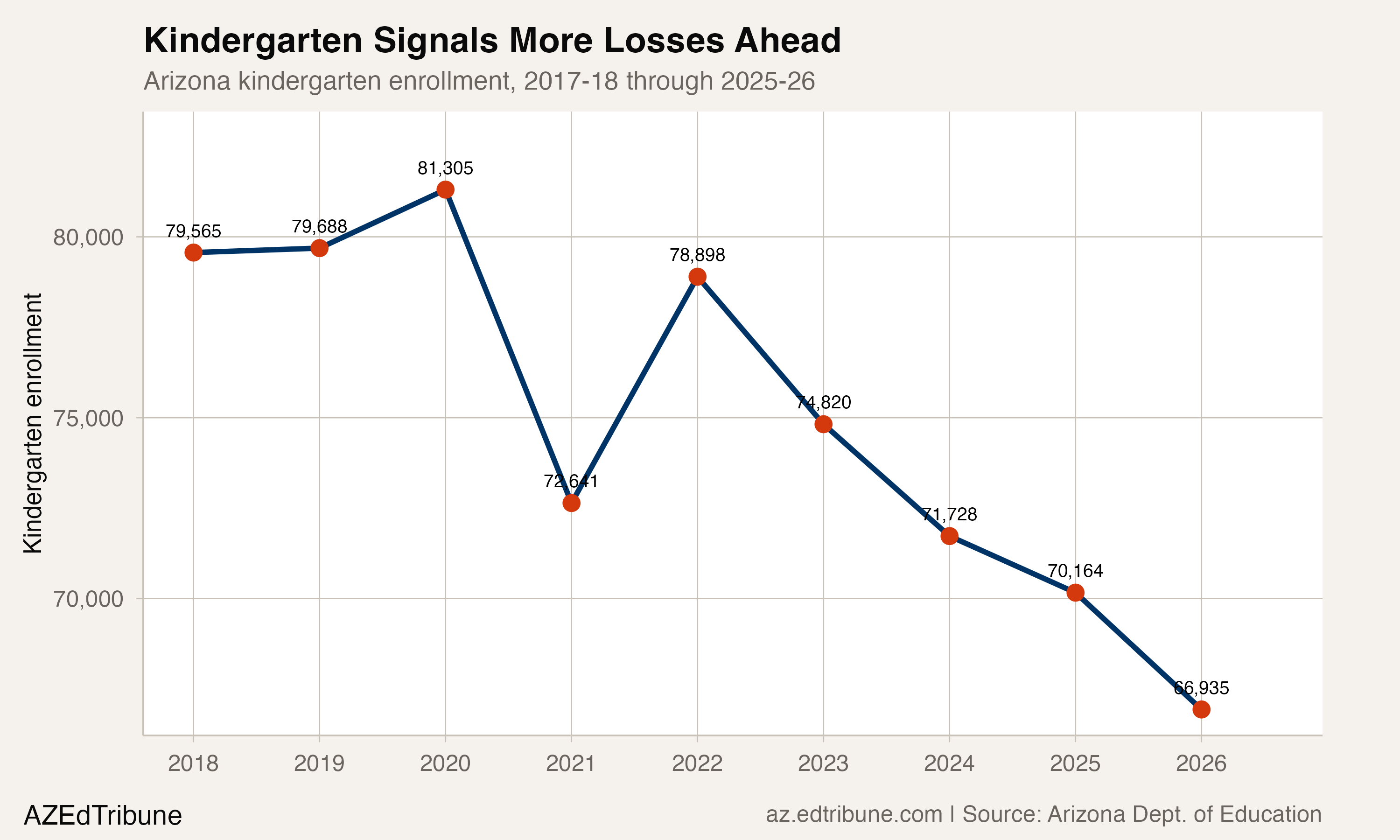
Each kindergarten cohort sets the ceiling for enrollment 12 years downstream. A class of 66,935 kindergartners in 2026 will become a class of roughly 66,000 or fewer seniors in 2038. If the decline continues at its current pace, Arizona's schools could be enrolling fewer than 60,000 kindergartners before the end of the decade, baking in total enrollment losses that compound for more than a decade.
The Common Sense Institute estimated that declining enrollment since 2020 has already reduced funding formula costs by $450 million per year compared to pre-pandemic trends, with cumulative savings exceeding $1.2 billion over four years. For taxpayers, that is a reduction in spending. For districts, it is the gap between the staff they have and the revenue to pay them.
The COVID shock was not the end of anything. It was the starting gun for a structural shift that has already cost 72,026 students. Superintendents who spent 2022 reassuring their boards can now see the trend line clearly enough to stop pretending it will reverse.
Detailed code that reproduces the analysis and figures in this article is available exclusively to EdTribune subscribers.
Discussion
Sign in to join the discussion.
Loading comments...