Part of the Arizona Enrollment SeriesET. Updated weekly.
Arizona gained 55,505 new residents from domestic migration in 2024, ranking fourth nationally. People are moving to the state. Their children, increasingly, are not showing up in public schools.
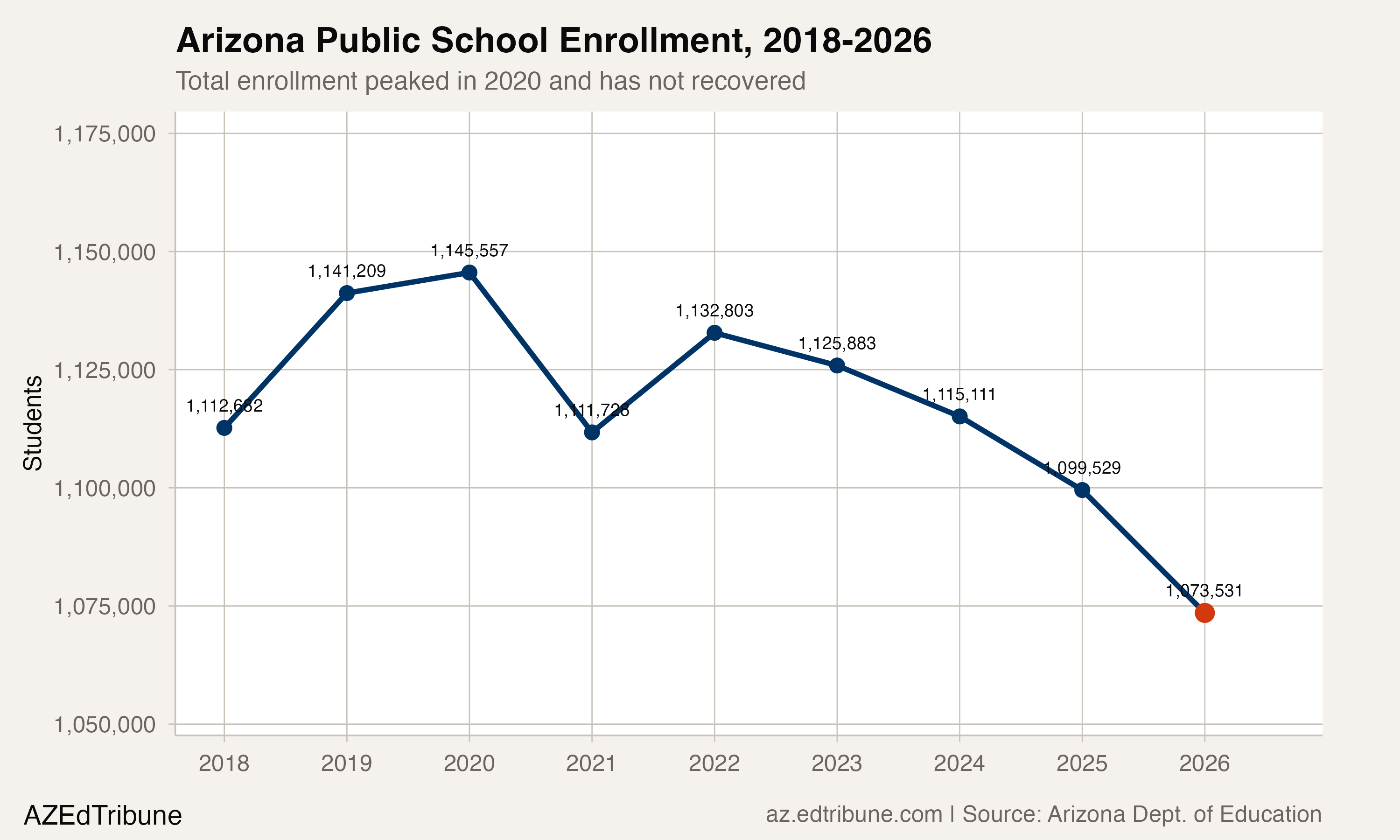
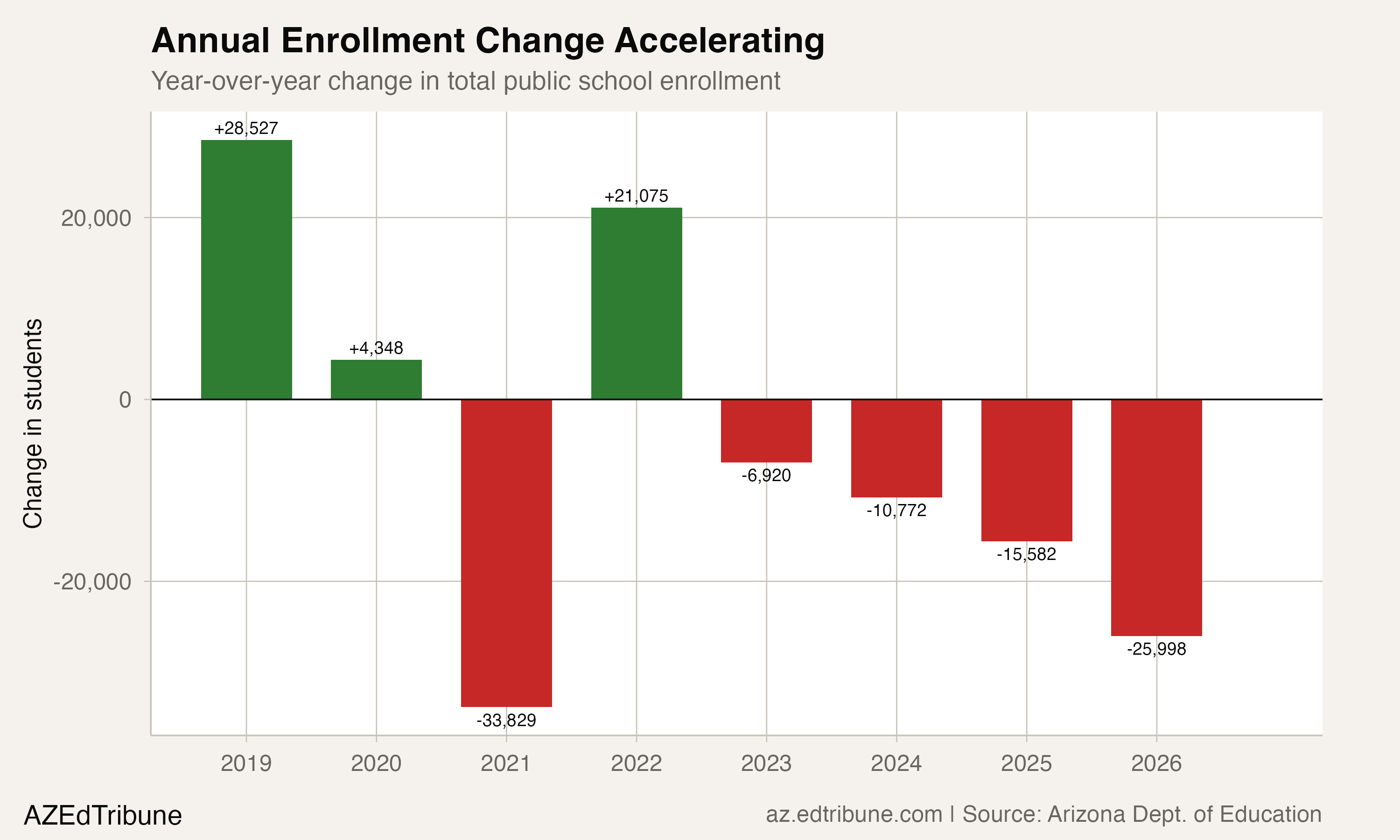
Total public school enrollment peaked at 1,145,557 in 2020 and has fallen to 1,073,531 in 2026, a loss of 72,026 students, or 6.3%. That alone would be notable. What distinguishes Arizona's trajectory from a routine post-pandemic slide is the rate at which the losses are growing: from 6,920 in 2023 to 10,772 in 2024 to 15,582 in 2025 to 25,998 in 2026. The most recent single-year loss is 3.8 times the size of the loss three years earlier.
Four years, no floor
The pattern since 2022 is unlike the COVID-era disruption. In 2021, enrollment plunged by 33,829 students, then bounced back the following year with a gain of 21,075. That recovery was brief. Since 2023, the state has lost 59,272 students across four consecutive years, and each year's loss has exceeded the one before.
Arizona spent $13.4 billion on K-12 education in fiscal year 2025, according to the Auditor General. Per-pupil funding follows enrollment, so those 72,026 missing students represent roughly $361 million in annual base funding that has evaporated from district budgets, using the state's FY2025 base of $5,013.33 per pupil. The operational consequences are no longer theoretical: 382 districts shrank in 2025-26, while only 213 grew.
The inner ring is hollowing out
The losses concentrate in the Maricopa County suburbs that defined Arizona's growth era. Mesa Unified District↗ET lost 9,515 students since 2020, a 15.2% decline. Tucson Unified District↗ET lost 6,240 (-13.8%). Chandler Unified District #80↗ET lost 5,851 (-12.9%). Paradise Valley Unified District↗ET lost 5,839 (-18.9%).
These are not small rural districts running out of families. Mesa enrolled 52,975 students in 2026. The most likely explanations are overlapping: aging neighborhoods where retirees have replaced school-age families, housing prices that push young families to outlying areas like Queen Creek and Maricopa, and a school-choice ecosystem that gives dissatisfied parents options their counterparts in other states lack.
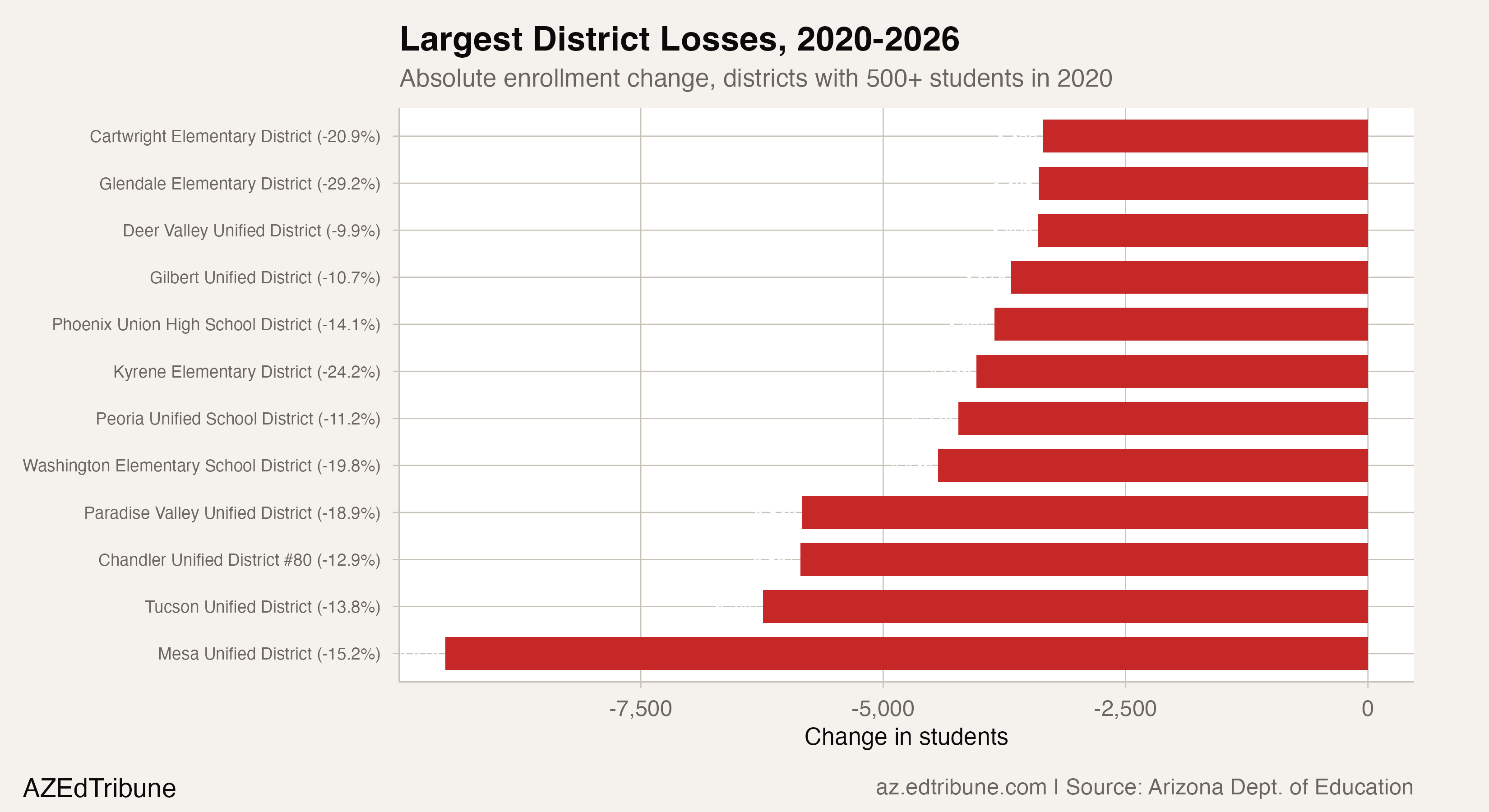
Eleven districts have declined in every one of the last eight years, including Paradise Valley, Cartwright Elementary, Alhambra Elementary, and Glendale Elementary. Kyrene Elementary District↗ET, which has lost students for seven consecutive years, voted in December 2025 to close six schools to offset a projected $6.7 million shortfall.
"They're just not going to be able to continue to operate if they don't close and divest themselves of some of these properties." -- Katie Ratlief, Common Sense Institute Arizona, March 2026
Kyrene is not alone. Roosevelt Elementary closed five schools. Isaac School District closed three. Scottsdale Unified announced two closures with up to six more planned. The Arizona Auditor General's January 2026 financial risk analysis found that 18 districts now meet the highest risk thresholds, up from nine the year before.
Demographics, vouchers, and the 'invisible hand'
Education historian Sherman Dorn has identified four factors driving Arizona's school closures: declining birth rates, school choice policies, pandemic aftereffects, and immigration enforcement. The enrollment data supports the first two most directly.
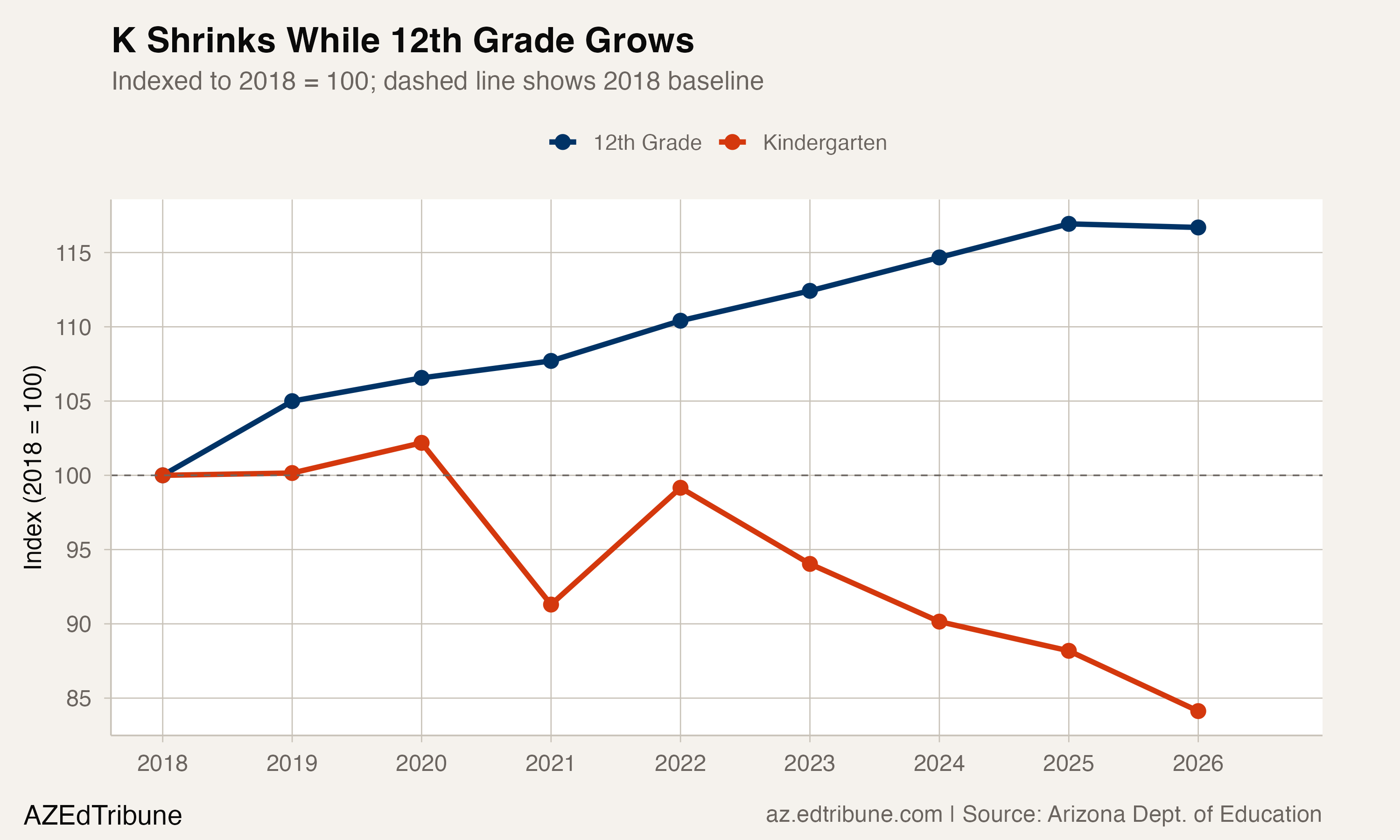
Fewer children are entering the pipeline. Arizona's birth rate fell 21.7% between 2007 and 2018, nearly double the national rate of decline. The children not born in 2014 are the kindergartners who did not arrive in 2020. Kindergarten enrollment has since dropped from 81,305 in 2020 to 66,935 in 2026, a 17.7% decline. Meanwhile, 12th-grade enrollment rose 16.7% over the same period, as larger cohorts born before the birth-rate collapse age through the system. This inversion guarantees that each graduating class will be replaced by a smaller entering one for years to come.
Students are leaving for alternatives that the data cannot fully track. Arizona's universal Empowerment Scholarship Account program, expanded in 2022, now serves 102,195 students as of March 2026. Between fiscal years 2024 and 2025 alone, more than 5,000 students left district schools to enroll in the ESA program. Because Arizona's enrollment data does not flag charter schools separately, the public enrollment figures cannot distinguish traditional district schools from charters. ESA recipients attend private schools outside the public enrollment count entirely. The visible losses in district enrollment likely understate the shift in where families are choosing to send their children.
A third, harder-to-measure factor emerged in late 2025: immigration enforcement. Dorn noted that ICE raids have caused families to withdraw students from schools, though the scale is impossible to quantify from enrollment files alone.
A demographic transformation underneath the decline
The enrollment losses are not evenly distributed across racial and ethnic groups. White enrollment has fallen by 76,162 students since 2018, an 18.0% decline that accounts for nearly all of the net loss. Hispanic enrollment, by contrast, grew by 20,001 over the same period (+3.9%), pushing Hispanic students to 49.2% of total enrollment in 2026. White students now make up 32.3%, down from 38.0% in 2018.
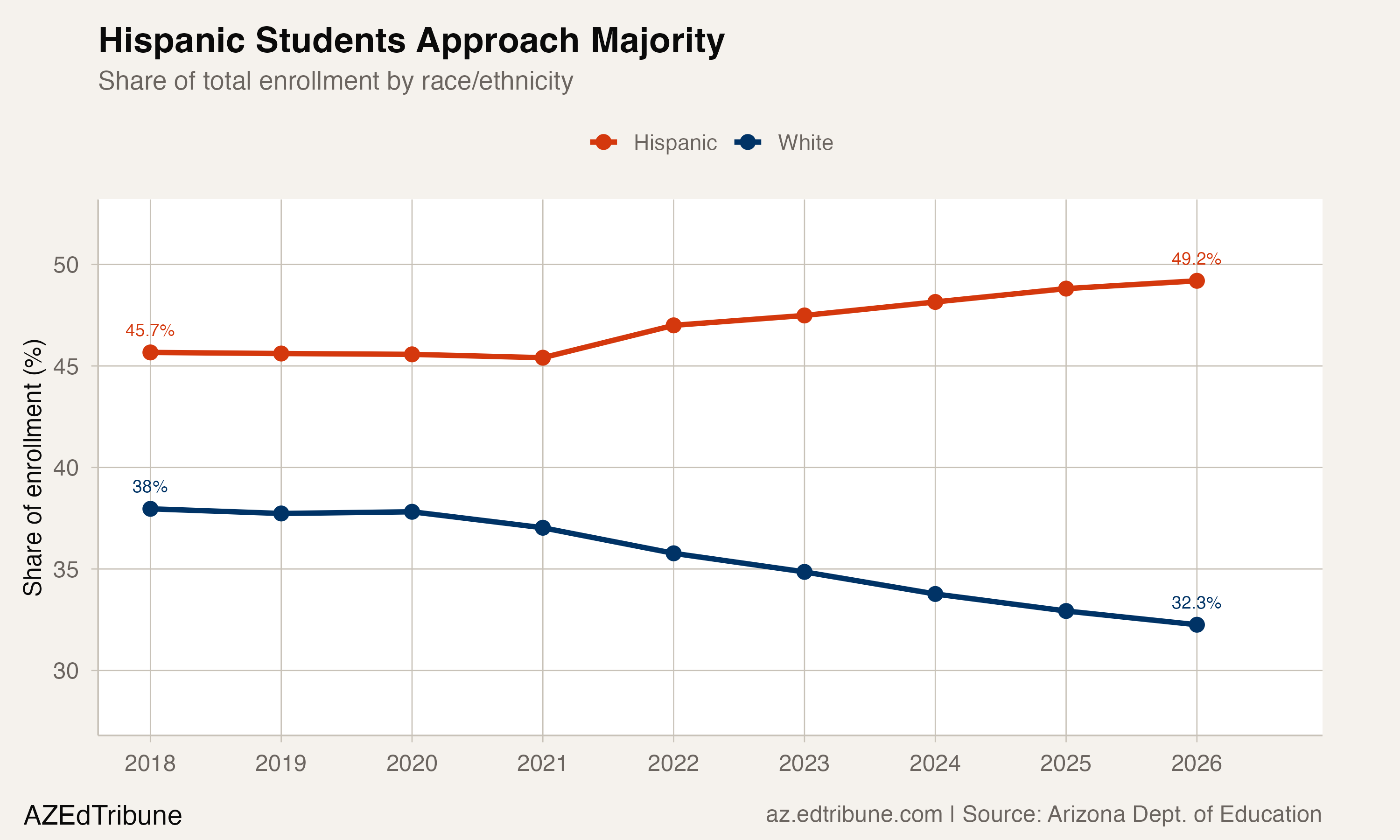
At the current rate, Hispanic students will constitute a majority of Arizona's public school enrollment within the next two to three years. This shift has implications for instructional programs, particularly bilingual education and English learner services, even as total enrollment contracts.
What to watch
Only 33.2% of Arizona districts have matched or exceeded their 2020 enrollment levels. That means two-thirds of the state's districts are operating at lower enrollment than six years ago. The Common Sense Institute estimates that district schools hold $12.2 billion in excess building capacity, enough to cover a decade of capital expenditures if divested.
The state's 2025-26 decline of 25,998 students, a 2.4% drop, is the largest non-pandemic loss in the data and nearly as large as the 2022 rebound that briefly suggested recovery was possible. If the acceleration holds, Arizona will fall below one million public school students before the end of the decade. Superintendent Tom Horne and the legislature have so far deferred the structural decisions that number demands.
Detailed code that reproduces the analysis and figures in this article is available exclusively to EdTribune subscribers.
Discussion
Sign in to join the discussion.
Loading comments...