Part of the Arizona Enrollment SeriesET. Updated weekly.
In the Amphitheater Unified District north of Tucson, the superintendent recently told families something they could verify by counting desks: this year's kindergarten class is half the size of the graduating senior class. If current trends hold, he warned, the district will shrink from 10,500 students to 5,250 within 11 years.
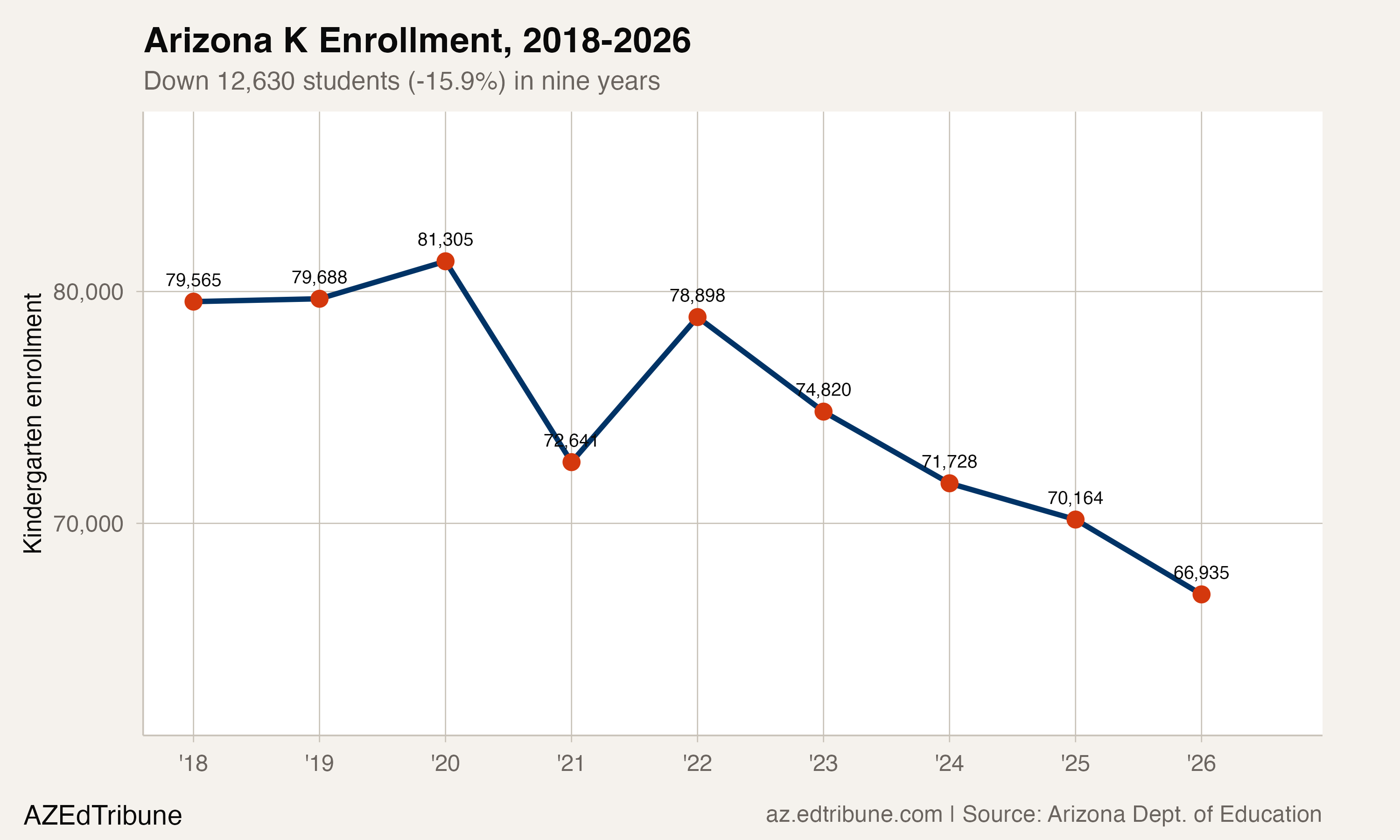
Amphitheater is not an outlier. Statewide, Arizona enrolled 66,935 kindergartners in 2025-26, down from 79,565 in 2017-18. That is a 15.9% decline, equivalent to emptying roughly 505 classrooms at 25 students each. Every one of those missing kindergartners represents 12 more years of missing enrollment as the gap advances through the system.
The shape of the collapse
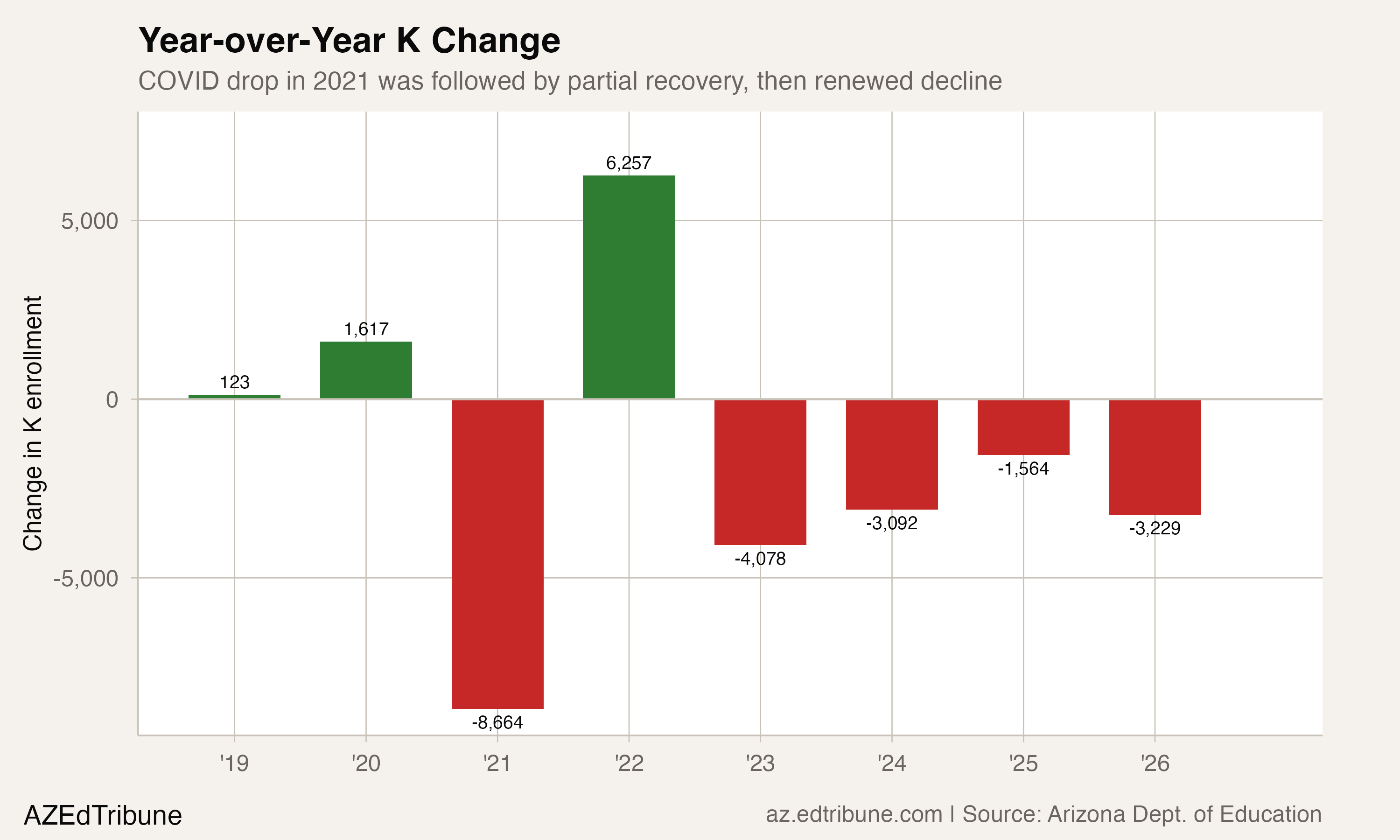
The decline was not steady. Kindergarten enrollment held flat near 80,000 from 2017-18 through 2019-20, then cratered by 8,664 students (10.7%) during the first pandemic year. A partial bounce-back in 2021-22 brought 6,257 students back to 78,898, but the recovery proved temporary. Since then, K enrollment has fallen every year: by 4,078 in 2022-23, by 3,092 in 2023-24, by 1,564 in 2024-25, and by 3,229 in 2025-26.
The cumulative post-peak loss is even steeper than the 2018 baseline suggests. Compared to the 2019-20 high of 81,305, kindergarten enrollment has dropped 17.7%, or 14,370 students.
Arizona's kindergarten class now represents just 6.2% of total statewide enrollment, down from 7.2% in 2017-18. That shrinking share matters for budgeting: kindergarten is where per-pupil funding enters the system for most families, and a smaller entry point means less money flowing into district budgets in subsequent years.
Fewer births, more exits
The most straightforward explanation is demographic. Arizona births peaked at 102,687 in 2007 and have declined sharply since, falling to roughly 78,000 by the early 2020s. That 24% drop in births translates directly into smaller kindergarten cohorts five and six years later. Arizona experienced the second-largest fertility rate decline of any state from 2005 to 2023, a 32.8% drop.
But birth rates alone cannot explain why the decline accelerated after COVID. The universal expansion of Arizona's Empowerment Scholarship Account program in 2022 gave every family access to public funding for private school tuition. Participation grew from roughly 12,000 students to nearly 90,000 by 2024-25, with program spending reaching $886 million. Kindergarten is the most common entry point for school choice decisions, and the ESA expansion gave families a new off-ramp from public schools at precisely the age when enrollment begins.
A third factor is the state's charter sector, which enrolled 231,703 students across roughly 580 schools as of 2024, representing 21% of public school enrollment. Charter schools compete most directly with traditional districts for kindergarten-age students, particularly in the Phoenix metro area where options are densest.
The relative weight of these three forces is difficult to isolate. Research from the Learning Policy Institute found that 71% of universal ESA recipients did not previously attend a public school, suggesting the program's impact on public enrollment is smaller than the headline participation numbers imply. Competition between public schools, as the Goldwater Institute's Matt Beienburg has argued, "significantly outpaces enrollment loss" from the ESA program. Still, at kindergarten, where families are making their first school choice, even marginal shifts compound over 13 years.
A pipeline running backward
The enrollment staircase inside Arizona's schools reveals the problem's full scale. In 2025-26, here is what each elementary grade looks like statewide: fifth grade has 79,416 students, fourth grade 81,280, third grade 77,696, second grade 73,800, first grade 72,156, and kindergarten 66,935. Each step down the staircase is smaller. When this year's fifth-graders leave elementary school and this year's kindergartners take their place, elementary enrollment will contract by another 12,481 students even if kindergarten enrollment holds exactly flat.
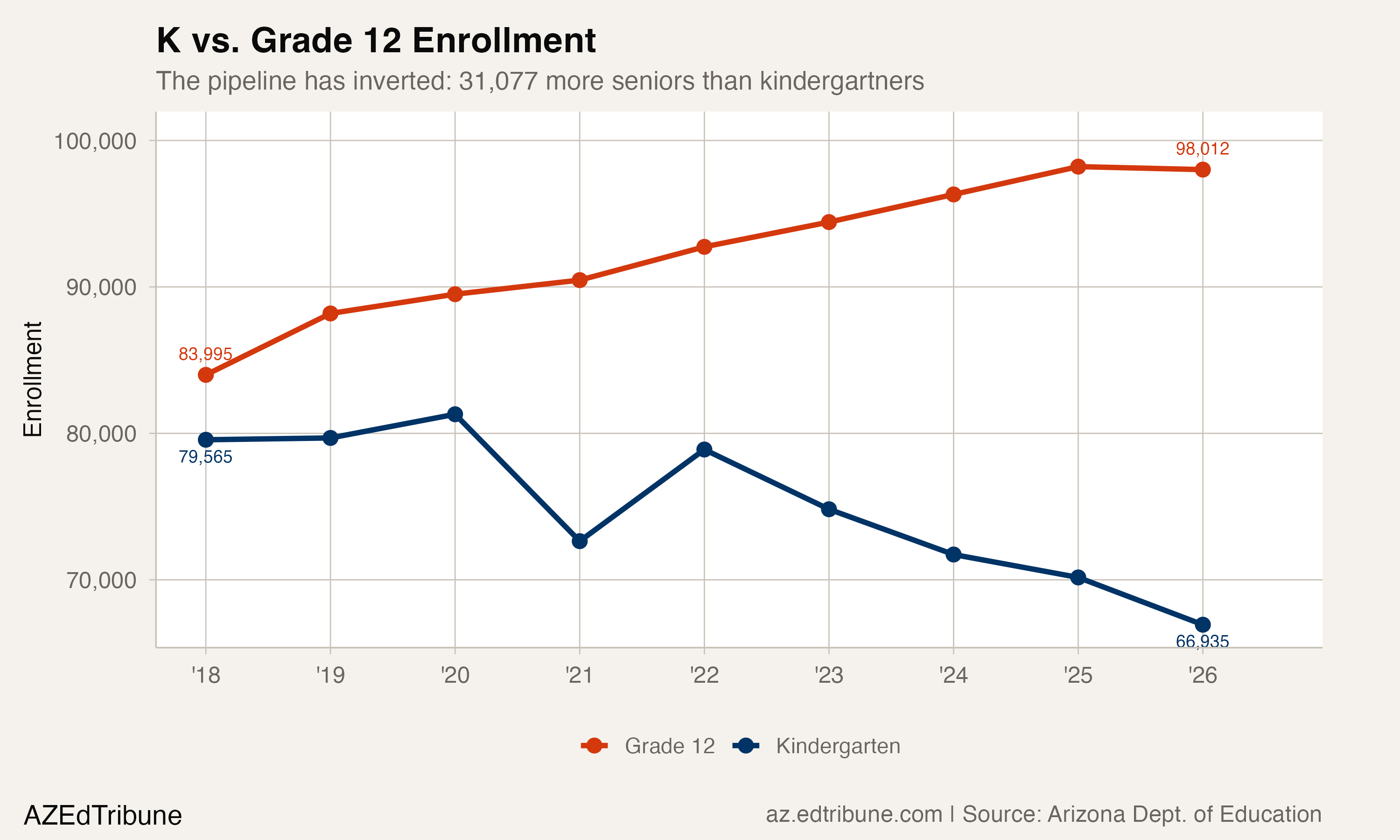
This structural math extends across the full K-12 system. Arizona now has 31,077 more seniors (98,012) than kindergartners (66,935). In 2017-18, the gap was just 4,430. The K-to-G12 ratio has fallen from 0.95 to 0.68.
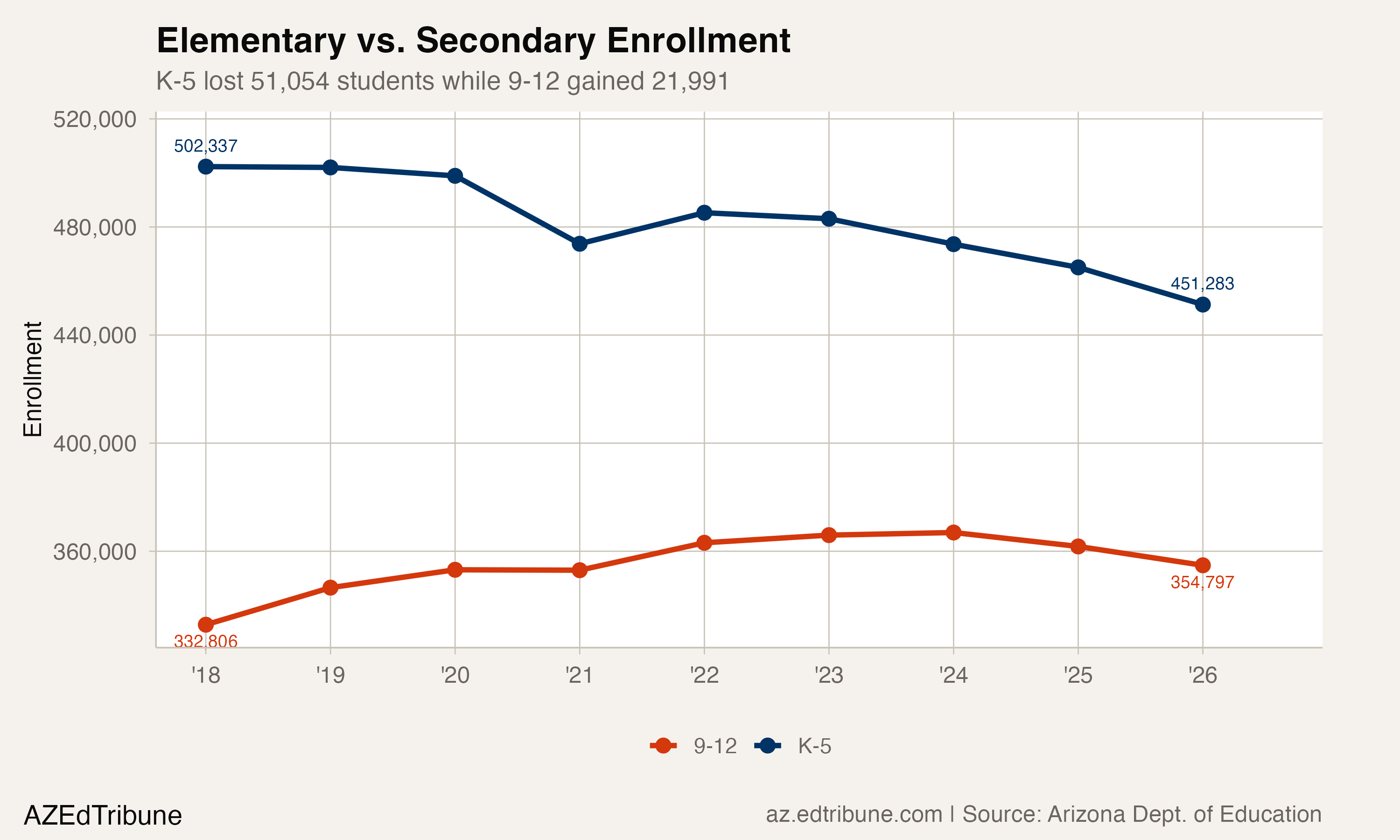
Statewide, grades K through 5 enrolled 451,283 students in 2025-26, down 51,054 (10.1%) from 502,337 in 2017-18. Over the same period, grades 9 through 12 grew from 332,806 to 354,797, adding 21,991 students (6.6%). The two bands are converging, and kindergarten's continued decline means the elementary pool will keep shrinking for years.
Where the classrooms emptied
The kindergarten losses are concentrated in Arizona's largest and most established districts. Mesa Unified District↗ET lost 1,464 kindergartners since 2017-18, a 32.6% decline from 4,487 to 3,023. Chandler Unified District #80↗ET lost 902 (31.9%). Paradise Valley Unified District↗ET lost 690 (31.0%). Kyrene Elementary District↗ET lost 565 (35.2%).
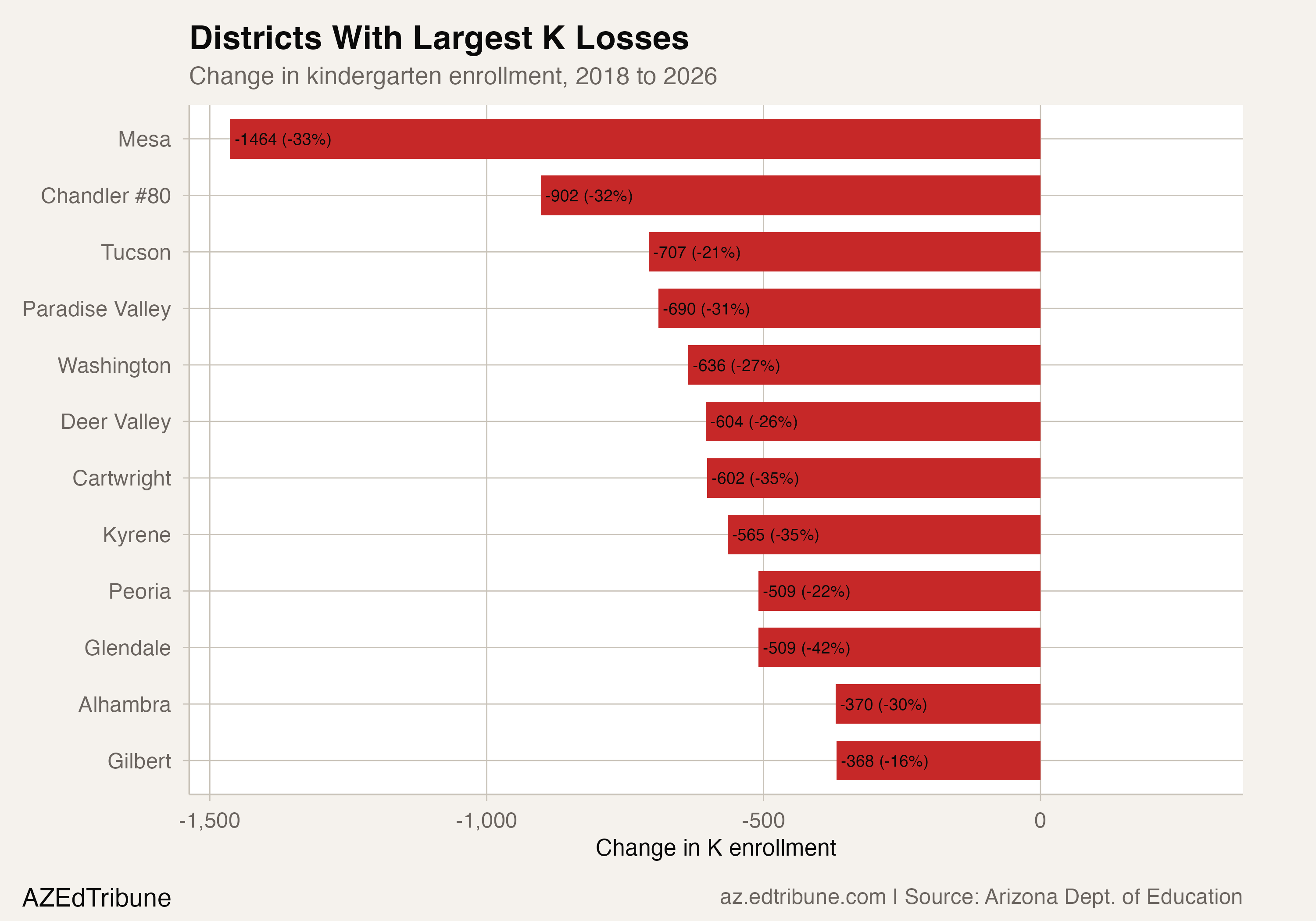
Among districts with at least 100 kindergartners in 2017-18, 88 lost students and only 24 gained. The losses totaled 16,609 students; the gains totaled just 2,730.
Kyrene offers a preview of what the kindergarten collapse means operationally. The district is closing six schools over the next two years to address a projected $6.7 million budget shortfall driven by a 19% enrollment decline since 2019. At least eight other Arizona districts have announced closures or consolidations for 2025-26 or later, including Roosevelt (five schools), Phoenix Elementary (two), Cave Creek Unified (two), Isaac School District (two), and Paradise Valley (three).
"$7 million was spent last year on things like keeping the lights on and the AC running in rooms that were not being used." -- AZPM, Dec. 2025
That was the Amphitheater superintendent describing the cost of maintaining buildings designed for students who no longer exist.
What the K number foretells
One piece of the data provides a rough measure of how completely the kindergarten drop translates into system-wide decline: the K-to-first-grade retention rate. In most years, Arizona's first-grade class the following fall is 2-4% larger than the preceding kindergarten class, reflecting late enrollees and transfers into the state. The 2024-25 kindergarten class of 70,164 became a first-grade class of 72,156 in 2025-26, a 2.8% gain. The pipeline does not leak. It faithfully transmits the kindergarten signal forward.
That means the 2025-26 kindergarten class of 66,935 will produce a first-grade class of roughly 68,800 next fall. The year after that, this cohort becomes a second-grade class of roughly the same size, replacing a second-grade class that currently numbers 73,800. The mechanical loss: approximately 5,000 fewer students in that grade alone.
One-third of Arizona's 207 school districts now face "increased financial risk" tied to enrollment declines, according to the Common Sense Institute Arizona. The state still has 50% more seats in district schools than it has students to fill them. That excess capacity carries a cost, estimated at $1 billion annually in facility maintenance alone, that compounds the per-pupil revenue loss.
The 2012 kindergarten cohort, the state's largest ever, graduated in spring 2026. When those seniors walked out, they were replaced by a kindergarten class more than 31,000 students smaller. The pipeline does not reverse. It just keeps delivering.
Detailed code that reproduces the analysis and figures in this article is available exclusively to EdTribune subscribers.
Discussion
Sign in to join the discussion.
Loading comments...