Part of the Arizona Enrollment SeriesET. Updated weekly.
Arizona's 12th grade class has been larger than its 11th grade class every year since 2018. Not once in nine years of data has a cohort of juniors shrunk on its way to senior year. Instead, it grew, by an average of 10.1%, producing a 12th grade that now enrolls 98,012 students, 31,077 more than the state's kindergarten class.
At the other end of the building, kindergarten enrollment has fallen four consecutive years to 66,935, the lowest in the nine-year dataset, a 15.9% decline from 2018. The two ends of Arizona's K-12 system are moving in opposite directions, and the consequences are arriving faster than most districts anticipated.
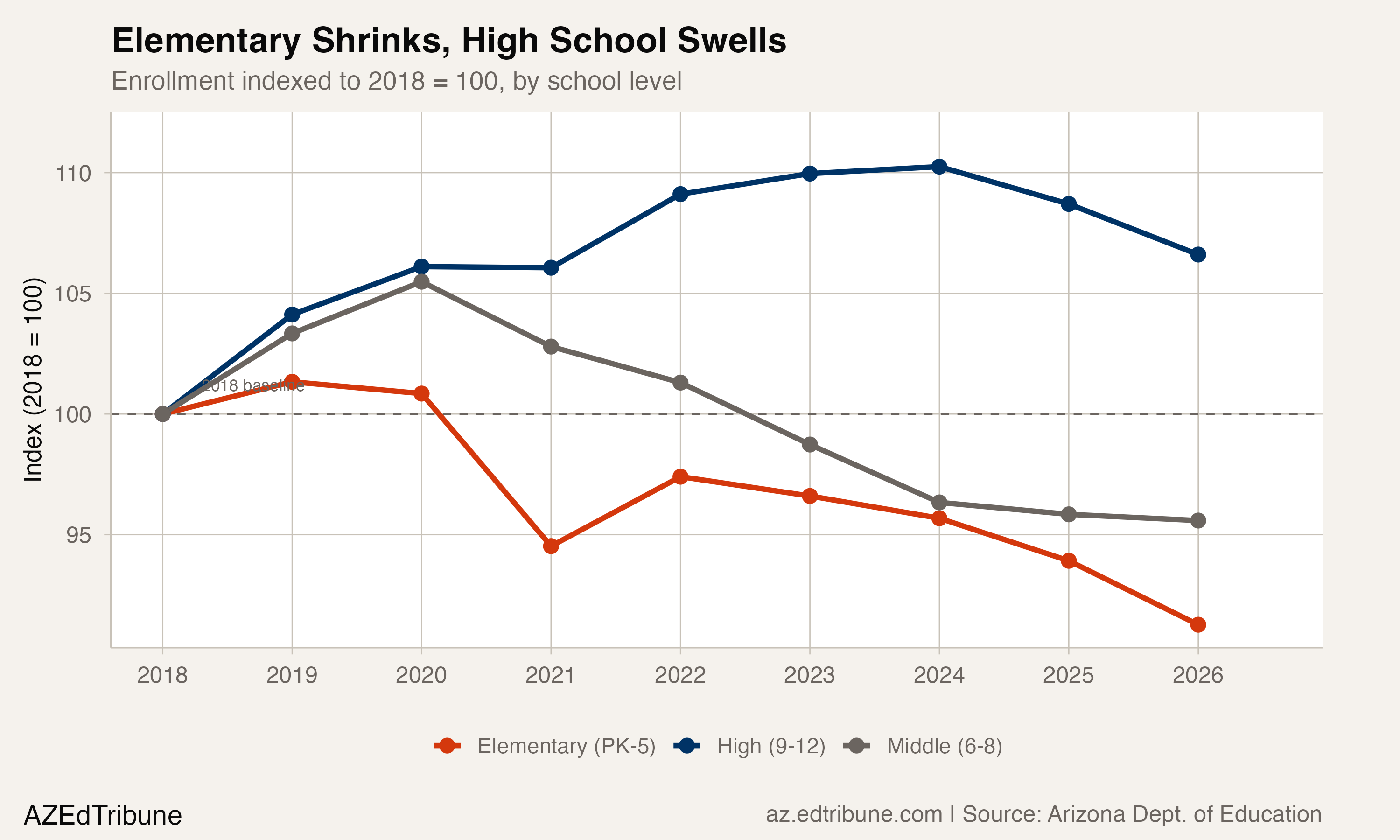
The shape of the inversion
The pattern is clean enough to read at a glance. Elementary enrollment (PK through 5th grade) fell from 516,257 in 2018 to 471,184 in 2026, a loss of 45,073 students, or 8.7%. Excluding the volatile pre-K category, the K-5 decline is steeper: 502,337 to 451,283, a 10.2% drop. Middle school (grades 6-8) lost 11,433 students over the same period, a 4.4% decline. High school (grades 9-12) gained 21,991, a 6.6% increase.
The net result: Arizona lost 34,515 students across all grade levels while its overall enrollment fell from 1,112,682 to 1,073,531, a 3.5% decline. High school growth masked roughly a third of the loss happening in younger grades.
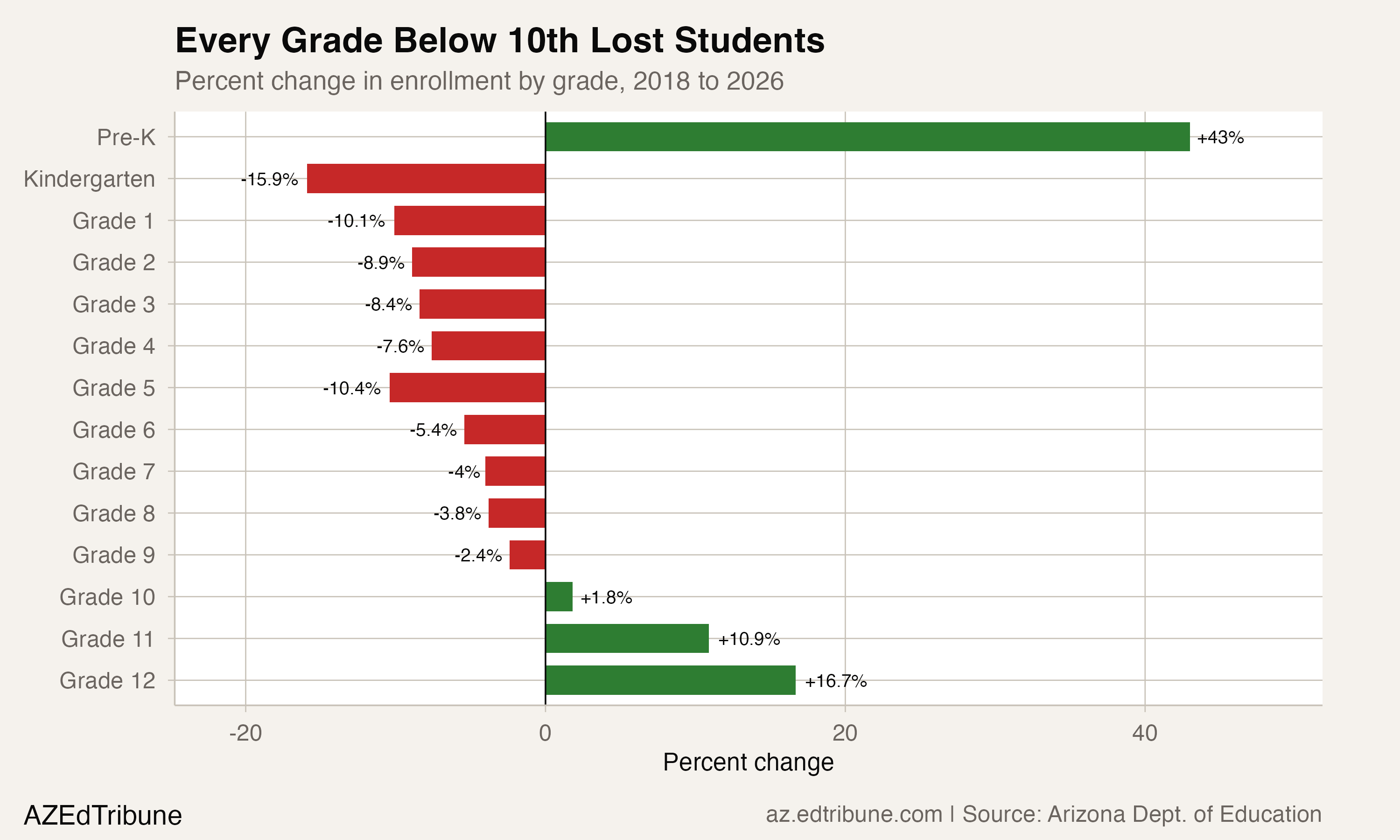
Every individual grade from kindergarten through 9th lost enrollment since 2018. Only three grades grew: 10th (+1.8%), 11th (+10.9%), and 12th (+16.7%). The gradient is remarkably consistent. Loss deepens at every step down the grade ladder, from -2.4% in 9th grade to -15.9% in kindergarten.
The 12th grade anomaly
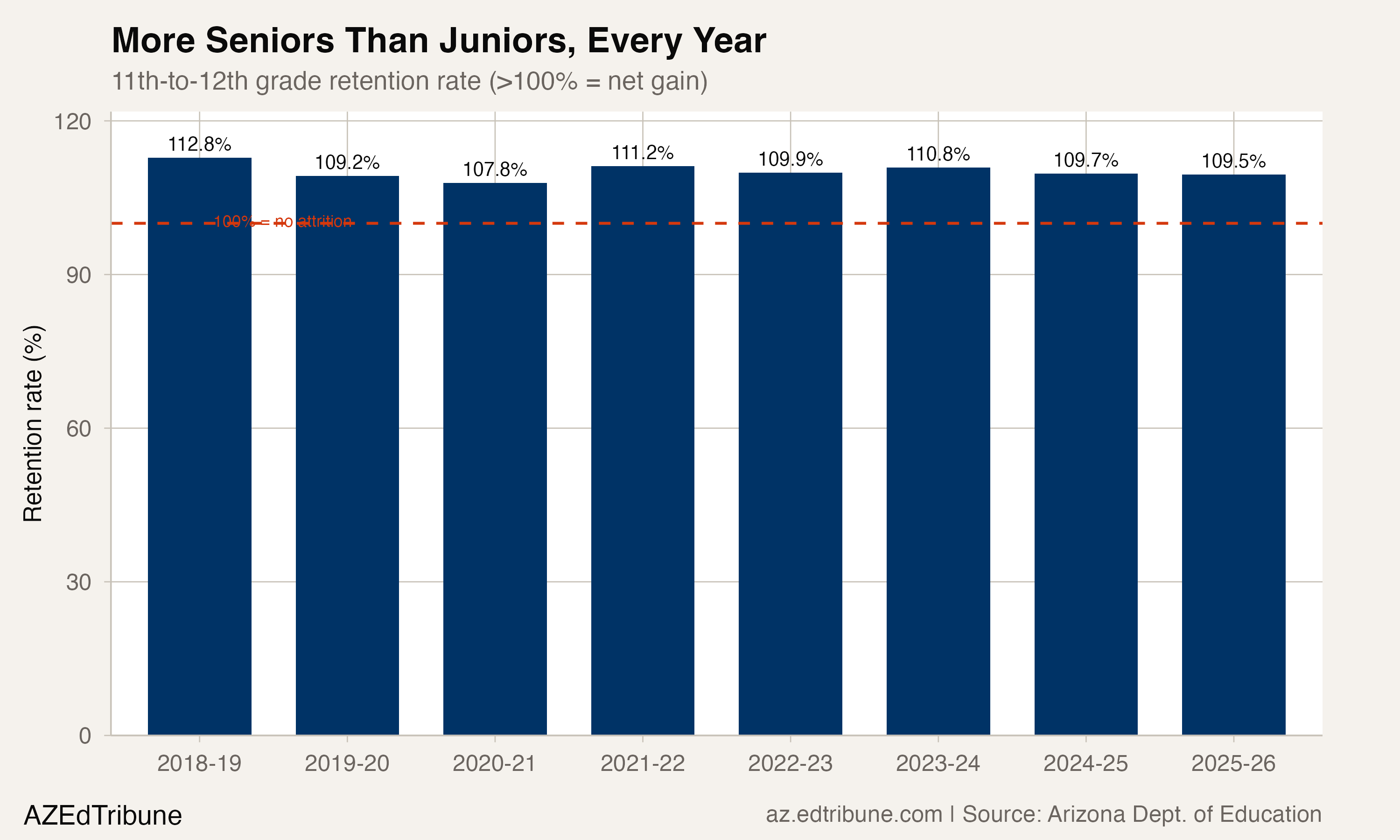
The most striking number in the dataset is not a decline. It is the persistent surplus of seniors over juniors.
In a stable system, a cohort of 11th graders should produce a slightly smaller 12th grade class the following year, as some students drop out, transfer, or leave the state. Arizona's data shows the opposite. The 11th-to-12th retention rate has exceeded 100% every year in the dataset, ranging from 107.8% (2020-21) to 112.8% (2018-19), with an average of 110.1%.
Over eight measured transitions, Arizona's 12th grade enrolled a cumulative 68,552 more students than the prior year's 11th grade would have predicted. That surplus, roughly 8,500 extra seniors per year, is not a small accounting artifact. It is structurally embedded in the system.
Several mechanisms could produce this pattern. Credit recovery programs, which allow students who failed courses to retake them and graduate late, are widely available across Arizona districts and charter schools, including tuition-free options for high school students. A student who spends a fifth year classified as a senior would inflate the 12th grade count without appearing in the 11th grade count the prior year.
Arizona's four-year on-time graduation rate, 77.3% in 2022, is among the lowest in the country and ranked last among the nine western states in 2022, declining while the national average rose. A low on-time rate mechanically produces a larger pool of students who persist into a fifth or sixth year of high school.
The 8th-to-9th grade transition also consistently exceeds 100%, averaging 102.2% over the same period. This smaller but persistent surplus may reflect students returning to public school for high school after attending private middle schools, or enrollment from online and alternative programs that count students differently at the high school level.
Where the kindergartners went
The pipeline inversion starts with births. Arizona's birth rate fell 21.7% from its 2007 peak of 102,687 to 80,393 in 2018, a decline nearly twice the national rate of 12.2%. That birth cohort decline is now arriving at school doors. The children born during the steepest years of decline, 2013 through 2020, are today's kindergartners through 7th graders.
But births alone do not explain the full kindergarten collapse. The share of Arizona families choosing traditional public schools for kindergarten fell from 79% in 2010 to 62% in 2023, a 17-percentage-point shift in 13 years. Arizona's universal Empowerment Scholarship Account program, which provides roughly $7,000 per student for private school tuition or homeschooling, now serves nearly 89,000 students. The ESA's effect on public school enrollment is debated: a Common Sense Institute analysis found that 78% of voucher recipients were already enrolled in private school or being homeschooled, suggesting the program largely funds students who were never in the public system. Katie Ratlief, the institute's executive director, pointed to demographic change as the larger force: "We're projecting that we will continue to see declines every year."
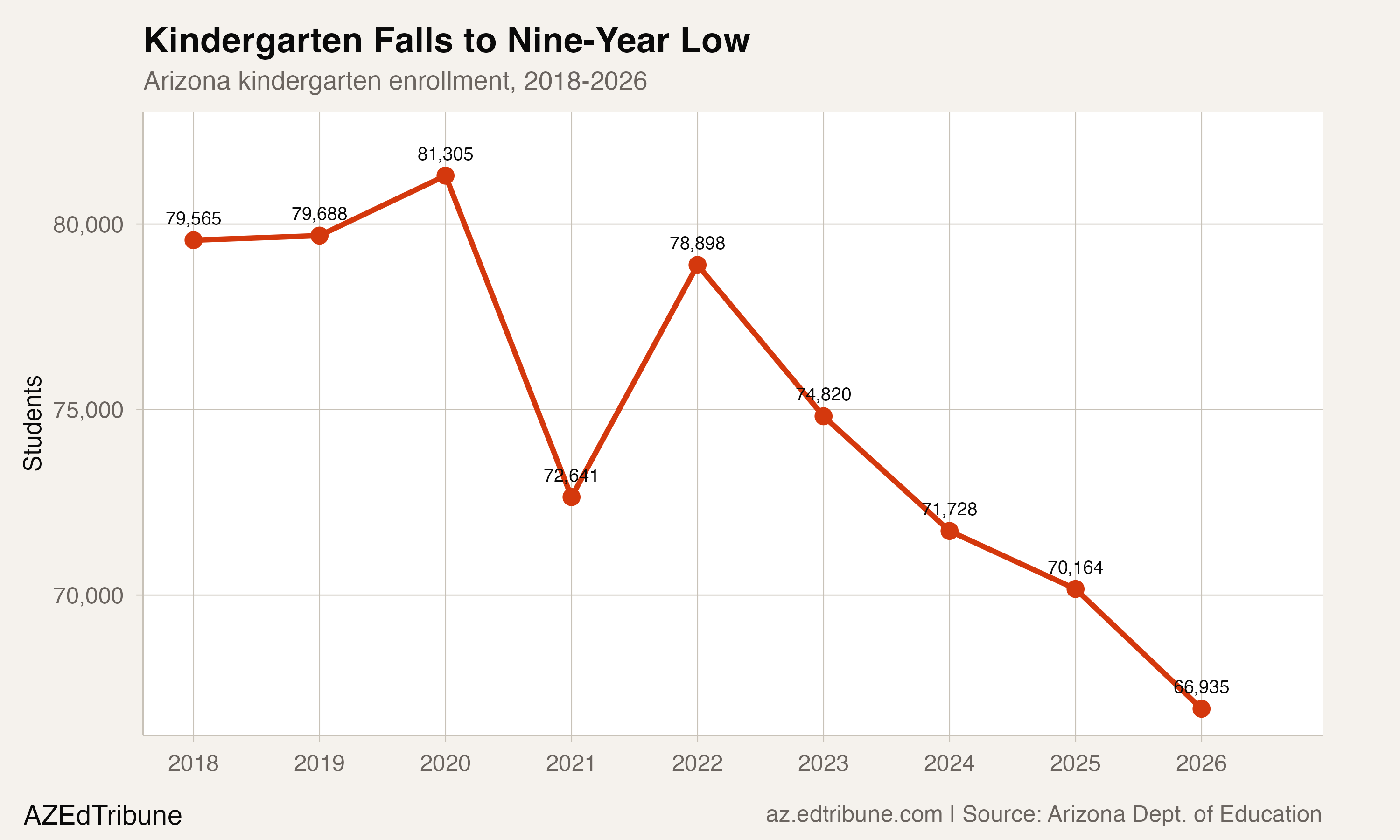
Kindergarten's four consecutive years of decline, from 78,898 in 2022 to 66,935 in 2026, represents the sustained arrival of post-2014 birth cohorts. The 2026 kindergarten class is 15.2% smaller than the 2022 class, and there is no demographic reason to expect a rebound.
The high school cliff arrives
For six years, high school enrollment provided a counterweight. Large pre-2014 birth cohorts, combined with the 12th grade retention surplus, pushed high school enrollment to a peak of 366,922 in 2024. That peak has now passed.
High school enrollment fell by 5,150 in 2025 and another 6,975 in 2026. Grade 9, the leading indicator, peaked at 94,323 in 2022 and has since fallen 10.2% to 84,699. The smaller cohorts that hollowed out elementary schools five years ago are now entering high school, and the 12th grade retention surplus, while large, is no longer large enough to offset the shrinking pipeline below it.
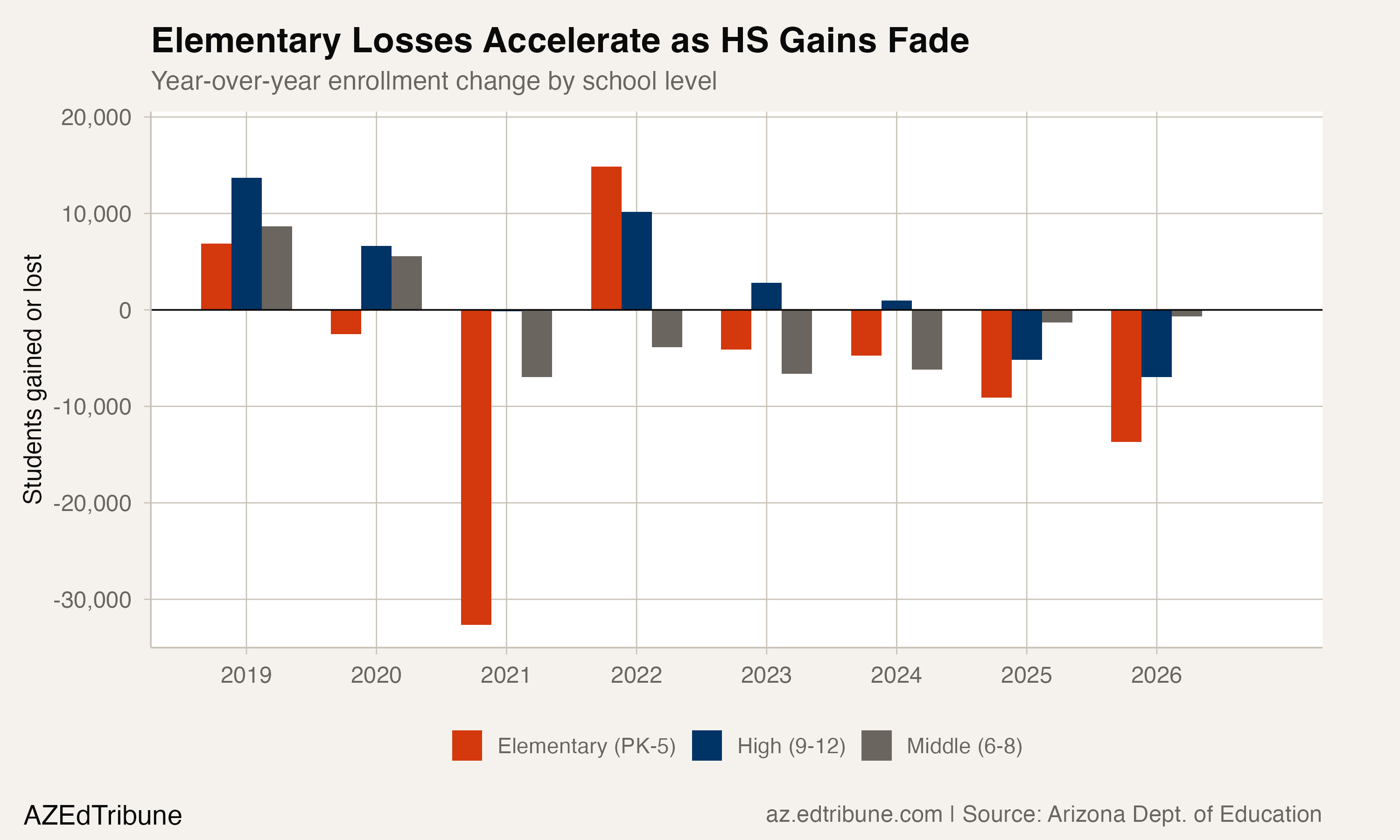
In 2026, all three school levels lost enrollment simultaneously for the first time in the dataset. Elementary lost 13,680, middle lost 666, and high school lost 6,975. The convergence marks the end of the period when high school growth could offset losses elsewhere.
Fiscal and operational pressure
The Arizona Auditor General's January 2026 analysis found that 69 of the state's 207 school districts now face increased financial risk, driven primarily by enrollment decline. Arizona's per-pupil funding follows students: when a kindergartner leaves for an ESA or never enrolls at all, the district loses the associated revenue while fixed costs for buildings and staff remain.
The school closure wave is already underway. Roosevelt School District shut five schools after the 2024-25 school year, citing a $5 million deficit and falling enrollment. Isaac School District closed three. Cave Creek Unified, Phoenix Elementary, and Paradise Valley Unified each closed two or three schools in 2024-25. Kyrene School District is considering closing up to eight more.
Ratlief characterized the mismatch bluntly: Arizona's public schools maintain "$12 billion worth of real estate" costing "$1 billion a year to maintain," yet have "50% more seats available in district schools" than students to fill them. Declining districts increased capital spending by 99% since 2019, nearly double the 58% increase at growing districts.
What comes next
The 2026-27 kindergarten class will be drawn from children born in 2020 and 2021, years when Arizona's birth rate continued its long decline and the pandemic further suppressed births nationally. There is no demographic cohort in the pipeline large enough to reverse the elementary contraction.
The 12th grade, meanwhile, edged down for the first time in 2026, from 98,216 to 98,012, a decline of just 204 students. Whether this is a one-year fluctuation or the beginning of the end of the senior surplus depends on whether the credit recovery and fifth-year pathways that inflated 12th grade enrollment continue to grow, or whether they too begin to shrink as the smaller cohorts age through the system.
For six years, high school growth masked the damage. That buffer is gone. Arizona's school system is contracting from both ends simultaneously, and neither end shows any sign of stabilizing.
Detailed code that reproduces the analysis and figures in this article is available exclusively to EdTribune subscribers.
Discussion
Sign in to join the discussion.
Loading comments...