Part of the Arizona Enrollment SeriesET. Updated weekly.
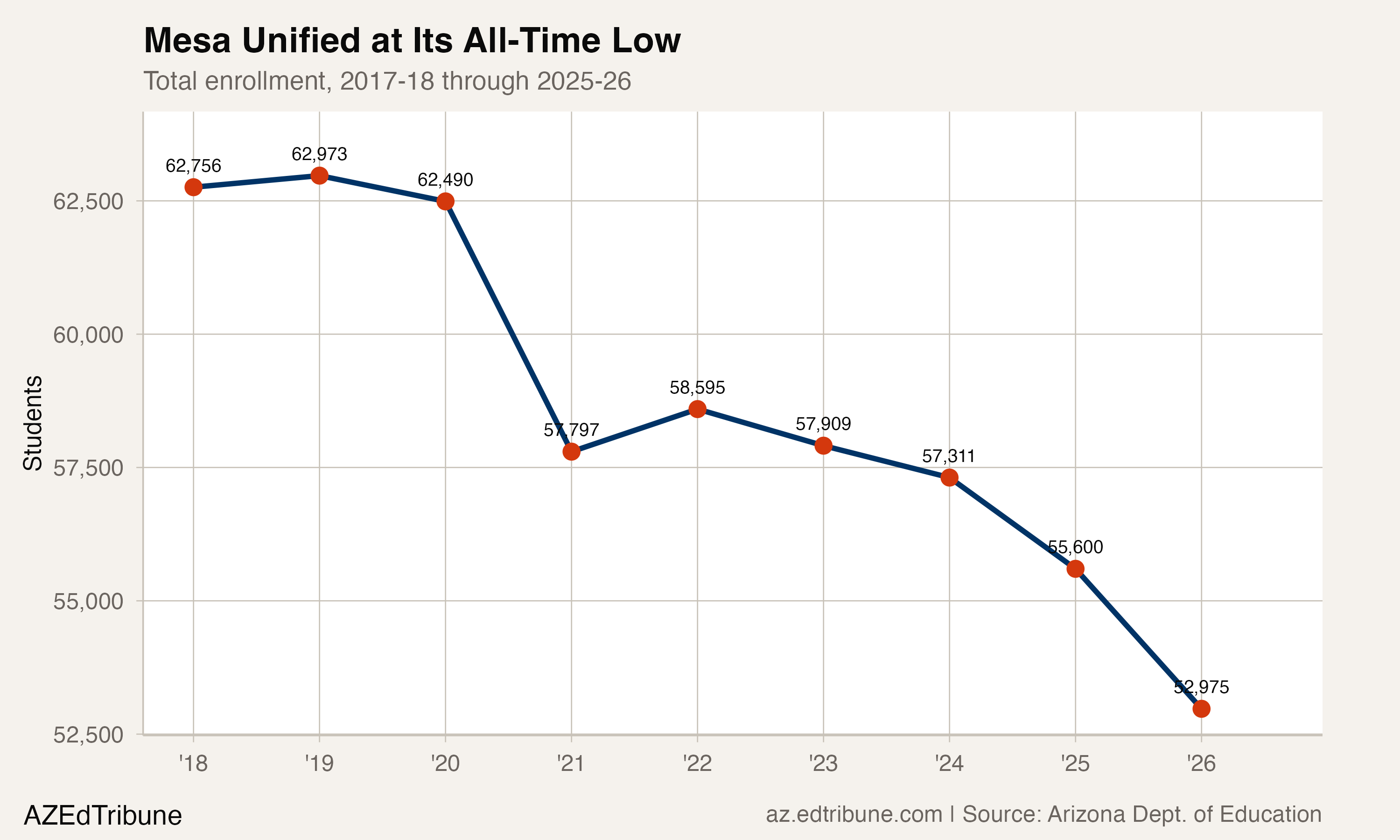
Mesa Unified District↗ET enrolled 52,975 students in 2025-26, the lowest figure in the nine years of state data available, and a loss of 9,998 students since the district's 2019 peak of 62,973. Arizona's largest district is shrinking at 4.4 times the statewide rate, and the bleeding is getting worse: the 2,625 students Mesa lost in 2025-26 is nearly double the prior year's loss and more than four times the loss two years earlier.
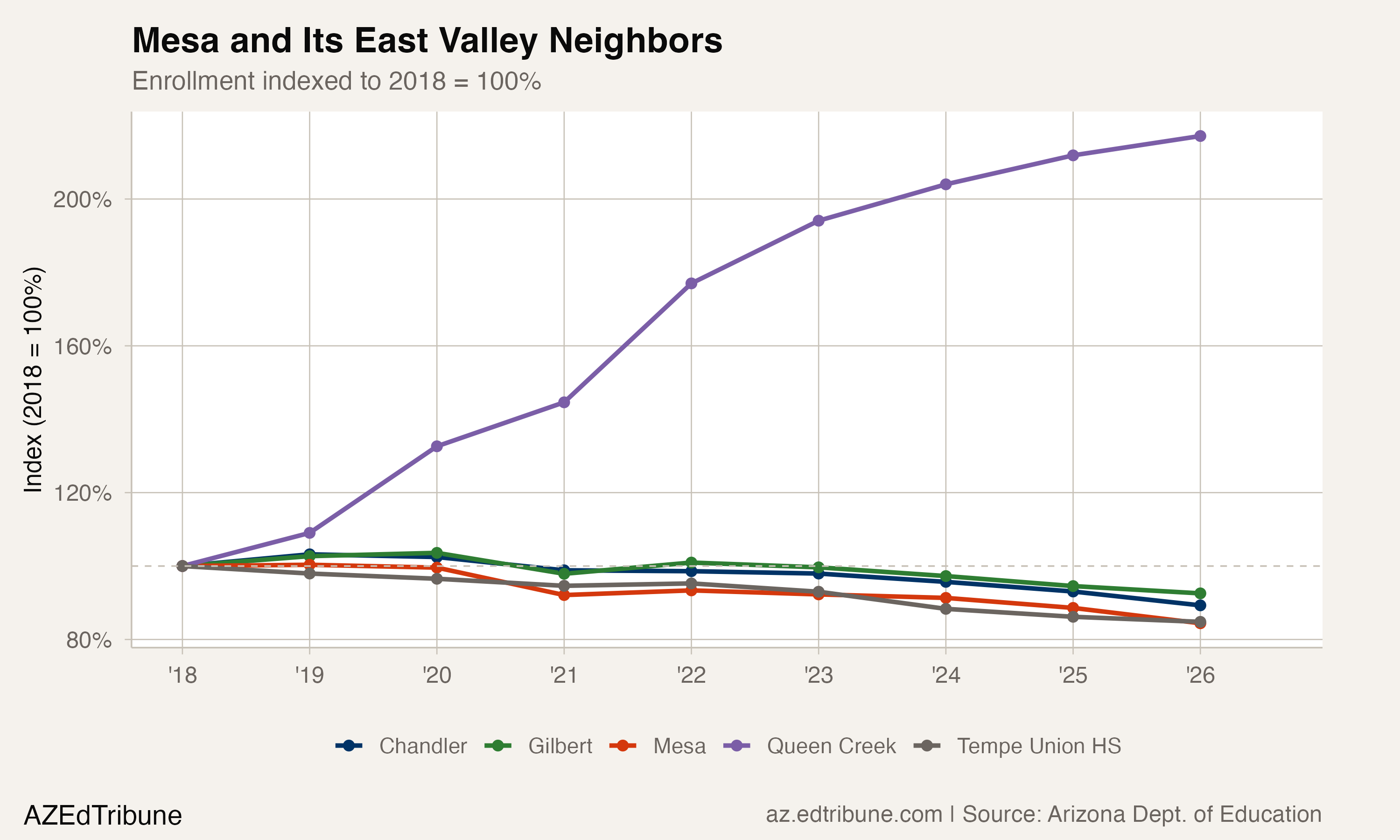
The district has shed 15.6% of its enrollment since 2018. For context, Arizona as a whole lost 3.5% over the same period. Every one of Mesa's East Valley neighbors except Queen Creek is also declining, but none at Mesa's pace.
Three years of acceleration
The most striking feature of Mesa's decline is not its size but its trajectory. After the COVID-era collapse of 4,693 students in 2020-21, the district clawed back 798 the following year. That partial recovery was the last positive number. Since then, the year-over-year losses have followed an unmistakable pattern:
- 2022-23: -686
- 2023-24: -598
- 2024-25: -1,711
- 2025-26: -2,625
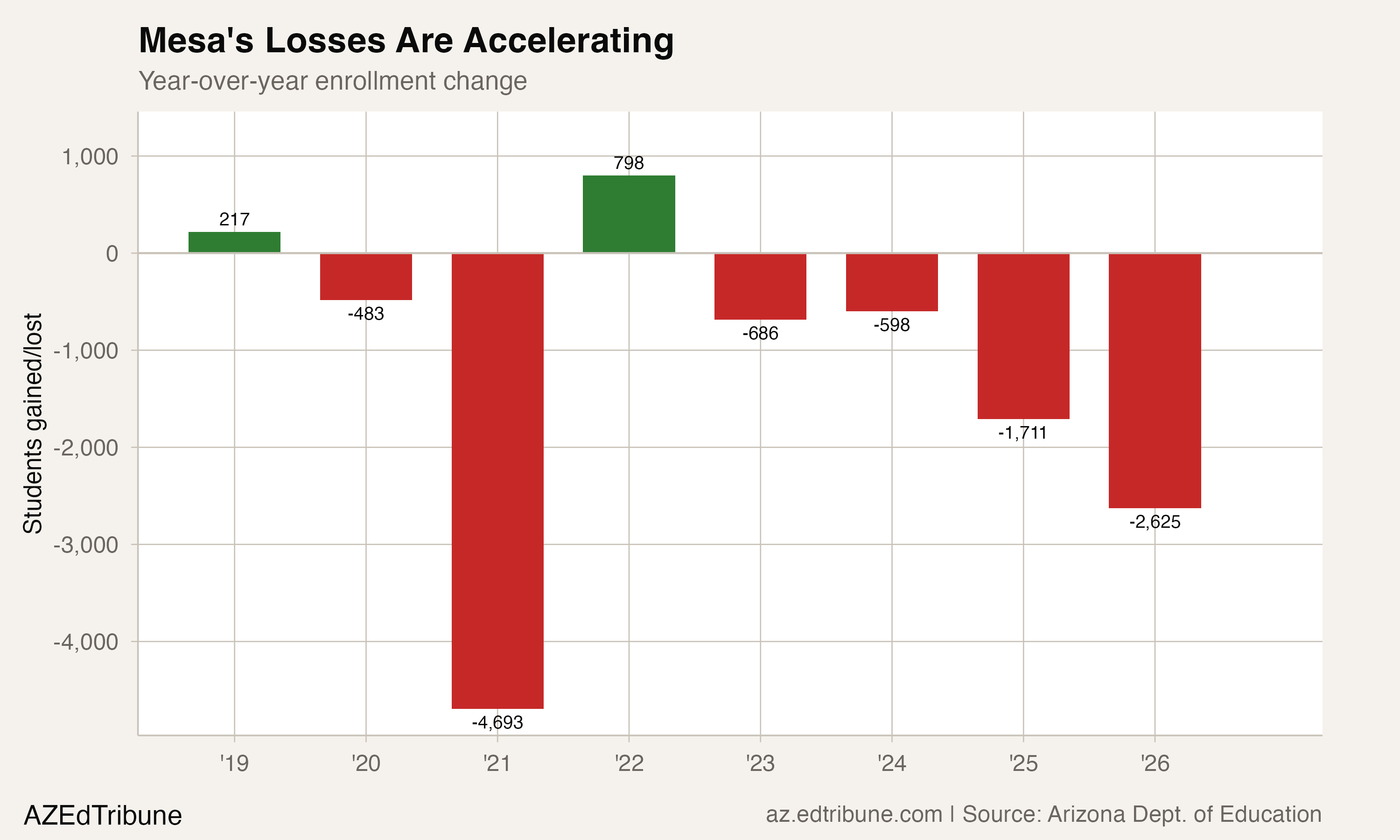
The last two years wiped out the post-COVID bounce entirely and then some. Mesa now sits 9,515 students below its pre-pandemic 2020 level of 62,490. Of the 4,693 students lost during COVID, only 798 ever came back, a recovery rate of 17.0%.
The kindergarten signal
Where a district's kindergarten enrollment goes, total enrollment eventually follows. In Mesa, the signal is blunt: kindergarten has dropped from 4,487 in 2018 to 3,023 in 2026, a 32.6% decline. The district now enrolls 1,400 more seniors (4,423) than kindergartners.
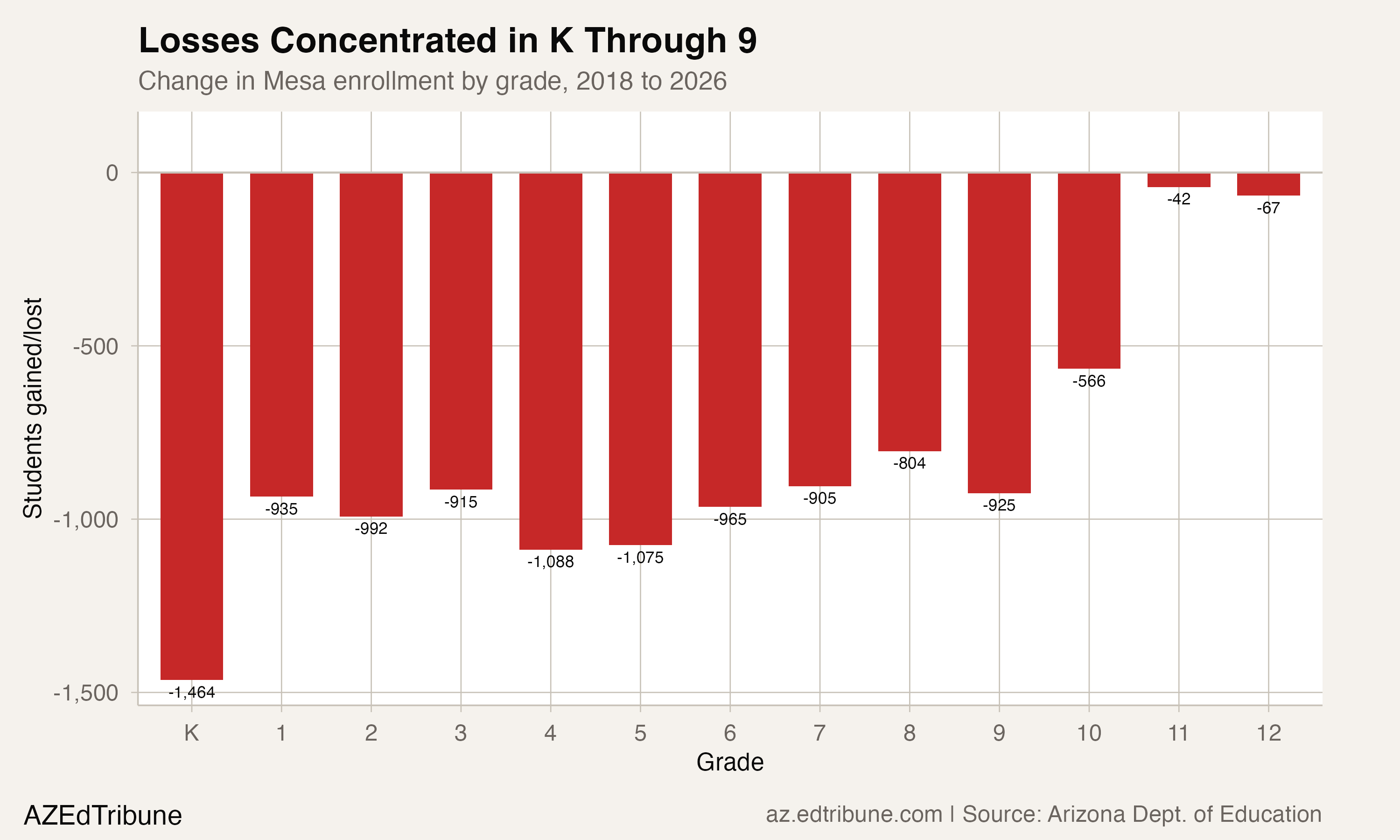
Losses are steepest in kindergarten through fifth grade, where every grade is down between 915 and 1,464 students. Grades 11 and 12, by contrast, have barely moved, losing just 42 and 67 students respectively. This inverted pipeline means the current decline will compound as the 2025-26 smaller cohorts age through the system.
Birth rates explain part of the gap. Mesa's birth rate has fallen 28% over the past decade, nearly double the 18% statewide decline. Fewer children born in the city means fewer kindergartners walking into Mesa campuses five years later.
Landlocked and losing ground
Mesa is a mature, built-out city. Unlike the Far East Valley communities that still have open desert to develop, Mesa cannot annex new subdivisions or absorb the housing tracts that drive enrollment growth. Retiring Superintendent Andi Fourlis put it plainly:
"These landlocked school districts throughout the county are seeing declining enrollment just be based on an aging population and less and less families having large numbers of children." — ABC15, Feb. 2025
The contrast with Queen Creek, 20 miles to the southeast, is stark. Queen Creek Unified has more than doubled since 2018, growing from 7,095 to 15,408 students (+117.2%). Chandler and Gilbert, Mesa's more established neighbors, are also declining but at slower rates: -10.7% and -7.4% respectively.
Mesa's geographic constraint is compounded by competition. Arizona's universal Empowerment Scholarship Account program, expanded in 2022, reached more than 61,000 participants by 2022-23 and has continued growing since. While the ESA program does not break down participation by sending district, the Learning Policy Institute found that 71% of participants had no prior public school enrollment, suggesting most ESA users are not direct transfers from districts like Mesa. Charter schools add another layer of competition in the East Valley, though the state data does not include a charter flag that would allow precise measurement.
The kindergarten data points toward demographics as the primary driver: fewer children born in Mesa means fewer kindergartners five years later. School choice likely accounts for some portion of the losses in upper elementary and middle school, where families have more alternatives and children are already enrolled somewhere. But a 32.6% kindergarten decline is not a school choice story. It is a birth rate story.
A shifting student body
While Mesa's total enrollment has fallen 15.6%, not every group has shrunk equally. White enrollment has dropped by 7,880 students since 2018, accounting for 80.6% of the district's total loss. Hispanic enrollment has declined by a smaller 1,816, and every other racial group has also lost students in absolute terms.
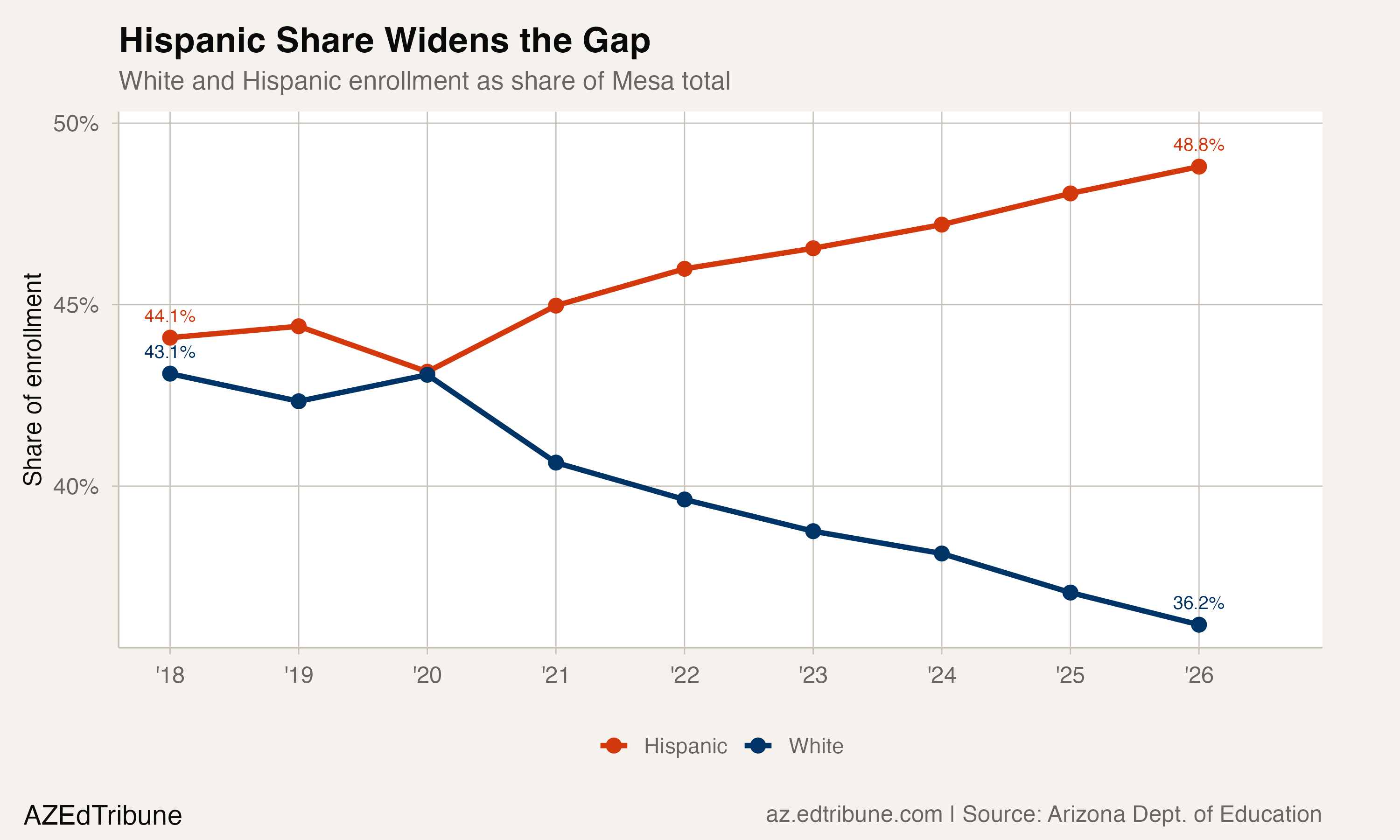
The result is a widening composition gap. In 2018, Hispanic students held a one-percentage-point edge over white students, 44.1% to 43.1%. By 2026, that gap has grown to 12.6 percentage points: Hispanic students now make up 48.8% of Mesa's enrollment versus 36.2% for white students. The multiracial category, meanwhile, has grown from 2.3% to 4.4%, the only subgroup to increase its share and its absolute count (+868).
Budget consequences
Every student who leaves takes per-pupil funding with them. Mesa's new superintendent, Matt Strom, told KJZZ that the district has lost nearly 3,400 students over the past three years and projects a further decline of approximately 4,900 over the next three. The projected budget shortfall stands between $9 million and $18 million for the coming year, with the 1,800-student loss alone accounting for roughly $12.5 million in lost revenue.
The district has responded with layoffs rather than school closures. In February 2025, Mesa eliminated 147 district-level positions including 42 certified staff members. By August, a second round under Strom cut another 43 positions. In total, the district has shed approximately 385 full-time positions over the past two budget cycles, including 194 teaching positions.
Strom has publicly committed to keeping schools open as long as possible, telling the Mesa Tribune: "The business team and the finance team are going to try to explore every option to keep as many schools opened as long as we possibly can." But neighboring districts facing similar pressure have not been able to avoid closures. Kyrene Elementary District is closing six schools, and Scottsdale Unified is considering repurposing up to eight. Scottsdale's superintendent estimated savings of roughly $1 million per building.
Mesa still operates 78 campuses. The district has not closed schools despite losing nearly 10,000 students, which means those campuses are operating with significantly lower utilization than they were designed for. How long that arrangement is fiscally sustainable is the central question facing the incoming administration.
What to watch
Mesa's own projections suggest 4,000 to 5,000 more students will leave over the next three years. If the 2026 loss rate of 2,625 holds steady, that estimate may prove conservative. The kindergarten class of 3,023 is the smallest on record, and the cohorts behind it in pre-K (2,057 students, up 87.9% from 2018 due to program expansion) will not fully offset the gap because pre-K programs do not guarantee continued enrollment in the district.
The expiration of Arizona's Proposition 123 in July 2025, which provided roughly $300 million annually to K-12 schools statewide, adds another layer of fiscal uncertainty. For a district already projecting an $18 million shortfall, even a partial reduction in state funding would accelerate the timeline for difficult decisions about school consolidation.
Mesa Unified remains Arizona's largest district, a title earned when the city's population was younger and its schools were full. The system was built for 63,000 students. It now serves 53,000, and the kindergarten class says the number is still falling.
Detailed code that reproduces the analysis and figures in this article is available exclusively to EdTribune subscribers.
Discussion
Sign in to join the discussion.
Loading comments...