Three years ago, more than half the students at Tuba City↗ET Unified School District did not show up to school often enough to learn. Located on the Navajo Nation in northern Arizona, the district posted a 57.2% chronic absenteeism rate in 2021-22. By 2024-25, that rate had fallen to 27.9%.
Arizona defines chronic absence as missing at least 18 days in a typical 180-day school year.
A 29.3 percentage point drop. Every single year, down. And in the most recent year, the steepest decline of the three: 13.1 points in one shot, as if something clicked.
Where the Lines Crossed
Arizona's statewide chronic absenteeism rate fell from 32.0% in 2021-22 to 23.8% in 2024-25, an 8.3 point improvement. The state's recovery, though, has stalled. The 2024-25 drop was just 0.6 points, barely a rounding error after two years of progress averaging nearly four points each.
Tuba City moved in the opposite direction. Its year-over-year improvements accelerated: 9.7 points, then 6.6, then 13.1. The district outpaced the state by 21 points over the full period.
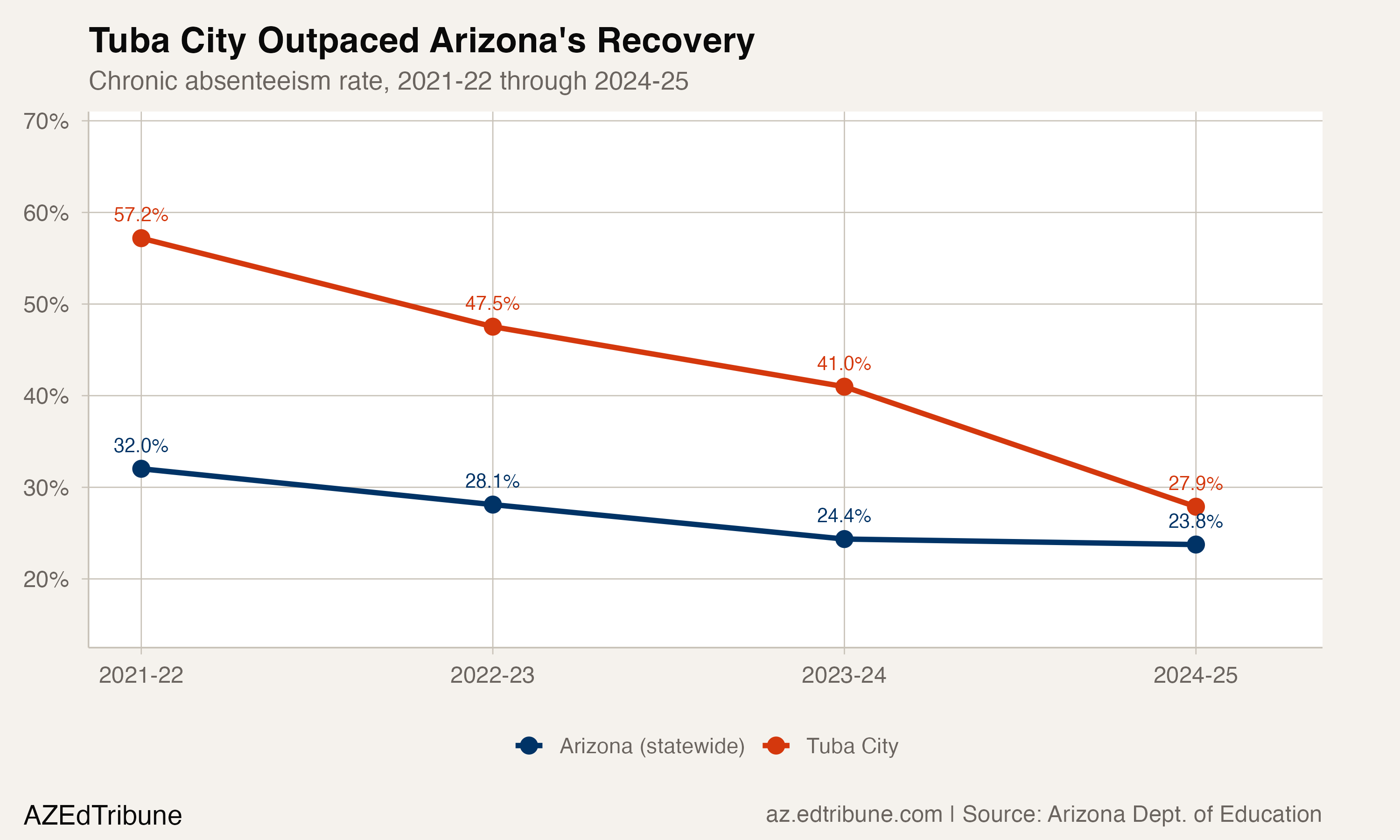
What makes the 2024-25 acceleration striking is that it came while the state flatlined. Most districts that improved rapidly in the first two post-pandemic years saw their gains decelerate. Tuba City's biggest improvement arrived last.
At 27.9%, the district is now 4.1 points above the statewide average. Three years ago, it was 25.2 points above it.
The Subgroups Tell the Same Story
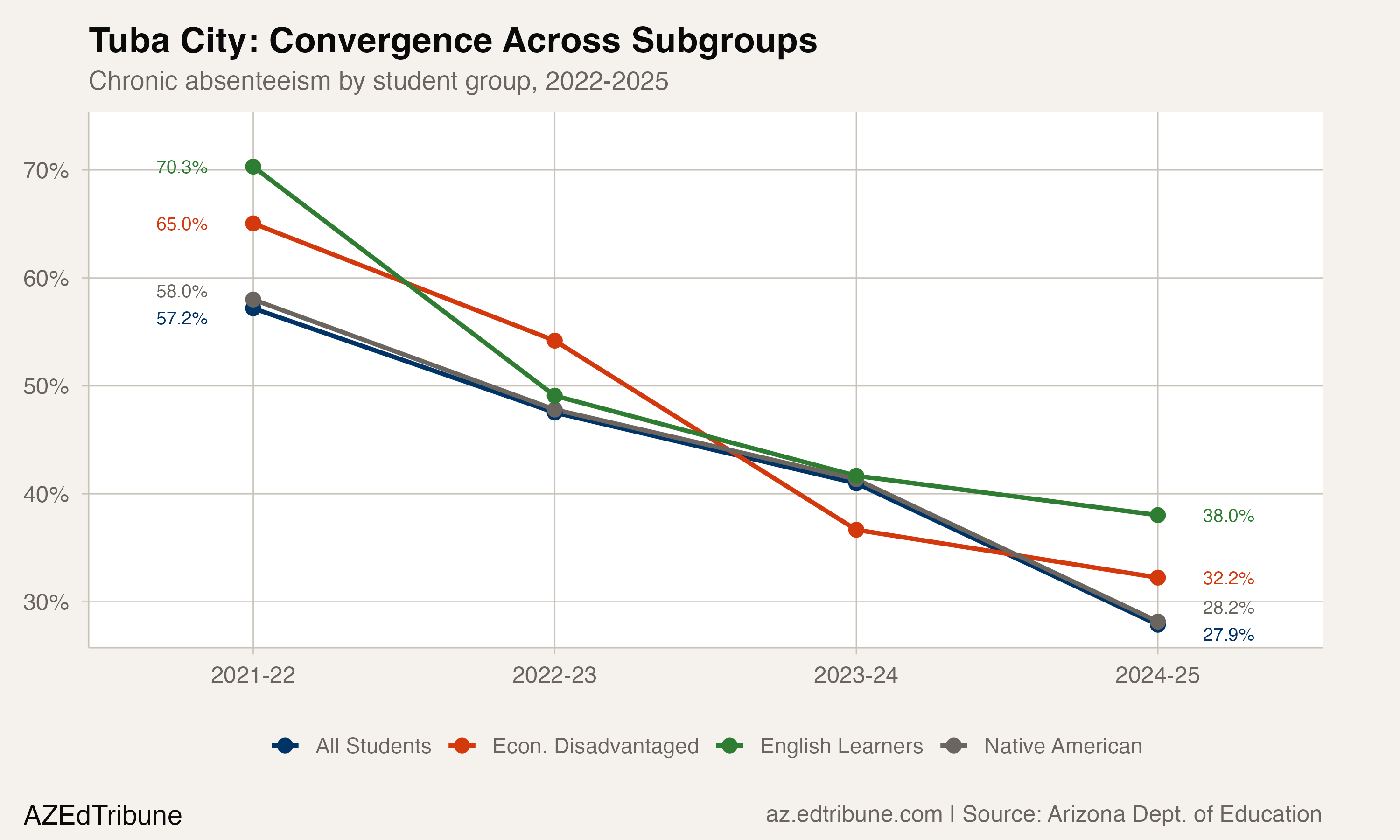
The recovery was not carried by one demographic. Native American students, who make up the vast majority of Tuba City's enrollment, dropped from 58.0% to 28.2% chronically absent, a 29.8 point improvement. Economically disadvantaged students improved even more: 65.0% to 32.2%, a 32.8 point swing. English learners, who started at the highest baseline of any subgroup at 70.3%, fell to 38.0%, a 32.3 point drop.
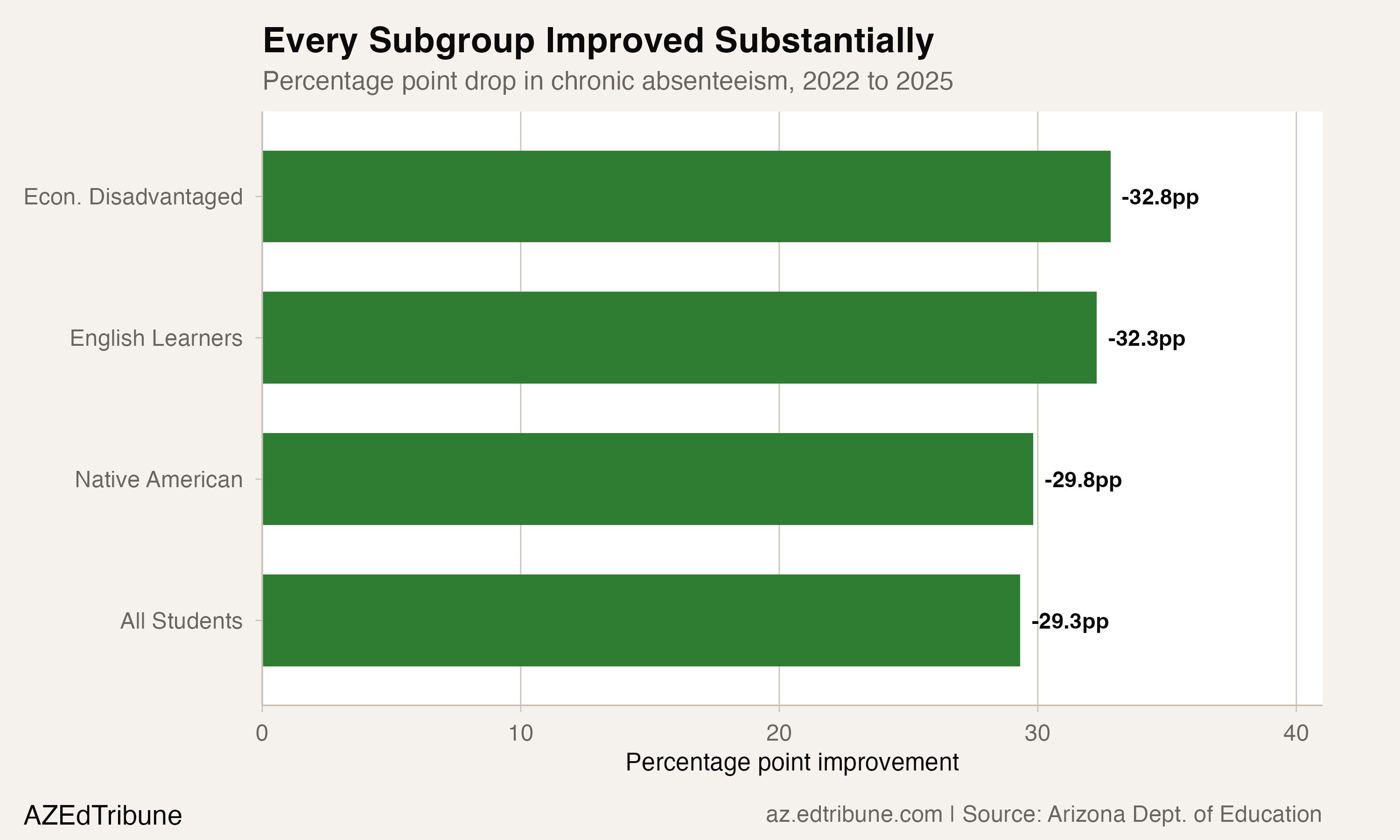
The convergence matters. In 2021-22, Tuba City's English learners were 13 points worse than the overall student body; by 2024-25, the gap had narrowed to 10. Economically disadvantaged students closed a similar spread. When every line drops together rather than one group pulling the average, it suggests a systemic intervention rather than a targeted program aimed at one population.
Tuba City's Native American students now post a chronic absenteeism rate of 28.2%, compared to 37.3% for Native American students statewide. The district's Native American students are 9.1 points better than their peers across Arizona, a reversal of the pattern three years ago when they were 14 points worse.
A Boarding School Town That Rewrote the Attendance Playbook
Tuba City's relationship with formal schooling carries a particular weight. The town is home to Tuba City Boarding School, established in 1898 by the Bureau of Indian Affairs and one of the most elaborate boarding school campuses on the Navajo Reservation. For generations, the building represented an education system imposed on Navajo families rather than built with them.
The district's current approach inverts that history. Tuba City USD operates a Native Language and Culture Program that integrates Navajo language instruction, cultural activities, and college and career development through community partnership. Parents, elders, and local leaders participate in school decisions.
The broader pattern across tribal districts suggests this community-centered model is not unique to Tuba City but may be the defining feature of reservation schools that are recovering fastest. At San Carlos↗ET Unified, Superintendent Deborah Dennison, a Navajo Nation member, has attributed the district's own attendance improvement to "all these connections with the community and the tribe."
"All these connections with the community and the tribe are what's making a difference for us. ... Making the school a system that fits them rather than something that has been forced upon them, like it has been for over a century of education in Indian Country." — Christian Science Monitor, Dec. 2024
San Carlos established care centers partnering with hospitals, dentists, and food banks, and hired cultural success coaches to help families address attendance barriers.
From 2022 to 2025, the district's chronic absenteeism rate fell from 75.7% to 61.7%, a 14-point improvement.
Eleven of Thirteen Tribal Districts Improved
Tuba City ranks third among Arizona's tribal and reservation-adjacent districts in total improvement. Fort Thomas↗ET leads at 45.1 points (80.6% to 35.6%), followed by Cedar at 31.8 points (65.1% to 33.3%). Whiteriver↗ET dropped 23.9 points. Sacaton improved 20.2 points. Even Peach Springs↗ET, still at 64.9%, improved by 10.5 points.
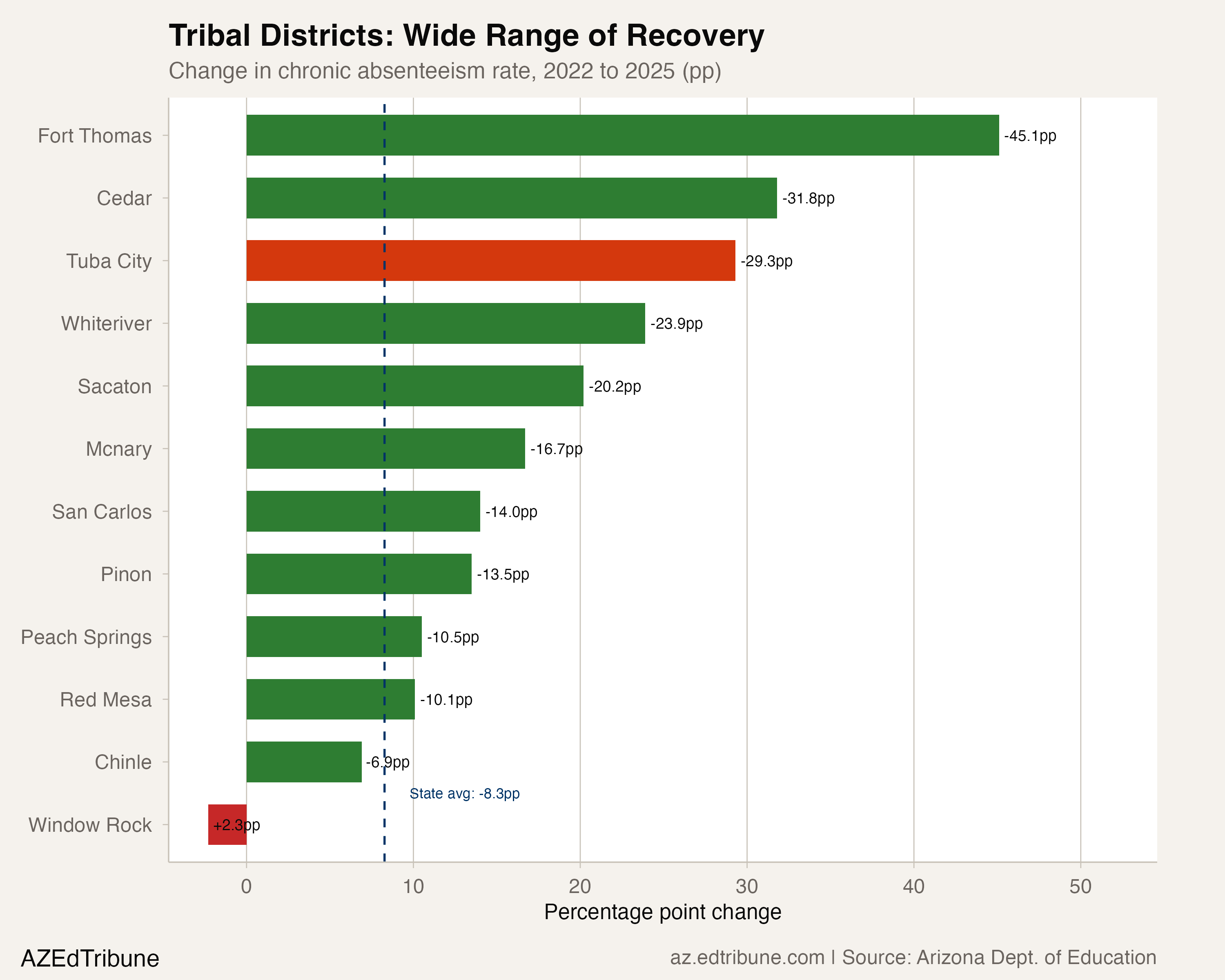
Eleven of 13 tribal districts improved over the three-year period. The exceptions: Window Rock↗ET worsened by 2.3 points (44.9% to 47.2%), and Kayenta's data shows an anomaly (4.2% in 2021-22 to 39.0% in 2024-25) that likely reflects a reporting change rather than a real deterioration.
The range across these districts is vast. Fort Thomas and Tuba City now sit at 35.6% and 27.9%, respectively, while San Carlos (61.7%) and Peach Springs (64.9%) remain at levels where the majority of students are chronically absent. Geography, poverty, and colonial history are shared across these communities. The outcomes are not.
The State's Two Approaches
Arizona's policy response to chronic absenteeism has split into two camps. State Superintendent Tom Horne has pushed punitive measures: automatic Fs for students with nine or more unexcused absences and urged city attorneys to give "a higher priority to truancy cases." Horne has described the situation as a "real catastrophe" requiring "radical efforts."
The other camp, represented by organizations like Read On Arizona and the Arizona Chronic Absence Task Force, has focused on root causes. Read On Arizona partnered with Attendance Works to train more than 350 participants from over 100 schools on evidence-based absence reduction strategies, including early-warning systems, same-day parent contact, and family engagement.
Tuba City's results do not settle the debate, but they complicate the punitive framing. The district improved faster than nearly every district in Arizona, and it did so on a reservation where the structural barriers to attendance, including transportation across vast distances, multigenerational poverty, and health care access, are among the steepest in the state. The Helios Education Foundation's follow-up report found that mobile students in Arizona had a 55% chronic absence rate in 2022-23 and that gaps between vulnerable populations and their peers have "stabilized but remain significantly higher than pre-pandemic levels."
A community-based model that makes school a place families choose to send their children may be harder to replicate than a policy mandate. It is also, based on what the data shows in Tuba City, dramatically more effective.
What Comes Next
Tuba City's rate of 27.9% is still more than double Arizona's pre-pandemic level, and the district data only begins in 2021-22 -- there is no baseline from before COVID. Some of this "recovery" may be a return to a norm that was itself too high.
The data also provides only percentages, not student counts, so it is impossible to say how many individual children shifted from chronically absent to regularly attending versus whether the improvement reflects families leaving the district entirely.
The acceleration in 2024-25 is the most interesting signal. If next year's rate holds near 28% or drops further, Tuba City will have demonstrated that the trajectory is structural. If it bounces back, the last year was the easy part.
Detailed code that reproduces the analysis and figures in this article is available exclusively to EdTribune subscribers.
Discussion
Sign in to join the discussion.
Loading comments...