Three years ago, Murphy Elementary District↗ET was losing nearly half its students to chronic absence. In 2021-22, 49.7% of students at the two-campus district in southwest Phoenix missed 10% or more of the school year. That rate was about 18 points above the state average.
By 2024-25, the rate was 10.4%.
That 39.4 percentage point drop ranks third among all 421 Arizona districts with comparable data, and first among the 86 districts that started in the 40-55% range. Only two other districts in the state managed to go from above 40% chronic absence to below 15%. Murphy did not merely improve. It crossed below Arizona's 2018-19 statewide rate of 12.7%, a threshold 82.7% of comparable districts had not reached by 2024-25.
The trajectory at Jack L. Kuban and William R. Sullivan
Murphy Elementary District operates two schools, Jack L. Kuban Elementary and William R. Sullivan Elementary. The 2024-25 enrollment file shows 1,038 students in grades PK-8; 92.6% were Hispanic, 43.3% were English learners, and 77.1% were economically disadvantaged.
The recovery happened in three distinct phases. Between 2021-22 and 2022-23, chronic absence fell 13.5 points to 36.3%. The following year brought the steepest drop: 18.6 points, cutting the rate nearly in half to 17.7%. The final year added another 7.4 points of improvement, bringing Murphy to 10.4%.
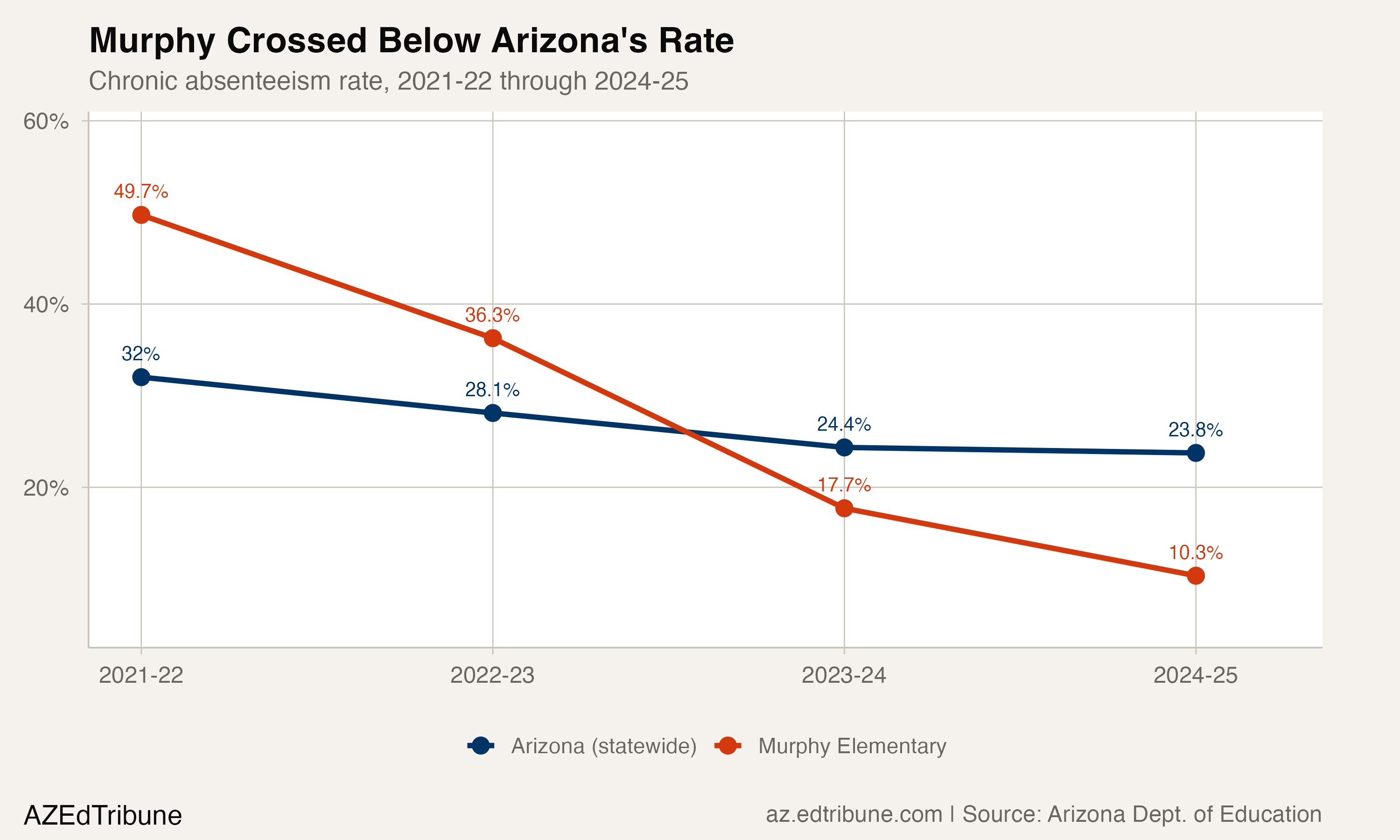
The deceleration in year three is not necessarily a warning sign. Suggestive context: Read On Arizona's chronic-absence guide notes that absences can reflect housing, transportation, illness, trauma, disengagement, or weak adult relationships at school, so the remaining cases at a 10.4% rate may be harder to move than the first wave of recovery.
The equity signal
The most striking feature of Murphy's turnaround is not the magnitude. It is the uniformity.
Hispanic students went from 51.2% chronically absent to 10.5%, a 40.6-point improvement. Economically disadvantaged students dropped from 51.9% to 9.6%, a 42.3-point reduction. English learners fell from 51.1% to 9.7%, a 41.4-point drop.
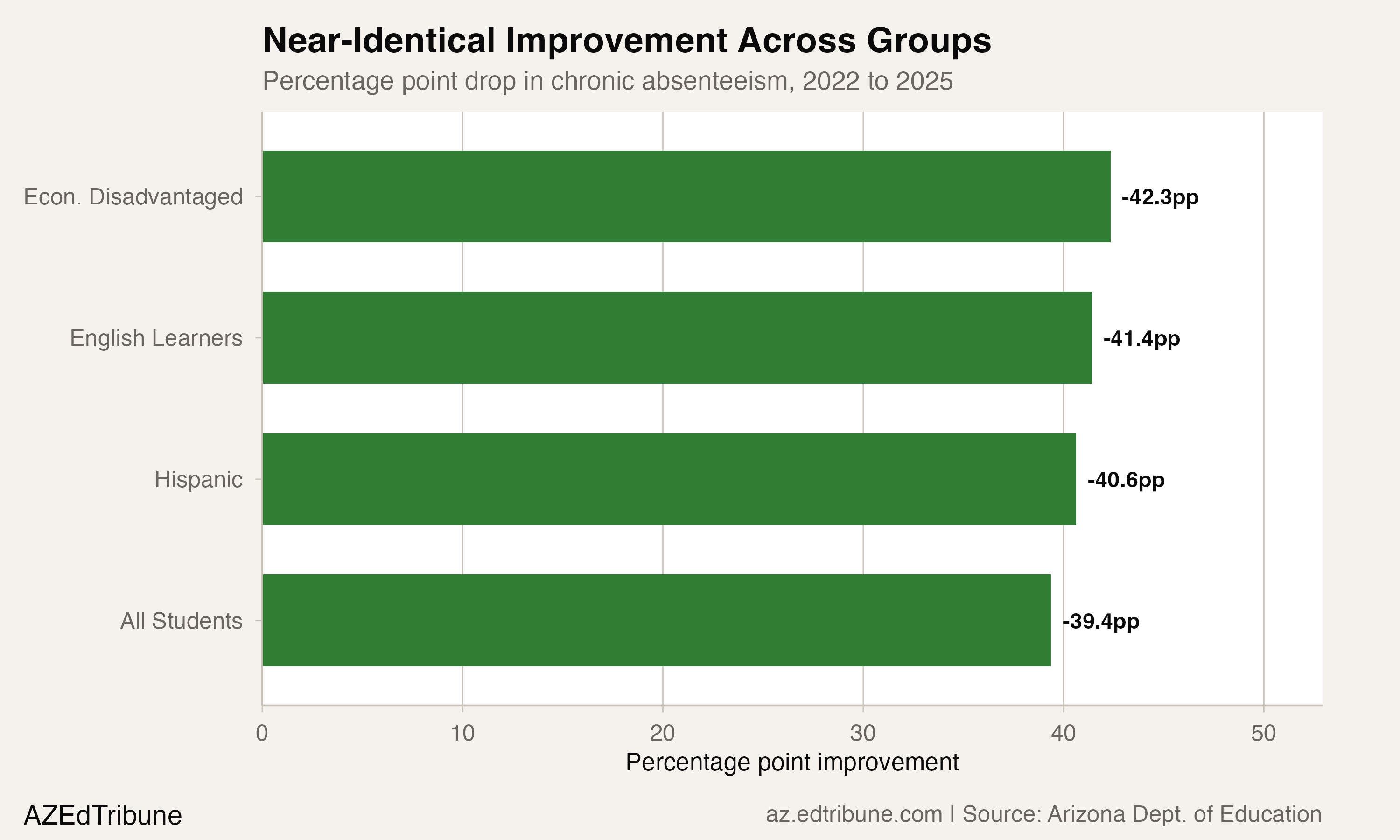
The direct evidence is the within-district pattern: Murphy's highest-need tracked groups now have the lowest chronic absence rates in the district. Economically disadvantaged students at 9.6% are below the district's overall rate, and English learners are at 9.7%.
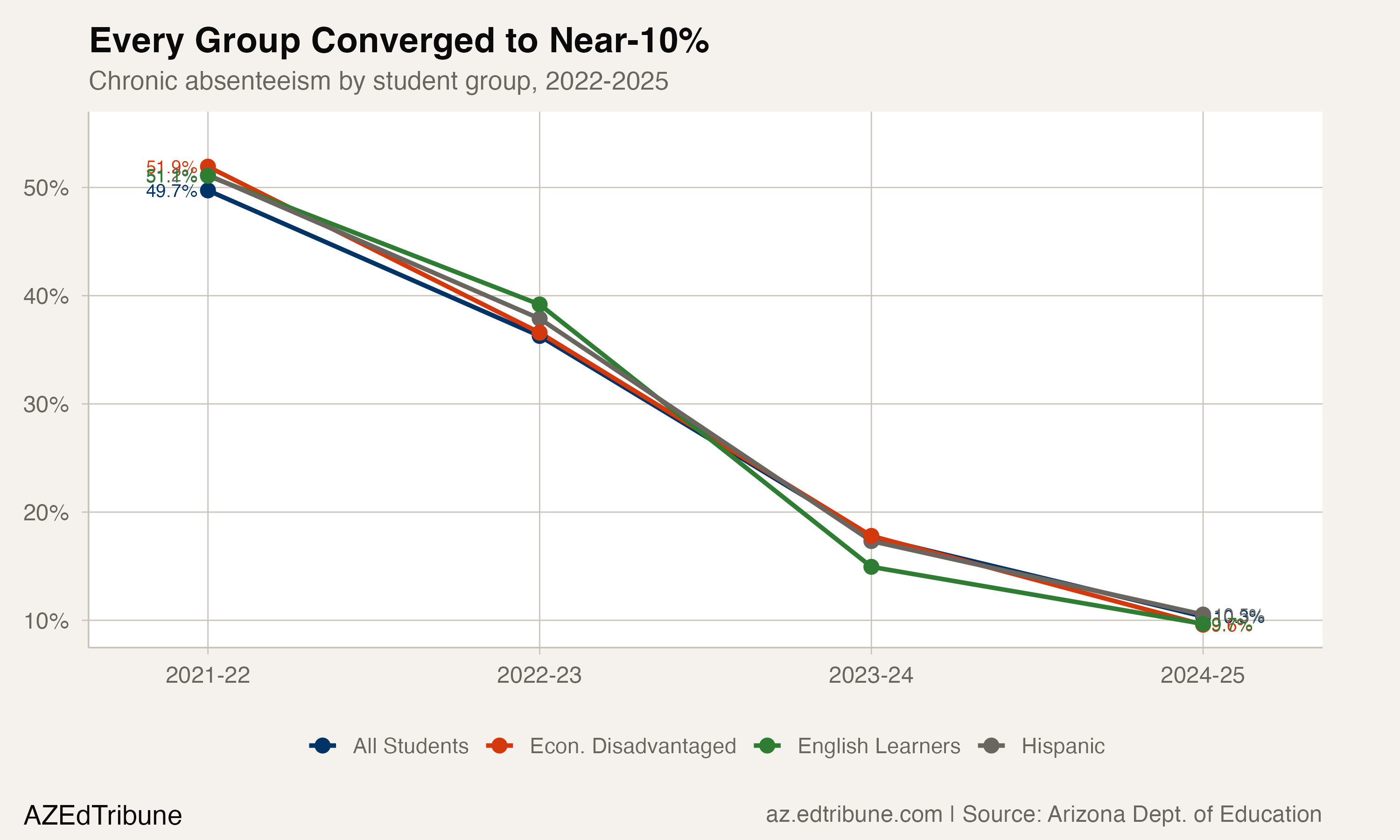
The convergence is visible year by year. In 2021-22, English learners were 1.4 points above the district average. By 2024-25, they were 0.7 points below it. The data show measured gap closure; they do not identify which intervention caused it.
What the outside evidence suggests
Suggestive context: Murphy's size may matter, but the district data do not prove causation. With 1,038 students across two campuses, the district averaged about 519 students per campus in 2024-25, small enough that attendance patterns can be monitored at a scale different from a large unified district.
Direct evidence: Helios Education Foundation and WestEd's 2025 brief, "Still Missing Too Much School," singled out Murphy as a district spotlight and described an emphasis on parent communication, technology, positive feedback, and relationship-building. The district also announced a 21st Century Community Learning Center grant application for free after-school enrichment and academic support, and its site lists after-school tutoring among academic and enrichment programs.
Direct evidence from the same Helios/WestEd report: students who change schools mid-year can have chronic absence rates above 55% in some grade levels. Suggestive context: a small, neighborhood-embedded district like Murphy may benefit when families remain connected to the same attendance system, but the public data do not test student mobility as the mechanism behind Murphy's decline.
Murphy's results also arrived during a period of statewide investment in absence reduction. Read On Arizona convened a Chronic Absence Task Force in 2023 and contracted with Attendance Works to train more than 350 participants from more than 100 schools and early-childhood programs, funded through the Arizona Department of Education's Project CALL. Unresourced: whether Murphy participated directly is not confirmed by public reporting.
Among peers, no one else came close
Among the 86 Arizona districts that started 2021-22 with chronic absence rates between 40% and 55%, Murphy's 39.4-point improvement is 2.9 points ahead of the next-closest district and 25.8 points ahead of the median.
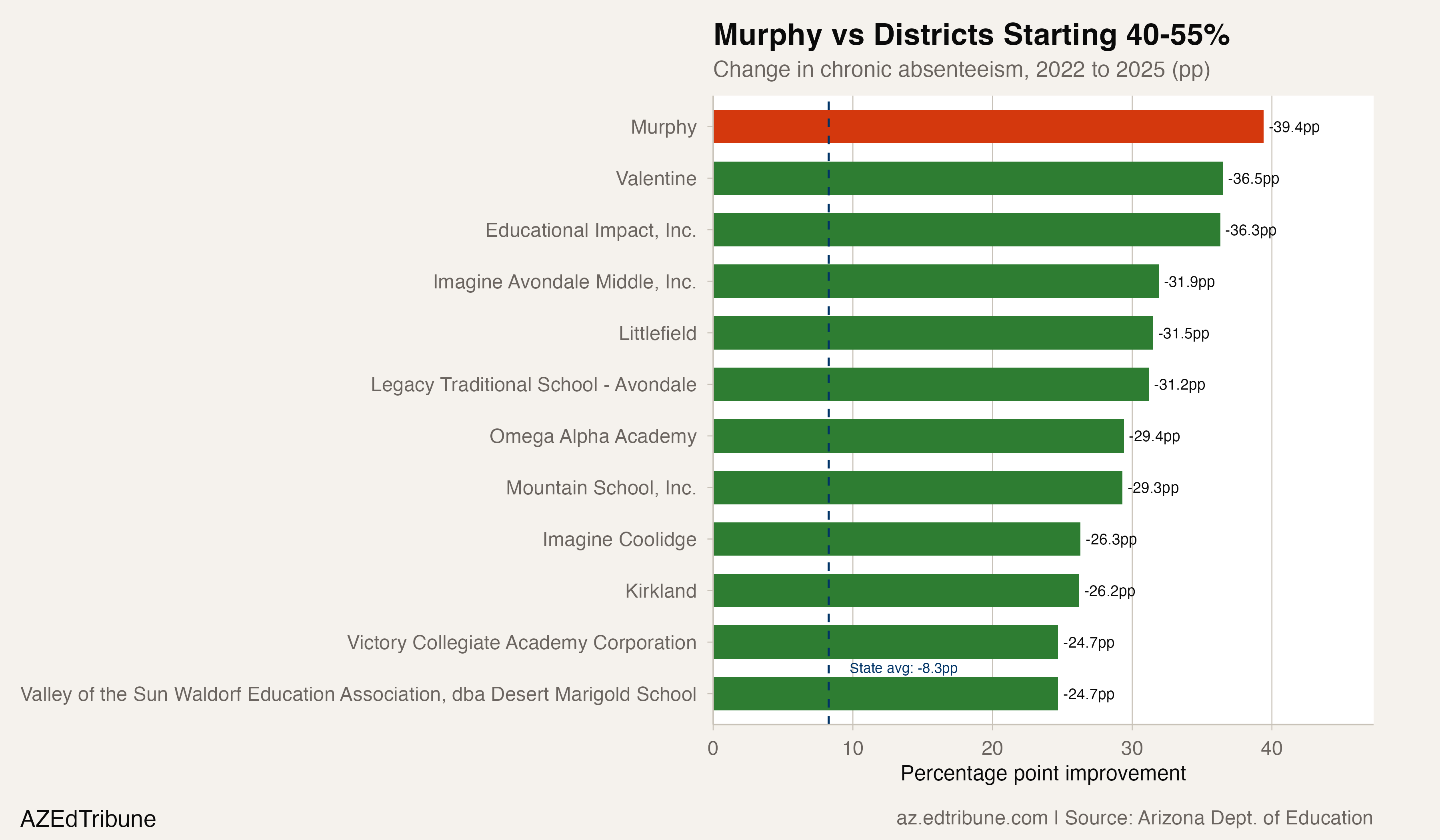
The comparison is relevant because starting point matters. It is easier to cut chronic absence from 50% to 40% than from 20% to 10%. Suggestive context: students still missing school at lower districtwide rates may be facing the kinds of barriers Read On Arizona identifies, including housing, transportation, illness, trauma, disengagement, or weak school relationships. That Murphy pushed past 20%, past 15%, and landed at 10.4% suggests the improvement extended beyond a one-year rebound.
Statewide, only 73 of 421 districts are below Arizona's pre-COVID chronic absence rate of 12.7%. Murphy is among them.
What the data does not explain
The data confirm that Murphy improved dramatically, consistently, and equitably. They do not explain the mechanism with certainty. The district's public pages describe academic support, after-school enrichment, student support services, and grant administration, but they do not break out attendance-specific expenditures. The Arizona Department of Education says ESSER funds had been fully expended as of June 30, 2025. Whether Murphy's gains survive in the first post-ESSER years is an open question.
Competing explanation: Arizona Superintendent of Public Instruction Tom Horne has urged districts to adopt tougher attendance policies, including no course credit after nine unexcused absences; in that same interview, he pointed to Dysart Unified as a district using that approach. Murphy's data do not prove that relationship-based work caused the decline, but they do show that a small elementary district reached a 10.4% rate without public evidence that the nine-absence policy was the driver.
The sustainability question
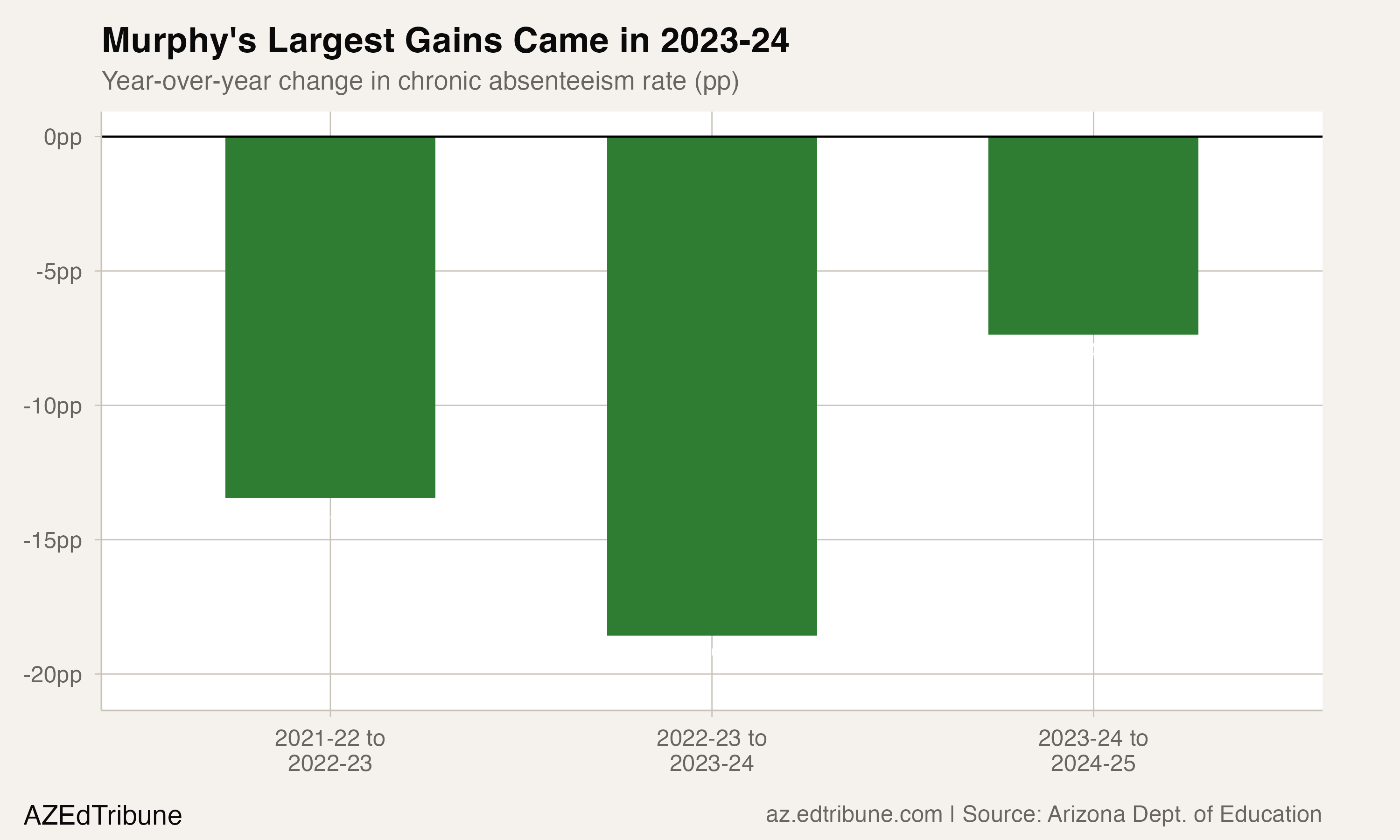
Murphy's 2024-25 improvement of 7.4 points was smaller than the prior year's 18.6. The relevant benchmark going forward is not whether Murphy continues to improve at the same pace but whether it holds below 15% in the first post-ESSER data releases. If the next published rate stays near 10%, the story shifts from turnaround to sustainability. If it rises, the 2024-25 result may look more like a high-water mark than a new normal.
EdTribune contacted Murphy Elementary District for comment in June 2026 and had not received a response by July 5, 2026.
Detailed code that reproduces the analysis and figures in this article is available exclusively to EdTribune subscribers.
Discussion
Sign in to join the discussion.
Loading comments...