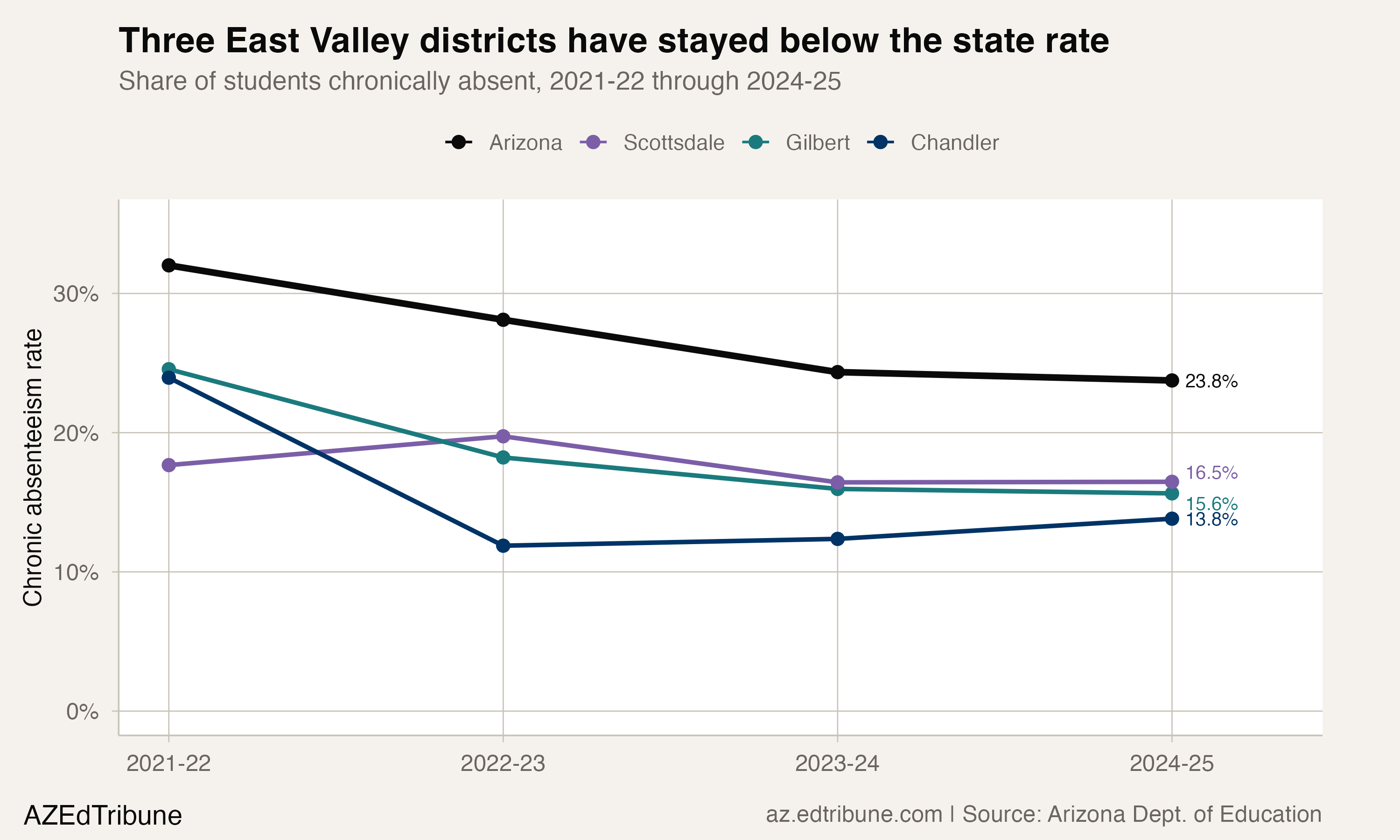
Chandler Unified↗ET, Gilbert Unified↗ET and Scottsdale Unified↗ET each had a lower chronic absenteeism rate than Arizona as a whole in every school year from 2021-22 through 2024-25. In 2024-25, the most recent school year in the state's published data, the three districts were 7.3 to 9.9 points below the statewide rate of 23.8%.
Chandler reported 13.8% in 2024-25, Gilbert 15.6% and Scottsdale 16.5%. None of the three was above 16.5% in either 2023-24 or 2024-25.
Three different paths
The districts reached similar rates in different ways.
Chandler had the largest single-year change. Its rate fell from 24.0% in 2021-22 to 11.9% in 2022-23, a drop of 12.1 points. It was 12.4% in 2023-24 and 13.8% in 2024-25, still 10.1 points below where it started.
Gilbert's rate went down in each of the three years: 24.6% in 2021-22, 18.2% in 2022-23, 16.0% in 2023-24 and 15.6% in 2024-25, a total decline of 8.9 points.
Scottsdale started lowest of the three, at 17.7% in 2021-22. Its rate rose to 19.7% in 2022-23, then came down to 16.4% in 2023-24 and 16.5% in 2024-25. Over the four years it stayed between 16.4% and 19.7%.
The statewide picture
Arizona's chronic absenteeism rate fell from 32.0% in 2021-22 to 28.1% in 2022-23 and 24.4% in 2023-24. The improvement slowed in 2024-25, when the rate fell 0.6 points to 23.8%, for a total decline of 8.3 points over the four years.
The state data shows the rates. It does not show which practices or conditions in these districts account for them. The data used here ends with 2024-25, so it does not show whether the pattern held in 2025-26.
Chronic absenteeism rates come from the Arizona Department of Education.
Detailed code that reproduces the analysis and figures in this article is available exclusively to EdTribune subscribers.
Discussion
Sign in to join the discussion.
Loading comments...